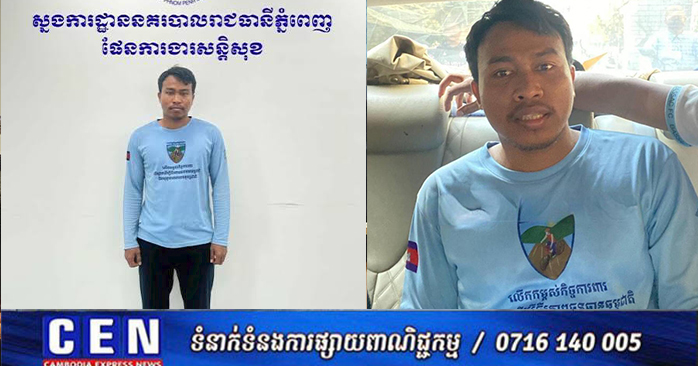
Cambodia's Supreme Court Upholds Conviction of Student & Intellectual Association President Kert Saray
Cambodia's Supreme Court has upheld the lower court's conviction of Kert Saray, president of the Khmer Students and Intellectuals Association (KSILA), who was charged with incitement and other offenses deemed to threaten social security.
The Supreme Court of Cambodia announced on the morning of July 3, 2026, that it upholds the Phnom Penh Court of Appeal's decision regarding the appeal filed by Mr. Kert Saray. This decision came after a hearing held on the morning of June 26, 2026, concerning the appeal against the Phnom Penh Court of Appeal's ruling on January 26, 2026, which in turn upheld the Phnom Penh Municipal Court's judgment of November 6, 2024. Mr. Kert Saray, president of the Khmer Students and Intellectuals Association (KSILA), was charged in criminal case number 2314 dated April 6, 2024, of the Phnom Penh Municipal Court. The trial took place on October 9, 2024, under charges of incitement to cause social unrest and other criminal offenses as stipulated in Articles 88, 494, and 495 of the Penal Code. In its verdict, the Phnom Penh Municipal Court sentenced Mr. Kert Saray to four years in prison and a fine of two million Riel. Mr. Kert Saray was arrested by police officers of Phnom Penh on April 5, 2024, at 3:45 PM while he was performing his duties at his office in Phnom Penh, and was subsequently sent to the Phnom Penh Municipal Police Commissioner's Office. The arrest followed a summons issued on April 5, 2024, by Mr. Seng Heang, Deputy Prosecutor of the Phnom Penh Municipal Court, which stated that it was related to incitement that caused severe social unrest. This arrest occurred after Mr. Kert Saray and his association's team visited Kulen district, Preah Vihear province, to meet with residents involved in land disputes. These residents had reportedly fled into the forest after being subjected to violence by provincial authorities in March 2024. Mr. Kert Saray had appealed for patience from the authorities in resolving the disputes. The NGO Adhoc provided legal counsel and monitored all proceedings in this case.
多角的分析
本件は直接的な経済活動への影響は限定的ですが、社会の安定性への懸念は、長期的に見て外国投資家がカンボジアへの投資を再評価する要因となり得ます。特に、社会運動や市民活動に対する司法の対応は、ビジネス環境の予測可能性に影響を与える可能性があります。
投資家にとって、法制度の運用と市民社会への対応は、事業運営におけるリスク要因となります。今回の最高裁判所の判断は、司法の独立性や法の支配に対する懸念を抱かせる可能性があり、慎重な監視が必要となるでしょう。特に、社会的な影響力を持つ人物への司法措置は、国際的な注目を集めやすい傾向があります。
カエト・サラ氏の逮捕と有罪判決は、カンボジアにおける言論の自由と結社の自由に対する懸念を浮き彫りにしています。特に、土地紛争の被害者を支援する活動が、社会の安全を脅かす行為とみなされることは、市民社会組織(CSO)の活動範囲を狭める可能性を示唆しています。プレアヴィヒア州での住民への暴力という、紛争の根本原因への言及は、司法判断が社会的な問題解決にどのように貢献すべきかという問いを投げかけています。
カンボジア市民、特に土地紛争に直面する人々にとって、カエト・サラ氏のような活動家の支援は重要な意味を持ちます。今回の判決は、社会的な不満や権利擁護の声を法的に封じ込める動きとして受け止められる可能性があります。これにより、市民は権利を主張する上で、より一層の困難に直面するかもしれません。また、法制度への信頼感にも影響を与える可能性があります。
背景・歴史的文脈
カエト・サラ氏の事件は、カンボジアにおける土地紛争と、それに伴う社会運動への司法の対応という、より広範な問題の一部です。過去数十年にわたり、カンボジアでは大規模な土地収奪が頻発し、多くの市民が住む場所や生計手段を失ってきました。これに対し、市民社会組織(CSO)は、被害者の権利擁護や、政府への説明責任追及のために活動してきました。しかし、政府はしばしば、CSOの活動を「社会の安定を脅かすもの」として規制しようとしてきました。2017年のNGO法改正はその一例であり、CSOの活動範囲を狭める結果となりました。今回のカエト・サラ氏のケースは、こうした背景の中で、社会問題の是正を求める活動が、どのように司法によって扱われるかを示しています。
原文ソース
CEN Cambodia