General articles are free for 24 hours after publish.
Human Noise Disrupts Siamang Behavior in Sumatran Forests, Study Reveals
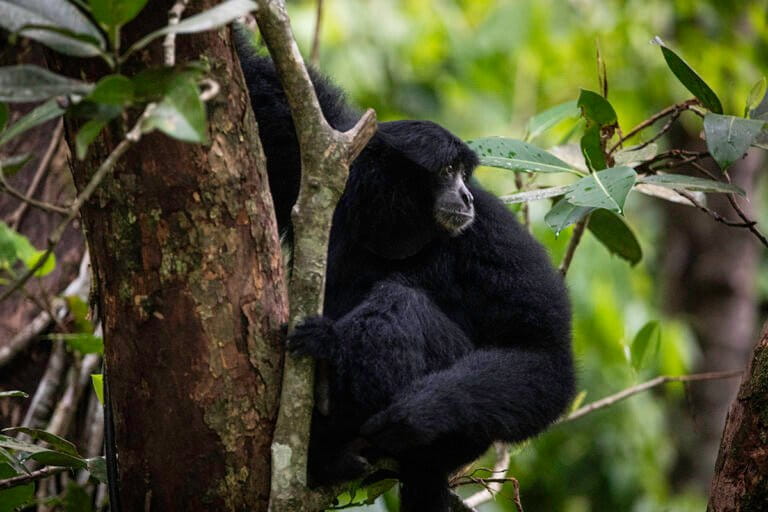
A study in North Sumatra has found that human-generated noise, such as from vehicles and construction equipment, disrupts the movement, foraging, and mating behaviors of siamangs (Symphalangus syndactylus). Comparative experiments with natural sounds showed siamangs reacted most strongly to human noise, tending to move further away to avoid it.
A recent study conducted in the forests of North Sumatra has revealed the significant impact of human-generated noise on the ecology of siamangs (Symphalangus syndactylus). The research, published in the journal Ethology in June 2025, observed seven siamang groups in the Sikundur, Ketambe, Kutapanjang, and Soraya areas of North Sumatra. Researchers played four types of sounds for approximately three minutes each, at a noise level close to 90 decibels. Three of these sounds originated from human activities: vehicle traffic, a concrete breaker (jackhammer), and rock music. The sound of cicadas was used as a natural environmental comparison. The results showed that siamangs exhibited the strongest response to the sounds of vehicle traffic and jackhammers. After hearing traffic noise, they moved an average of 103.86 meters away from the sound source. This distance is nearly double the average distance of approximately 51.14 meters in response to the natural sound of cicadas. While the researchers acknowledge that not all siamangs may always flee 100 meters upon hearing vehicles and that the number of groups studied was relatively small, the experiment demonstrates that human noise can alter animal behavior even without direct changes to the physical forest environment. Siamangs typically live in family groups consisting of a mated pair and their offspring. They maintain territories of about 20-70 hectares and travel 700-1500 meters daily in search of fruits and leaves. Repeated noise disturbances have the potential to create an "acoustic fearful landscape." In such conditions, siamangs may map noisy locations as risky areas and choose to avoid them. If these avoided areas are rich in food, this avoidance could restrict access to resources and increase energy expenditure, potentially impacting their ability to thrive and reproduce. Information Source: Mongabay Indonesia
Original source
Mongabay Indonesia