Vietnam Stock Market Enters Adjustment Phase Amidst Lower Liquidity and Foreign Investor Trends
Economy
2026年8月7日
3
Nhan Dan

General articles are free for 24 hours after publish.

Vietnam Stock Market Enters Adjustment Phase Amidst Lower Liquidity and Foreign Investor Trends

Share
AI Summary

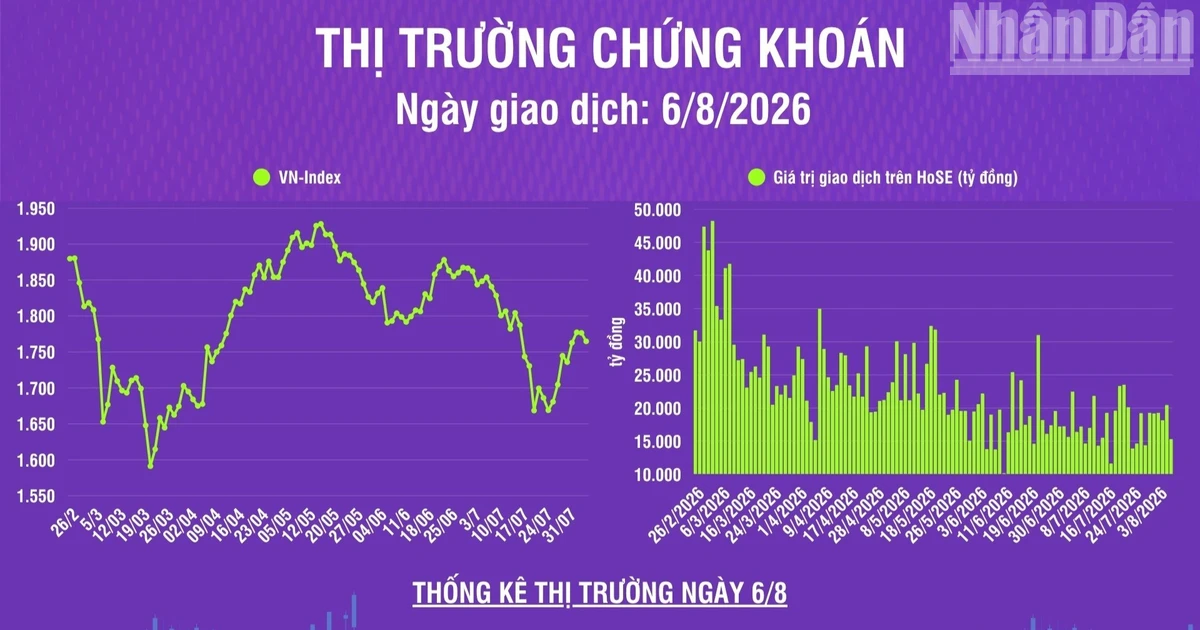
Vietnam's stock market closed on August 6 with the VN-Index down 11.68 points to 1,764.78. Market breadth favored decliners, and trading volume significantly decreased. Foreign investors, after three consecutive net buying sessions, turned to net selling.

Vietnam's stock market closed on August 6 with the VN-Index down 11.68 points (0.68%) to 1,764.78 points, falling below the 200-day moving average resistance level around 1,775 points. The market breadth on the Ho Chi Minh Stock Exchange (HoSE) leaned towards decliners, with 209 stocks falling, 104 rising, and 50 remaining unchanged. This indicates a correction after a recent recovery phase. Market liquidity decreased, with the trading volume of matched orders dropping significantly by 25.3% compared to the previous session. Foreign investors, after three consecutive days of net buying, turned to net selling on HoSE, with a net selling value of VND 119.9 billion (approximately USD 5 million). This market adjustment contrasts with Vietnam's robust economic growth trajectory. In recent years, Vietnam has achieved remarkable economic growth driven by manufacturing development and export expansion. However, global economic uncertainties, inflationary pressures, and domestic real estate market dynamics are likely influencing the stock market as short-term volatility factors. Foreign investor activity remains a crucial element for the Vietnamese stock market. While their net buying supports the market, net selling can increase downward pressure. Future market movements are expected to be influenced by domestic and international economic indicators, monetary policies, and geopolitical risk factors.

0

Original source

Nhan Dan

原文を読む