General articles are free for 24 hours after publish.
Cavite's last traditional salt makers hold onto dying industry
In Cavite, Philippines, traditional salt makers are facing extinction due to the rise of industrial salt production. Land conversion and climate change have drastically reduced output and increased prices, while government support remains insufficient. Despite challenges, artisans strive to preserve their heritage.
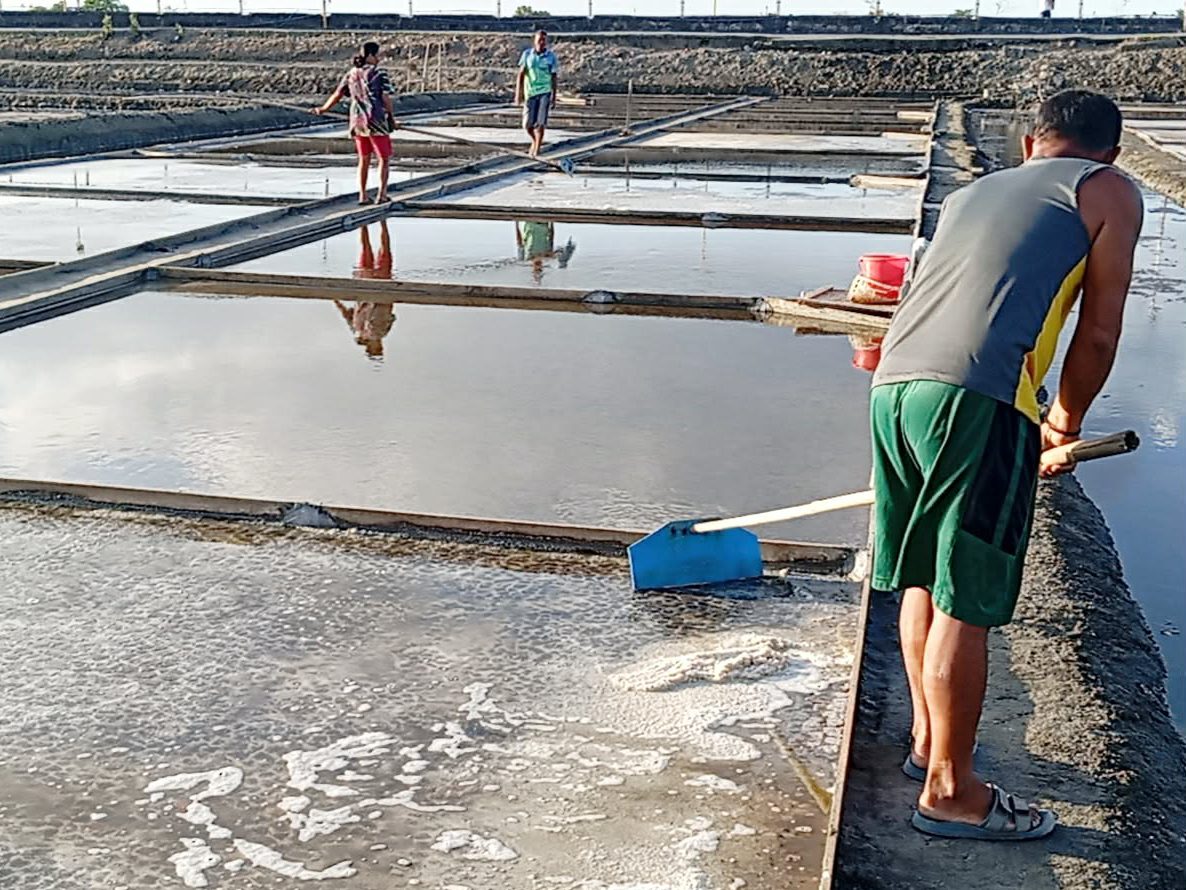
CAVITE, Philippines – Amid rise of industrial salt making, mang-iiras (traditional salt makers) in municipalities of Noveleta and Kawit in Cavite continue to breathe life to a dying tradition. Due to massive land conversion in the area, only three irasan (salt farms) remain in the entire province, with salt makers having to make do with reduced production areas: two in Barangay San Rafael III in Noveleta and one in Barangay Sta. Isabel in Kawit. Rolando Palustre, 63, known as “Ka Olan” in Barangay San Rafael III, said Noveleta’s salt farms offer his family not only livelihood but also a sense of pride in a craft that he has been doing for 45 years. On average, salt makers produce P20,000 per production period, which lasts for five months from January to June. “Sa mga buwang ito, sinasamantala ng mga mag-aasin ang matinding init ng araw upang matuyo ang tubig-dagat at mabuo ang mga kristal ng asin,” Palustre told Rappler in an interview in March. (During those months, salt makers take advantage of the extreme heat of the sun so the seawater crystallizes into salt.) However, in recent years, they have come to also depend on solar heat for seawater’s desalinization. Albert “Emboy” Samartino, 58, also from San Rafael, said the onset of the rainy season is expected to hinder salt production. “Yung bagyo, kapag pinasok kami n’yan, wala na, patay na ‘yung asinan namin. Kaya kapag may bagyo, kakaba-kaba kami,” Samartino told Rappler in early July. (When typhoon hits, our salt farms are gone. News of typhoons makes us nervous.) Frequent rains, he added, have resulted in relatively lower harvests and shortened the salt-making period from six to three months. This in turn increased the price of traditional rock salt from P70 per sack in 1990 to the current P250. From 1980 to 1990, salt makers had been harvesting over 1,000 sacks of rock salt. Due to reduced salt farms and current climate swings, their production rate has been cut to only 400 sacks within a six-month period. Salt industry’s decline The industry’s decline began in 1995 when the Republic Act 8172 mandated the salt iodization program to eliminate “micronutrient malnutrition” and “iodine deficiency disorders” in the country. Left without adequate support from government for sophisticated machinery, salt makers were forced to halt their operation as they could not keep up with the industry demand. “’Yung iodized salt, ayan ang pumatay sa industriya namin. Sinasabi ng gobyerno na ‘yung rock salt ay marumi. Pero mula nang kabataan, ayan na ‘yung ginagamit namin,” lamented Samartino. (Iodized salt killed our livelihood. The government has been saying that rock salt is unsanitary. But that’s what we’ve been using since we were young.) While the Philippine shoreline stretches to over 36,000 kilometers, the Philippine Association of Salt Industry (PhilASIN) reported that it has only produced 60,000 metric tons of salt, compared to Vietnam’s 1.1 million MT from a shorline of only 3,200 kilometers. Ironically, the country has been importing about 92% of its salt resources from other countries. Keeping up with the mandate In 2023, President Ferdinand Marcos Jr. signed RA 11985, known as the “Philippine Salt Industry Development Act,” to “encourage salt farming” and “attain salt self-sufficiency” and placed the country as the product’s net exporter. However, salt makers underscored that while the Bureau of Fisheries and Aquatic Resources (BFAR) has provided materials for salt bed building, they have not been given any financial support to boost their production. To keep up, salt makers go into alternative means such as fishing and farming to gain capital when the production period starts around November until June. “Kapag nagsimula na ang tag-ulan, napipilitan silang ihinto ang produksiyon dahil nasisira ang asin sa tubig-ulan. Pinapalitan naman ito ng pag-aalaga ng bangus,” explained Palustre. (When the rainy season sets in, the salt makers are forced to stop their production because rain water destroys the salt. So shift to milkfish farming.) Despite the dwindling industry and competition posed by iodized salt manufacturers, Cavite’s traditional salt makers vow to continue with their long-held livelihood. This industry, they say, is what has helped them survive for years. “Hindi madaling trabaho ang pag–iiras, kailangan mo ng tiyaga at sipag. Sana patuloy ito na suportahan at huwag pabayaan ng susunod na henerasyon kasi ganito na ang hanapbuhay at kultura rito sa Noveleta,” said Palustre. (Salt making is not an easy job, you need to be patient and diligent. We hope we will continue to get support for doing this, and that the next generation will carry this on, because this is part of Noveleta’s livelihood and culture.) – Rappler.com Axel John Cainglet is a BA Political Science student at the University of the Philippines Manila. An Aries Rufo Journalism Fellow for 2026, he is also the news editor of The Manila Collegian.
Original source
Rappler Business