General articles are free for 24 hours after publish.
Thailand Braces for Heavy Rains and Floods; Disaster Insurance Expanded, Economic Measures Underway
The Thai Meteorological Department has forecast heavy to very heavy rainfall across the country, urging vigilance for potential floods. In response, the government has approved a 15.5 billion baht disaster insurance plan to stabilize livelihoods and extended the 'Thais Help Thai Plus' handout program for two months to combat rising living costs.
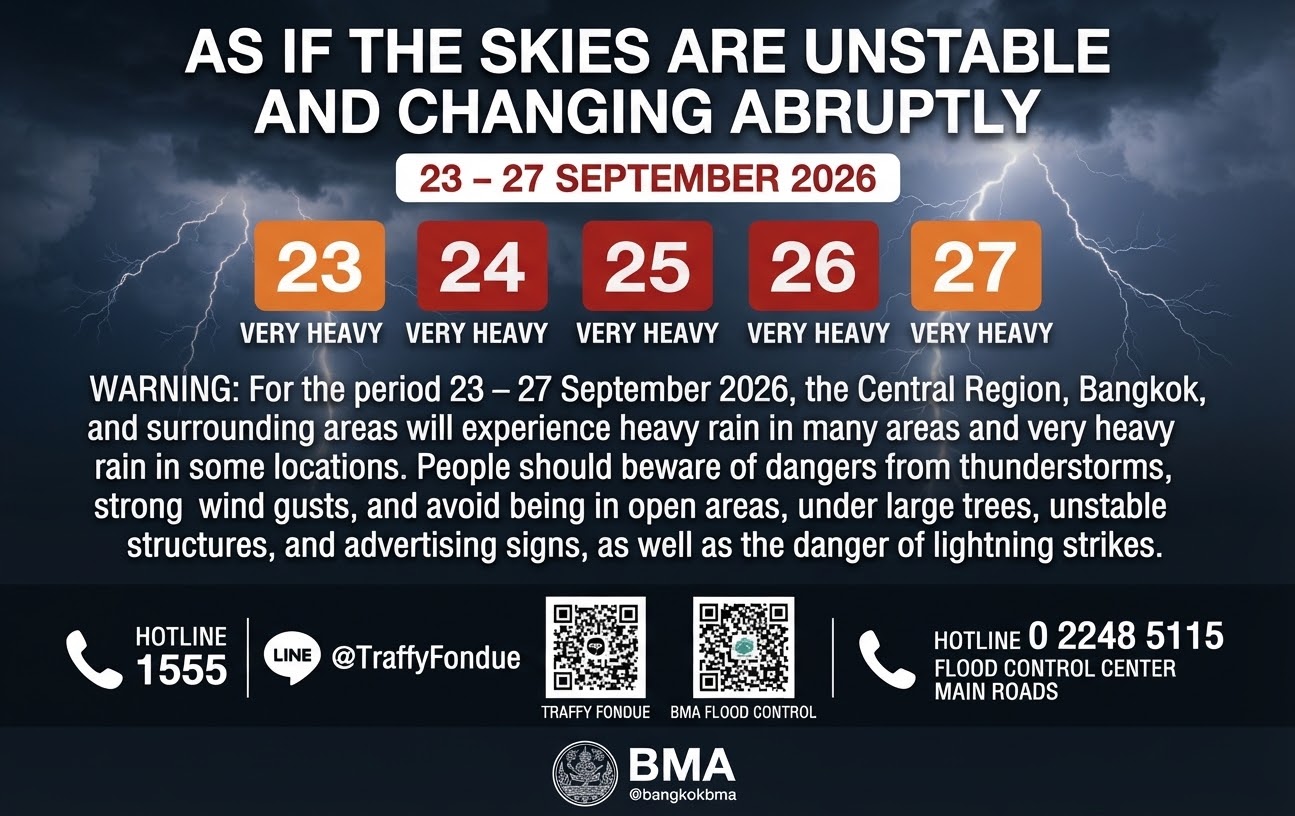
The Thai Meteorological Department (TMD) has issued warnings forecasting heavy to very heavy rain across multiple regions of Thailand from September 23–27, 2026. The severe weather brings significant risks of flash floods and sudden run-off, with the lower Northeast and East expected to be affected first before rainfall spreads to other regions. The widespread downpours will hit the North, lower Northeast, Central region—including Bangkok and surrounding provinces—as well as the East and South. Officials advised high-risk zones—including Northern, lower Northeastern, Eastern, Central Thailand, and the Bangkok metropolitan area—to remain vigilant for potential flash floods and localized waterlogging caused by heavy accumulated rain between September 23 and 27. Additionally, stronger waves are expected in the Andaman Sea and the Gulf of Thailand, prompting authorities to urge the public to follow official weather updates directly. In response, the Cabinet has approved a 15.5 billion Baht disaster insurance plan covering approximately 30 million households and fatalities caused by floods, storms, and earthquakes. Effective from October 1, 2026, to October 1, 2027, the scheme prioritizes vulnerable groups and residents in high-risk areas. The budget allocates 15 billion Baht for residential property insurance and 500 million Baht for personal accident coverage, with regulatory oversight to select insurers and prevent overlapping government compensation payouts. Existing relief payments of 9,000 Baht per household and 2 million Baht per death will apply to disasters occurring between May 15 and September 30, 2026. Additionally, the government is reviewing expanding access for tenants, remote communities, and individuals without official household registration. The Office of the Insurance Commission and the Thai General Insurance Association will select stable and capable insurers to ensure prompt and transparent claims payments, while the Ministry of Interior and the Department of Disaster Prevention and Mitigation will prevent duplicate state assistance. For victims during the 2026 rainy season from May 15 to September 30, 2026, prior Cabinet criteria of 9,000 Baht per household and 2 million Baht per death will still apply. Economically, the Cabinet has approved an additional phase of the Thais Help Thais Plus program, running from October 1 to November 30, 2026, to ease living costs and support consumer spending. Deputy Prime Minister and Finance Minister Eakniti Nitithanprapas said a cabinet-approved 43-billion-Baht stimulus package, utilizing remaining funds from the 2026 Emergency Decree on Energy Crisis Borrowing, features added welfare card benefits and the 'Thai Chuay Thai Plus' co-payment scheme, aiming to boost GDP growth by 0.1–0.2%. The interventions target compounding economic shocks from the Middle East conflict, which drove up global crude and refined oil prices. Officials warned of three cascading crisis waves—rising energy costs, escalating inflation with producer prices surging nearly 10%, and weakened consumer purchasing power—prompting government support to cushion domestic impacts. Finance Ministry Spokesperson Vinit Visessuvanapoom updated the state welfare card review process, noting 9.5 million approvals from 18.8 million applicants, with 5 million currently under appeal. The Cabinet approved relaxed criteria to exempt vocational and informal education students, as well as shareholders in social and community enterprises. Asset rules were also adjusted: securities accounts with no trading history or under 5,000 Baht are now exempt. Vehicle limits were eased to exclude motorcycles up to 15 years old and utility or agricultural vehicles over 20 years old, helping separate luxury vehicles from essential daily transport. BYD Auto (Thailand) and Rêver Automotive have expressed full support for the Thai government’s plan to raise excise taxes on imported electric vehicles, viewing the policy as a correct step to protect domestic automotive industries and investors with local manufacturing bases rather than importers paying low tax rates. The BYD plant in Rayong, which opened in mid-2024 with a total investment exceeding 30,000 million Baht, has accumulated a production milestone of 100,000 units over two years and is working to expand phase-one capacity to 150,000 units annually. The facility currently produces five new energy vehicle models, collaborates with over 266 local parts suppliers, maintains about 50% local content, and employs over 6,000 workers while exporting to
Original source
Thai Enquirer