General articles are free for 24 hours after publish.
BRT Lane Intrusion Accidents: Determining Fault and Liability
Following a fatal accident involving a motorcycle entering a Bus Rapid Transit (BRT) lane in Hanoi, legal experts clarify how fault is determined. They emphasize that simply violating lane rules does not automatically assign full responsibility; a comprehensive assessment of direct causes and mutual negligence is required.
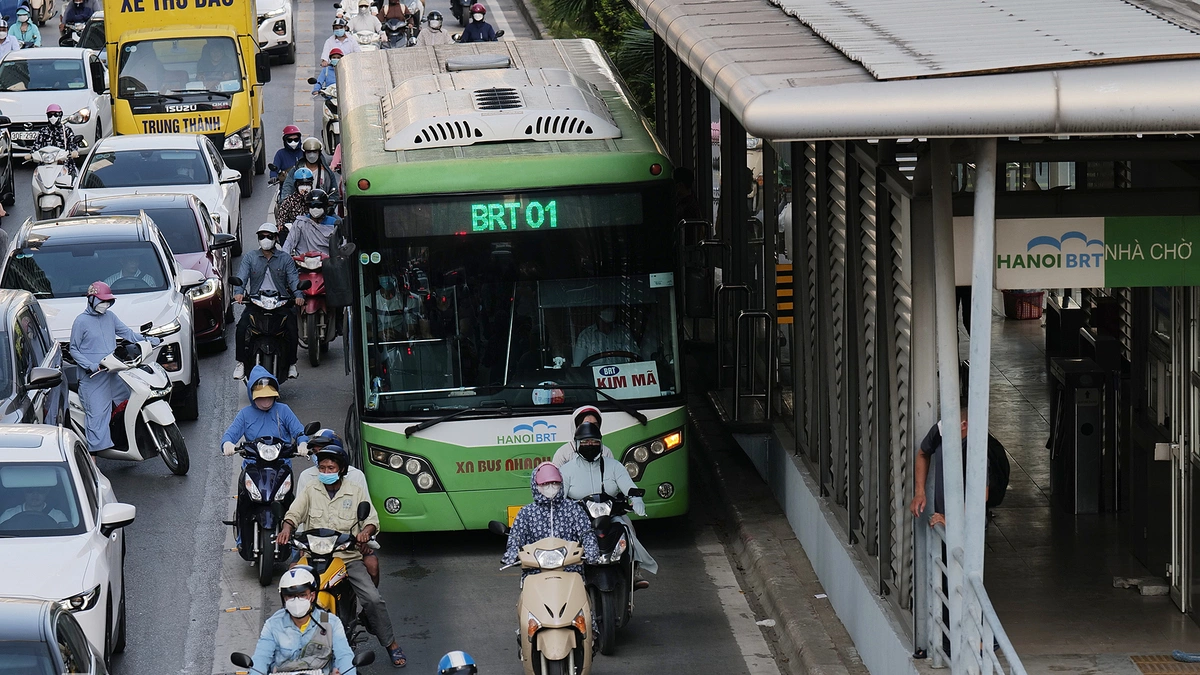
Following a fatal accident where a motorcycle entered a Bus Rapid Transit (BRT) dedicated lane and collided with a bus on Le Van Luong street in Hanoi, legal experts have clarified the criteria for determining fault in traffic accidents. The incident, which resulted in the motorcyclist's death at the scene, prompted discussions about the common practice of vehicles, especially during peak hours, entering BRT lanes to bypass traffic. Some argued that the party violating the lane rules should bear full responsibility. However, lawyer Nguyen Duc Thinh from Fanci Law Company stated that determining legal responsibility is not straightforward. In traffic accident investigations, authorities do not assign fault based solely on who suffered more severe injuries, who died, or who was driving a larger vehicle. The crucial aspect is to clarify which specific violation directly led to the consequence. According to Thinh, the accident could be analyzed under three legal scenarios: First, if the investigation concludes that the motorcyclist unilaterally entered the BRT lane without proper observation, failing to ensure safety and yield to a legally operating vehicle within the lane. Simultaneously, if the bus driver was operating at a legal speed, within their designated path, maintained observation, and took evasive action within their capabilities but still could not avoid the collision, the primary fault would likely lie with the motorcyclist. Conversely, if evidence shows the bus driver was speeding, inattentive, failed to decelerate at an intersection, or had the means to detect and avoid the collision but did not act promptly, the motorcycle's entry into the BRT lane does not absolve the bus driver of responsibility. The investigating agency would then need to examine the bus driver's independent traffic rule violations. Thirdly, both parties could share fault. For instance, if the motorcyclist changed lanes improperly while the bus driver also failed to maintain speed or observe properly. In such cases, each action contributes to the accident, and the investigating agency will determine the degree of fault for each party to serve as a basis for criminal, administrative, and civil liability proceedings. Legally, responsibility is determined by the causal link between the violation and the outcome, not by sentiment. While entering a BRT lane without authorization is a violation, it does not automatically mean bearing full responsibility for the accident's consequences. Thinh emphasized that authorities must assess whether the lane violation was the direct cause, noting that if the motorcycle had entered the lane and was moving stably, allowing the bus driver time to observe and react, the driver's responsibility for improper speed or failure to avoid the collision would still be considered independently. Evidence for determining fault includes on-site inspections, vehicle damage, collision points, movement trajectories, braking marks, inter-vehicle distances, and road conditions. Data from traffic cameras, dashcams, GPS trackers, speed logs, and testimonies from drivers, passengers, and witnesses, along with technical expert conclusions, are vital. Investigations will clarify the bus's speed, the motorcycle's lane change initiation point, whether turn signals were used, the distance between vehicles at the time, and whether the bus driver braked or steered to avoid the collision, as well as visibility and traffic control conditions. Not all fatal accidents lead to criminal prosecution. If the bus driver's violation is determined to be the direct cause of the fatality, they may face criminal charges for violating road traffic regulations, depending on the nature and severity. If the violation does not warrant criminal charges, administrative penalties may apply. Similarly, the motorcyclist's improper lane change would be subject to administrative penalties. For civil liability, the party at fault causing damage, or the vehicle owner/manager where legally mandated, must compensate. If both parties are at fault, compensation will be allocated according to their respective degrees of liability. Thinh lamented that a decision made in mere seconds can lead to irreversible consequences. He urged motorcyclists to adhere to lane regulations, particularly in areas with BRT or dedicated public transport lanes, emphasizing the need for observation, signaling, maintaining safe distances, and changing lanes only where permitted. Bus drivers and operators of large vehicles are reminded that proper lane usage is not a substitute for constant observation, maintaining appropriate speeds, and proactively managing unexpected situations.
Original source
VnExpress