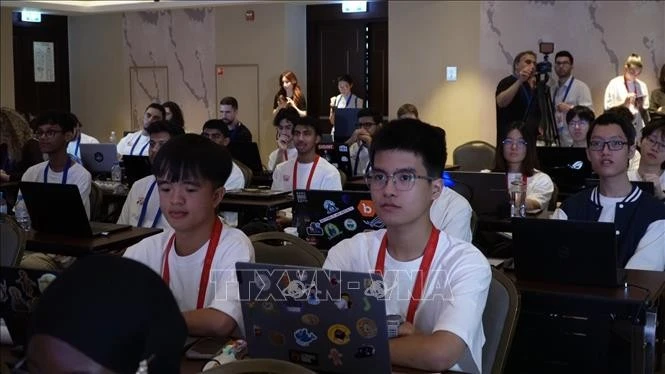
Vietnam Boosts International Cooperation in Cybersecurity and Next-Gen Tech
Technology
2026年7月30日
5
VietnamPlus English
Relations
🇻🇳Vietnam🇨🇳China🇷🇺Russia

General articles are free for 24 hours after publish.

Vietnam Boosts International Cooperation in Cybersecurity and Next-Gen Tech

Share
AI Summary

Vietnam is enhancing international cooperation in areas like cybersecurity, quantum technology, AI, and semiconductors, including student participation in a Russian cybersecurity camp, to counter rising cyberattacks and bolster national competitiveness and technological autonomy.

Vietnam is strengthening international cooperation to counter the increasing frequency and sophistication of cyberattacks. Recently, Vietnamese students participated in an international cybersecurity camp in Russia, aiming to enhance defensive capabilities in cyberspace. Cyberattacks are targeting critical infrastructure, personal data, and public services with growing frequency and severity. To address this, Vietnam is advancing comprehensive legal provisions on data security, information system protection, and measures to prevent, detect, and address cybersecurity violations. Emphasis is placed on strengthening prevention, enhancing early warning and incident response capabilities, and linking cybersecurity with social order and security. This is a critical policy objective for maintaining national stability amidst rapid digital transformation within Vietnam's one-party system. For Vietnam, which aims to sustain economic growth and escape the "middle-income trap," scientific and technological development is essential. Artificial intelligence (AI), in particular, holds significant potential for improving productivity, according to National Assembly Committee for Cultural and Educational member Dr. Ho Duc Thang. AI is also being utilized in the financial industry for credit analysis, eKYC, risk management, and service personalization, contributing to the promotion of the digital economy. Furthermore, Vietnam is promoting international research and development in quantum technology and semiconductors. Ho Chi Minh City is focusing on talent development for the quantum computing era, while Hanoi aims for the digital economy to contribute around 40% of its Gross Regional Domestic Product (GRDP) by 2030. Platforms like the Vietnam Global Innovation Connect (VGIC) 2026 provide opportunities for policymakers, enterprises, startups, and investors to converge and transform knowledge and technology into practical projects. Regarding the semiconductor industry, Dr. Vo Duc Thang, Assistant Professor at the National Taiwan University of Science and Technology and President of the Vietnam Innovative and Intellectual Network in Taiwan, emphasizes learning not only cutting-edge technology from Taiwan but also how to build an entire ecosystem from the ground up. This is part of Vietnam's strategic effort to enhance national competitiveness and technological autonomy. These initiatives demonstrate Vietnam's commitment to playing a larger role in the global technology race. However, how these technological innovations will concretely impact the lives of its citizens and how domestic technological disparities and talent development challenges will be addressed will be crucial focal points moving forward.

0

Original source

VietnamPlus English

原文を読む