General articles are free for 24 hours after publish.
Hanoi's Hoan Kiem Lake Redevelopment Plan Sparks Debate Over New 'Arc de Triomphe'
Hanoi authorities' proposed redevelopment of the Hoan Kiem Lake area, including demolishing the old city hall and constructing a new 'Arc de Triomphe,' has drawn criticism over concerns of landscape destruction and historical disconnect. Experts emphasize the need for balance between tradition and modernization, and public consensus.
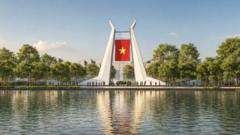
Hanoi authorities' proposed redevelopment of the Hoan Kiem Lake (Ho Guom) area has sparked a debate among citizens and experts. The plan includes demolishing the current building housing the City People's Council and People's Committee to construct a new 9-story building with 4 underground levels, and erecting a new "Arc de Triomphe" by the lake. The objective of this plan is to renovate and rebuild the Hoan Kiem Lake area into a large square, connecting it with surrounding structures to create a historical, cultural, and artistic space. As Hoan Kiem Lake has long been a symbol of Hanoi, its redevelopment plan has garnered significant attention. However, the demolition of the old city hall and the construction of the "Arc de Triomphe" have drawn strong concerns from some quarters. The former city hall was once described as resembling a "guillotine," and its demolition and replacement with a new structure are sarcastically referred to by some citizens as "moving a guillotine to another spot." The proposed "Arc de Triomphe" has also been criticized for its design, which some find resembles a "guillotine," raising fears of landscape damage. Questions have also been raised about why it would be placed by the lake, facing the water. Opinions are divided among architects. Architect Ho Thieu Tri, the designer of the Arc de Triomphe, explained that the monument is a symbol of victory and that facing the water creates an optimal scenic viewpoint, enhancing the value of the entire area. However, other architects argue that an Arc de Triomphe should fundamentally possess a "spatial spine" long enough to organize large-scale movements and create a visual focal point, and that applying a Western architectural form to Hanoi's unique spatial characteristics is "incompatible," citing examples from Paris and Berlin. The demolition of the old post office and the construction of a building recalling the former Bao An Pagoda have also been criticized as forced attempts. The redevelopment plan is seen as grappling with the conflict between preserving urban memory and modernization, and maintaining the traditional serene space of Hoan Kiem Lake versus transforming it into a bustling exchange center. On the other hand, the idea of converting the space behind the Opera House into an outdoor performance venue is praised as a bold solution to address the messy situation of temporary stages during major events. Dao Ngoc Nghiem, Vice Chairman of the Vietnam Association of Urban Planning and Development and former Chief Architect of Hanoi, stated that the Hoan Kiem Lake area plan must ensure harmony between three core elements: culture, civilization, and creativity. He emphasized that decisions on demolishing or preserving historical structures should be based on a comprehensive evaluation of their historical and architectural value, as well as their overall landscape context. He also stressed that achieving broad consensus from local residents and the public nationwide plays a decisive role in any major change. Under Vietnam's one-party system, large-scale urban planning often reflects the strong intentions of the central government and the Party, while also incorporating formal public consultation processes. Hoan Kiem Lake is a special place for Hanoi residents, and public interest and concern over its development are high. In a continuously growing Vietnamese economy, the balance between preserving historical structures and development is a constant challenge. Particularly amidst complex relations with China, Vietnam also shows interest in symbolic projects that strengthen its national identity, but how these harmonize with citizens' lives and historical landscapes is crucial. Source: BBC Vietnamese
Original source
BBC Vietnamese