General articles are free for 24 hours after publish.
Giant Crab Devours Coconuts: The Little-Known Ecology of the Protected Coconut Crab
The coconut crab, found in Indonesia's Togean Islands, is a giant crustacean weighing up to 4kg with a 2m leg span. Despite being a protected species, it's traded at high prices and has a peculiar fondness for coconuts, a behavior whose reason remains unknown.
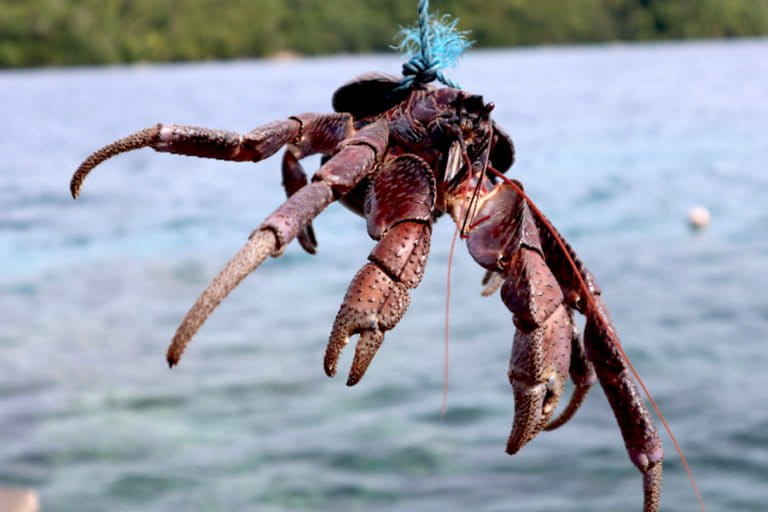
The coconut crab (Birgus latro), found in Indonesia's Togean Islands, Tojo Una-Una Regency, is a unique creature known for its colossal size. Weighing up to four kilograms and measuring 40 centimeters in body length, its leg span can reach up to two meters. This species is known by various names, including kenari crab, coconut crab, and robber crab, the latter referring to its habit of pilfering coconuts for consumption. The coconut crab is a protected animal in Indonesia, as stipulated by Decree of the Minister of Forestry No.12/Kpts/II/1987 and Government Regulation No.7/1999 concerning the Conservation of Plant and Animal Species. It is also listed on the IUCN Red List with a status of Vulnerable (VU). Despite its protected status, the coconut crab is frequently hunted and sold for consumption, fetching high prices that can reach up to Rp800,000 per individual. In Indonesia, these crabs can be found in several regions, with the Togean Islands being one prominent habitat. Here, they typically reside in rocky crevices along the coast or among remnants of old wood. Coconut crabs exhibit a strong affinity for coconuts. Local residents in Togean even use pieces of coconut meat as bait, scattering them around the crabs' hiding spots. At night, the crabs are drawn out by the scent of coconut, emerging from their burrows to feed on the bait. However, the exact reasons behind this particular fondness for coconuts remain largely unknown. Research explaining this behavior is limited, as noted by Mongabay Indonesia. The capabilities of the coconut crab are not to be underestimated. Its claws are incredibly strong, reportedly capable of lifting weights up to 29 kilograms. Furthermore, this species possesses the ability to climb coconut trees, a remarkable trait that also attracts tourist attention. This article was originally published on Mongabay.
Original source
Mongabay Indonesia