General articles are free for 24 hours after publish.
Cambodia Urges Stronger UN Role in Dispute Resolution, Warns Against Forcible Border Changes
Cambodia has called on the United Nations to strengthen its role in peaceful dispute resolution under international law and to prevent border changes by force. The appeal was made by Cambodia's representative at the UN Security Council, who also called for enhanced preventive diplomacy and respect for international judicial mechanisms.
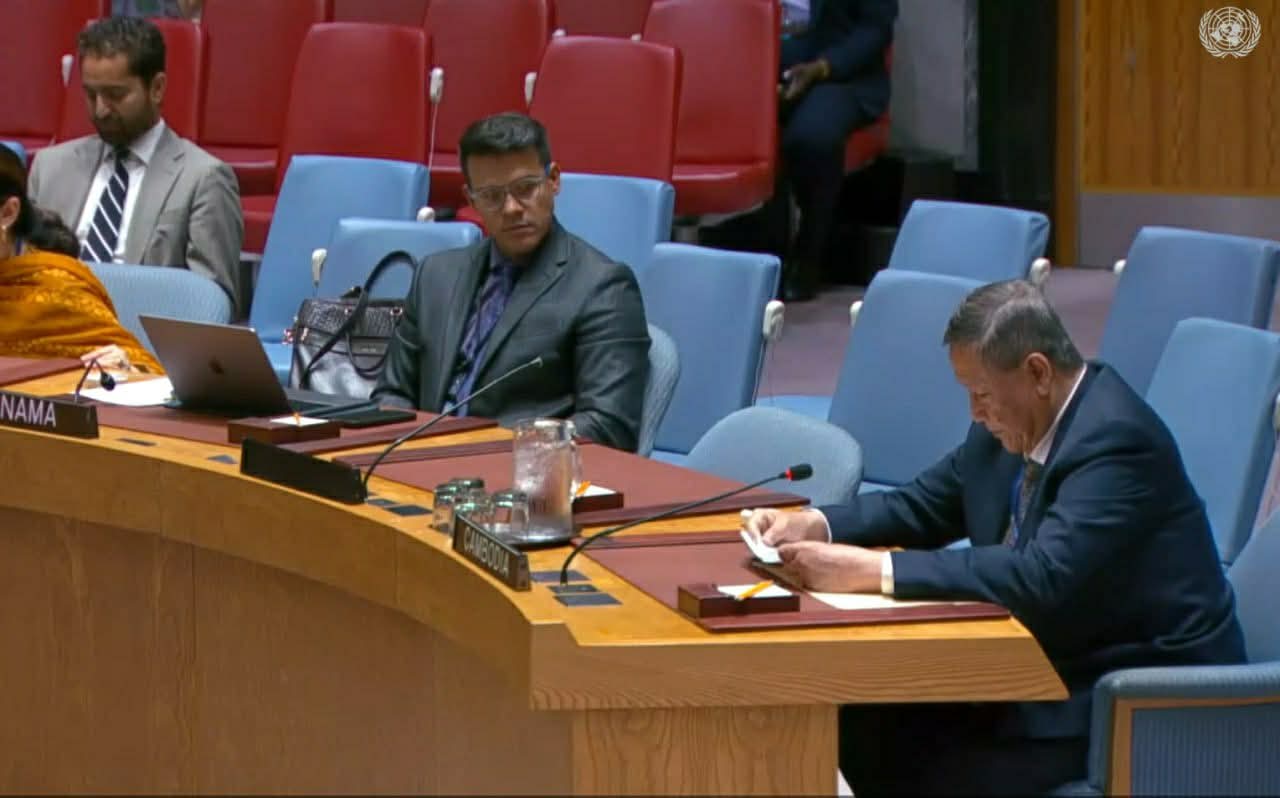
Cambodia has called on the United Nations to strengthen its role in preventing conflicts and ensuring disputes are settled peacefully in accordance with international law, while warning that borders and sovereignty must never be altered by force or through the creation of new facts on the ground. The appeal was made by Keo Chhea, Cambodian permanent representative to the UN, during a high-level open debate at the UN Security Council in New York on July 23. While addressing the Security Council, Chhea called for the international community to renew its commitment to resolving disputes through dialogue, diplomacy and adherence to international law, stressing that peaceful settlement remains the most effective means of maintaining international peace and security. He recalled that Cambodian Minister of Foreign Affairs and International Cooperation Prak Sokhonn reaffirmed the Kingdom’s unwavering commitment to peaceful dispute resolution during his address to the Security Council in May, emphasising dialogue, diplomacy and respect for international law as the country’s guiding principles. Building on that position, Chhea outlined four priorities that Cambodia believes should guide the UN’s efforts to strengthen global peace and security. First, he called for a stronger UN role in preventive diplomacy, arguing that early diplomatic engagement is essential to preventing tensions from escalating into armed conflict. Second, he urged all states to ensure disputes are resolved exclusively through peaceful means and in accordance with international law, including compliance with decisions of the International Court of Justice (ICJ), describing respect for international judicial mechanisms as fundamental to a rules-based international order. Third, he stressed the need to reinforce the unity, credibility and impartiality of the UN Security Council so it can effectively carry out its mandate to maintain international peace and security. Finally, Chhea highlighted the humanitarian consequences of the ongoing Cambodian-Thai border dispute, noting that more than 20,000 Cambodian civilians remain displaced by the conflict and continue to require protection and assistance. He said humanitarian considerations must remain central to international efforts to resolve disputes, particularly when civilians bear the greatest burden of prolonged tensions. Concluding his statement, the representative underscored Cambodia’s position that international borders and national sovereignty must never be altered by force or through the creation of a fait accompli on the ground, reaffirming the country’s support for peaceful, rules-based solutions to international disputes. His remarks come as Cambodia continues to pursue diplomatic and legal avenues to address tensions along its border, while repeatedly emphasising that disputes should be resolved through dialogue and established international mechanisms rather than military confrontation. The Security Council debate reviewed progress in implementing Resolution 2788 (2025), which seeks to strengthen international mechanisms for the peaceful settlement of disputes and reinforce the UN’s preventive diplomacy agenda. Cambodia has consistently advocated for multilateral approaches to conflict resolution and has repeatedly called for greater respect for international law and judicial mechanisms, arguing that lasting peace depends on adherence to the UN Charter and internationally accepted legal principles. The latest statement reinforces Phnom Penh’s broader diplomatic campaign to rally international support for peaceful conflict resolution while drawing attention to the humanitarian impact of unresolved border tensions, particularly the continued displacement of thousands of Cambodian civilians.
Original source
Phnom Penh Post