Australia and Fiji Sign New Security Agreements, Charting New Course for Regional Security
Diplomacy
2026年7月7日
5
The Diplomat Indonesia

Australia and Fiji Sign New Security Agreements, Charting New Course for Regional Security

AI サマリー

Australia and Fiji have signed two new security agreements, the Vuvale Union and the Veitacini Treaty, strengthening bilateral cooperation and introducing a new framework for regional security. The Veitacini Treaty, in particular, includes mutual defense provisions and is open to accession by other regional nations.

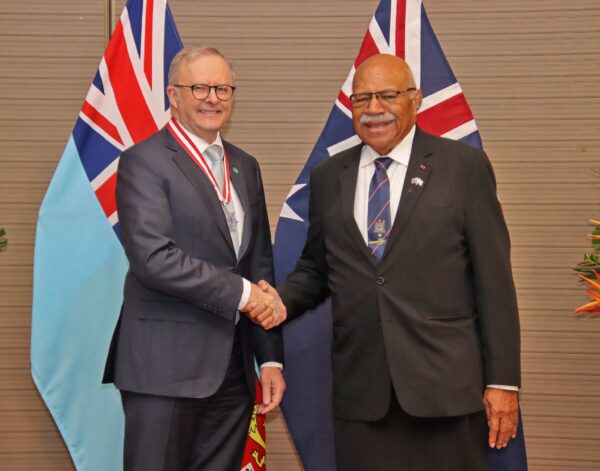
Read The Diplomat, Know The Asia-Pacific With the Vuvale Union and the Veitacini Treaty, Canberra and Suva chart a new course for regional security. In the Fijian capital of Suva this week, Australian Prime Minister Anthony Albanese and his Fijian counterpart, Sitiveni Rabuka, signed two new security agreements. The agreements form part of a period of hyperactive diplomacy by Canberra in the Pacific, which has also included a series of new partnerships with Tuvalu, Nauru, Papua New Guinea (PNG), and Vanuatu. The first agreement with Fiji was the Vuvale Union, an expansion of the Vuvale Partnership signed in 2023. This new union moves to a more permanent framework for collaboration, with stronger commitments to economic integration, workforce mobility, education, skills development, and investment. It establishes new initiatives such as the Vuvale Skills Hub and expanded training and labor mobility pathways, which demonstrate a shift from simply encouraging cooperation to creating the institutions that support it. The Union also establishes closer day-to-day collaboration between government agencies, making the relationship more deeply embedded than the consultation-based approach of the partnership. Yet it was the second agreement signed in Suva that has the potential to be the more consequential. The new Ocean of Peace Alliance, also known as the Veitacini Treaty, is both a defense pact and a broader statement about the future of Pacific regional security. Primarily driven by Rabuka, the treaty is not limited to Fiji and Australia; it is open to accession by other Pacific Island countries. At its core, the Veitacini Treaty is a mutual defense agreement. Its most consequential provision – Article 6 – states that an armed attack on one party in the Pacific “would be dangerous to each other’s peace and security” and commits both sides to act against the common danger according to their domestic legal processes. While the wording is not identical to NATO’s collective defense clause, it clearly creates a much stronger security obligation than previous bilateral agreements between Australia and individual Pacific Island states. Beyond this, the treaty also establishes mechanisms for consultation and security cooperation. Its Article 5 commits both countries to consult whenever developments threaten the sovereignty, peace, or stability of either state. Other sections focus on defense cooperation, visiting forces arrangements, democratic values, and dispute resolution through dialogue and the “Pacific Way” – the ethos of the Pacific Islands Forum. The treaty deliberately frames security in regional and Pacific terms rather than simply as a bilateral military arrangement. This is why the treaty is open to future expansion. It draws upon the ideals of the 250 Strategy for the Blue Pacific Continent and its focus on regional solidarity and partnership. At present, alongside Australia and Fiji, only New Zealand, PNG, and Tonga have militaries within the region, but given these ideals of regional solidarity and collective defense, other states may see it in their interests to join and find non-military ways to contribute. For Fiji, the treaty is historically important because it is the country’s first formal alliance agreement. Fiji has traditionally pursued a more non-aligned foreign policy, balancing relationships with Australia, New Zealand, China, and other regional powers. With Rabuka being more sympathetic to Australia and Western allies than his predecessor, Frank Bainimarama, he appears to have decided that the current regional environment requires closer strategic cooperation with Canberra. Here the agreement must also be understood in the context of growing geopolitical competition in the Pacific. In recent years, China has expanded its diplomatic, economic, and security presence across the region. Beijing’s 2022 security agreement with the Solomon Islands was particularly significant because it raised concerns in Canberra and Washington about the possibility of future Chinese military access in the South Pacific. Since then, Australia has accelerated efforts to rebuild and deepen relationships with Pacific states through aid, labor mobility programs, infrastructure investment, and security agreements. At the same time, both Australia and Fiji have tried to avoid presenting the treaty as explicitly anti-China. The treaty language itself stresses peace, consensus decision-making, and respect for sovereignty. This reflects the political reality that many Pacific Island countries still want economic engagement with China while also maintaining strong structural ties with Australia and New Zealand. There is nevertheless a risk that closer security arrangements with Australia could draw Fiji – and potentially other Pacific countries – into wider strategic rivalries. Clearly Fiji assessed that risk and concluded that the benefits outweigh it. Yet the longer-term success of the Ocean of Peace Alliance rests with whether and how it evolves to work in the interests of Pacific Island countries. Security in the region is not only framed in terms of traditional defense, but also includes economic development, disaster resilience, and climate change mitigation. This may complicate the idea of “collective defense” in Canberra’s eyes, but it is central to giving the idea of the “Pacific Family” substantive weight. Subscribe today and join thousands of diplomats, analysts, policy professionals and business readers who rely on The Diplomat for expert Asia-Pacific coverage. Get unlimited access to in-depth analysis you won't find anywhere else, from South China Sea tensions to ASEAN diplomacy to India-Pakistan relations. More than 5,000 articles a year. Already have an account? Log in. Grant Wyeth is a Melbourne-based political analyst specializing in Australia and the Pacific, India and Canada. Get briefed on the story of the week, and developing stories to watch across the Asia-Pacific.

多角的分析

経済的影響

この協定は、経済統合と労働力移動の強化を謳っており、特に「ヴヴァレ・ユニオン」はその具体的な枠組みを提示している。これは、オーストラリアが太平洋諸国への経済的依存度を高めることで、地域における中国の影響力拡大に対抗する戦略の一環と考えられる。フィジーにとっては、オーストラリアからの投資や労働市場へのアクセス拡大が期待できる一方、経済構造のオーストラリアへの依存度が高まるリスクも孕む。

投資家心理

「ヴヴァレ・ユニオン」における経済統合、労働力移動、投資の強化は、オーストラリア企業にとってフィジーへの投資機会を拡大する可能性がある。特に、スキル開発や労働力移動の円滑化は、人材確保の面でメリットとなりうる。しかし、地域全体の地政学的な緊張の高まりは、投資リスクを増大させる要因ともなりうるため、慎重な判断が求められる。

社会的影響

「ヴェイタチニ条約」は、地域的な連帯と集団的防衛の理念を掲げ、太平洋諸島フォーラムの精神である「パシフィック・ウェイ」を重視している。これは、単なる軍事的な安全保障に留まらず、地域諸国の主権、平和、安定を共同で守るという意思表示である。一方で、この協定が中国との関係に与える影響や、地域内のパワーバランスの変化は、フィジー国民や他の太平洋島嶼国の人々の生活や将来の選択肢に間接的な影響を与える可能性がある。

市民の声

「ヴヴァレ・ユニオン」で言及されている労働力移動の拡大は、フィジー国民、特に若年層にとって、オーストラリアでの就労機会の増加を意味する可能性がある。これは、経済的機会の拡大や生活水準の向上につながる一方で、国内の労働力流出や、文化的な摩擦といった社会的な課題を生む可能性もある。また、「ヴェイタチニ条約」による地域安全保障の強化は、直接的な脅威の低減につながるが、地政学的な対立の激化は、地域全体の不安定化を招くリスクも否定できない。

背景・歴史的文脈

太平洋地域は近年、中国の経済的・軍事的影響力の拡大により、地政学的な競争の激化が進んでいる。特に2022年のソロモン諸島と中国の安全保障協定締結は、オーストラリアや米国に強い警戒感を与えた。これに対し、オーストラリアは太平洋諸国との関係強化を加速しており、援助、インフラ投資、労働力移動プログラムに加え、安全保障分野での協力を深めている。フィジーは伝統的に非同盟外交を志向してきたが、現ラプカ政権はオーストラリアとの関係強化に前向きな姿勢を示しており、今回の協定締結は、こうした地域情勢の変化とフィジーの外交政策の転換が背景にある。

原文ソース

The Diplomat Indonesia

原文を読む