China's Moon Laser Ranging Test Advances Space Capabilities Amid Global Concerns
Diplomacy
2026年7月18日
5
Chiang Rai Times

General articles are free for 24 hours after publish.

China's Moon Laser Ranging Test Advances Space Capabilities Amid Global Concerns

Share
AI Summary

China announced a successful laser ranging experiment with its Tiandu-1 satellite in lunar orbit. While advancing future lunar mission navigation and communication accuracy, the test also raises concerns about the potential military applications of laser technology.

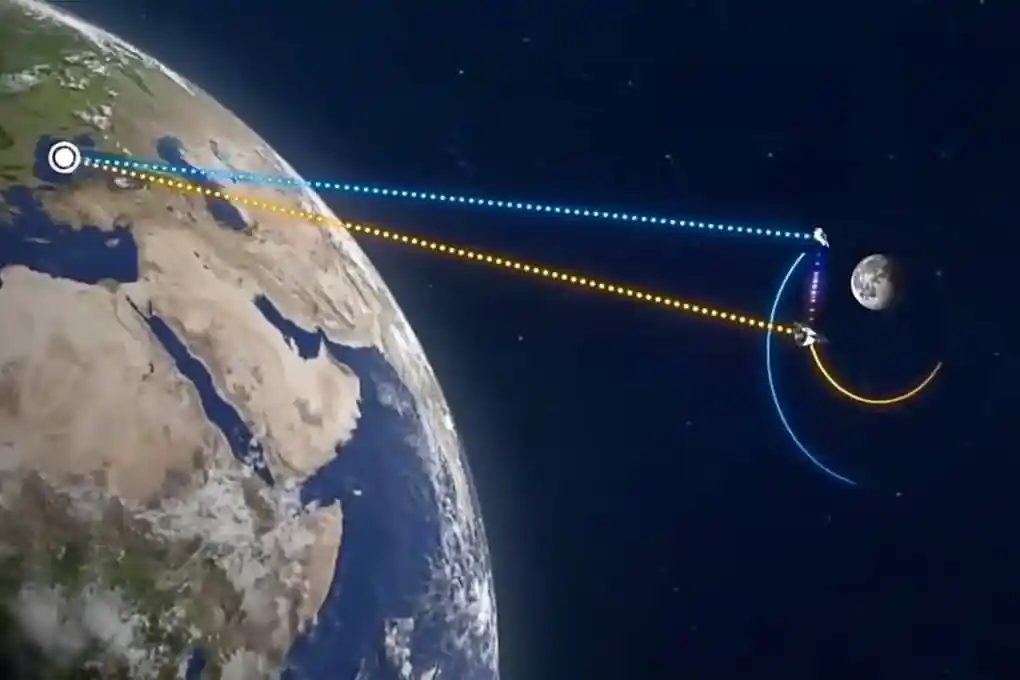
China reported a successful laser ranging experiment targeting its Tiandu-1 satellite in lunar orbit in late April 2025. The experiment is considered a significant step towards developing precise navigation and communication systems for future lunar missions, while also raising concerns about the potential military applications of laser technology. Researchers at the Yunnan Observatories successfully tracked the Tiandu-1 satellite, located approximately 130,000 kilometers from Earth, by sending a near-infrared laser pulse and detecting the faint return signal from a retroreflector mounted on the satellite. This technique calculates distance with extreme precision by measuring the time it takes for the laser pulse to travel to the target and return. The success of the experiment, particularly under bright daylight conditions, is attributed to a combination of advanced optical filters, high-speed detectors, precise timing control, and noise reduction techniques. Tiandu-1, launched in March 2024, is a satellite demonstrator for communication and navigation technologies. The experimental results are expected to contribute to improving the accuracy of spacecraft tracking, lunar mapping, landing support, and orbit calculations for future lunar exploration activities, including China's planned International Lunar Research Station (ILRS). However, the dual-use nature of laser technology, applicable for both civilian and military purposes, has caused apprehension within the international community. While some online speculation suggested the experiment might be related to the development of space weapons or attacks on other nations' satellites, Chinese authorities and scientists have refuted these claims. They emphasize that the experiment was purely for scientific purposes and had no intent of attacking or destructively targeting the Moon. Nonetheless, some countries, including the United States, have previously expressed concerns about the expansion of China's space capabilities, particularly the potential military use of laser technology. This experiment could reignite such discussions. It is pointed out that enhanced transparency, sharing of technical information, and space traffic coordination are crucial to prevent misunderstandings and accidental escalations. Source: Chiang Rai Times

0

Original source

Chiang Rai Times

原文を読む