Vietnam Surpasses Thailand as ASEAN's Second-Largest Commercial Aviation Market
Economy
2026年8月7日
7
Thai Enquirer
Relations
🇹🇭Thailand🇮🇩Indonesia🇻🇳Vietnam🌐United Nations / ASEAN

General articles are free for 24 hours after publish.

Vietnam Surpasses Thailand as ASEAN's Second-Largest Commercial Aviation Market

Share
AI Summary

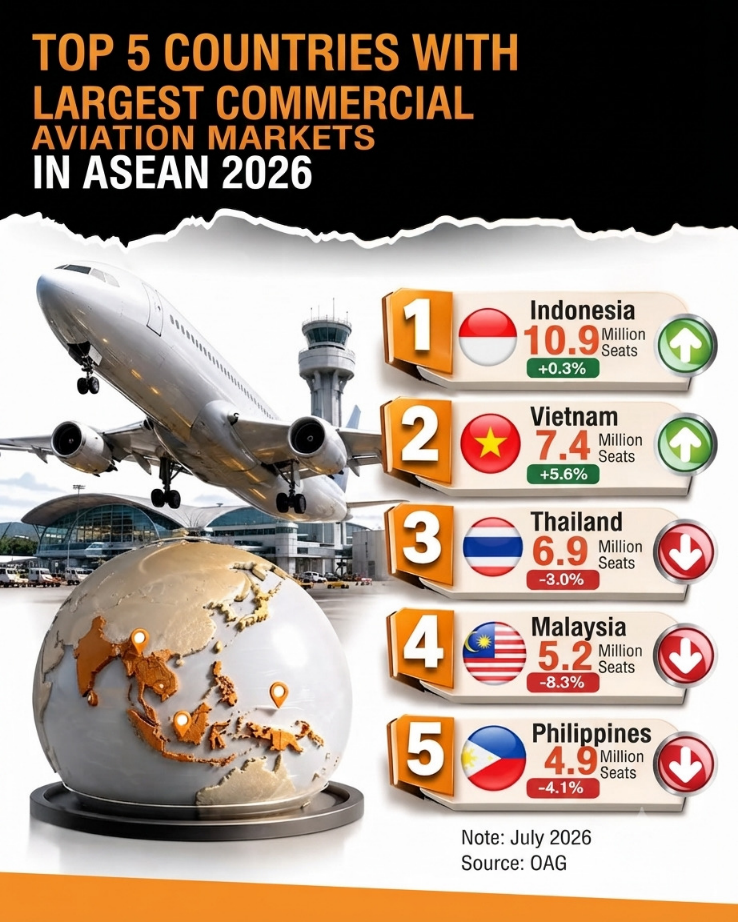
Vietnam has overtaken Thailand to become the second-largest commercial aviation market in ASEAN, according to OAG data, with Indonesia retaining the top spot. Thailand's market contraction is attributed to rising jet fuel costs amid geopolitical tensions.

August 7, 2026 Economic News Vietnam Overtakes Thailand in ASEAN Commercial Aviation Market According to data from global aviation intelligence firm OAG, Vietnam has officially surpassed Thailand to become Southeast Asia’s second-largest commercial aviation market. Indonesia continues to lead the region at the top spot with 10.9 million seats (a 0.3% increase), while Vietnam secured second place with 7.4 million seats—a 5.6% year-on-year growth—propelled by flag carrier Vietnam Airlines becoming the largest airline in ASEAN with 2.81 million seats. Meanwhile, Thailand fell to third place as its capacity dropped 3% to 6.9 million seats, followed by Malaysia in fourth place with 5.2 million seats (down 8.3%) and the Philippines in fifth with 4.9 million seats (down 4.1%). Overall commercial flight capacity across ASEAN shrank by 1.2% year-on-year to 50.4 million total seats, driven by drops in both domestic (-1.3%) and international (-1.5%) route allocations. The contraction seen in markets like Thailand, Malaysia, and the Philippines stems mainly from surging jet fuel costs linked to ongoing geopolitical tensions in the Middle East and instability in the Strait of Hormuz. High fuel expenses have forced numerous regional carriers to reduce international flight frequencies, reshaping the competitive aviation dynamics in Southeast Asia. The Ministry of Finance is evaluating the “Thai Chuai Thai Plus” economic stimulus project, which has successfully alleviated living costs and improved consumer confidence. While the program has received positive feedback from citizens and small merchants alike, some participants noted that calculating the 60:40 co-payment matching structure can occasionally be complex. Deputy PM and Minister of Finance Ekniti Nitithanprapas stated that a comprehensive evaluation of the project will be conducted after it concludes in September, which will serve as the basis for carefully considering a potential Phase 2 extension. In addition to short-term relief measures, the government is focusing on empowering small-scale vendors and micro-entrepreneurs to sustainably access formal financial systems. This includes promoting smart accounting tools like the “Nok Krasip” (Whispering Bird) AI system, designed to help business owners easily track and manage their daily revenues and expenses. Ekniti said the scheme has generated more than 100 billion Baht in economic activity, with 84-85% of spending occurring outside Bangkok and just 15-16% in the capital. He said the program has received a positive response from consumers and merchants and helped reduce household living costs. His comments came after the University of the Thai Chamber of Commerce (UTCC) said weak consumer spending and a fragile economy continued to weigh on SMEs despite the scheme. A survey of 600 businesses found Thai Chuay Thai Plus boosted sales and lowered household expenses but had limited spillover benefits beyond participating businesses. Small retailers excluded from the scheme reported losing about 10% of customers, while 38% of nearby businesses said they benefited from increased economic activity. The Thai Chamber of Commerce (UTCC) president Thanavath Phonvichai said weak consumer spending and a fragile economy continued to weigh on Thailand’s small and medium-sized enterprises in the second quarter, with the SME Competitiveness Index falling to 45.1, down 0.8 points from the previous quarter. All major indicators remained below the neutral 50-point mark. Sales improved, but profits remained under pressure from high fuel and operating costs. The university forecasts Thailand’s economy will grow 2-2.5% this year, with SMEs expanding 2.2-2.7%. Meanwhile a survey of consumer spending behavior during Mother’s Day 2026 found that the estimated spending during the festival was 11,139 million Baht, the highest in 7 years. Although this represents only a 0.7% increase from the previous year, it reflects a continued level of spending activity similar to last year. However, consumers remain cautious about spending amidst an economy that has not yet fully recovered. Thailand will hold another round of technical negotiations with the United States on the Agreement on Reciprocal Trade (ART) at the end of August, with Deputy Prime Minister and Commerce Minister Suphajee Suthumpun leading the Thai delegation. The talks will focus on securing additional exemptions from the U.S. Section 301 tariff, which currently applies to about 28% of Thai exports. Thailand has already secured exemptions for more than 2,000 product lines, covering about 72% of its exports under the measure. Suphajee said Thailand would not compromise on its “red lines” and would use policy-level negotiations alongside trade measures, including proposals to expand Thai private-sector investment in the United States, to help strengthen its negotiating position. Thailand is seeking further tariff relief for products that remain subject to the Section 301 measure while protecting its national interests, she said. During the first nine months of the 2026 fiscal year, Thailand recorded a total import value of 10.20 trillion Baht, marking a significant increase of 23.66% compared to the same period in the previous year. In US dollar terms, imports reached 317,213 million dollars, surging by 30.23%. The primary driving forces behind this import growth consisted of crucial industrial and energy commodities, with integrated circuits and electric circuit boards, crude oil, and gold leading the volume. Meanwhile, China, Taiwan, and ASEAN nations (excluding CLMV) remained Thailand’s primary trading partners for these imports. Despite the robust recovery in global trade and import activities driving overall customs revenue up by 7%, actual tariff collections fell below target. This shortfall was primarily attributed to the impacts of various Free Trade Agreements (FTAs) that reduced duty rates, alongside the appreciation of the Thai Baht, which lowered the local currency value calculations for imported goods. Consequently, while trade volume expanded substantially, the corresponding tariff revenue did not scale proportionally with the initial projections. The recent subscription for “Bond Oom Plus” was a significant success, successfully reaching 22,703 retail investors across the country. Following this positive response, the Ministry of Finance and the Public Debt Management Office have confirmed that they will continue to offer these bonds on a monthly basis, with a target of 4 billion Baht per month, through the “Wallet Sor Bor Mor” and “Bond Connect” platforms. Investors who missed out on the current offering can look forward to the next round, scheduled for September 2026. The Ministry of Finance is committed to maintaining this monthly sales schedule throughout the 2027 fiscal year as part of its ongoing strategy to provide savings opportunities for the public, with official details for future rounds to be announced

0

Original source

Thai Enquirer

原文を読む