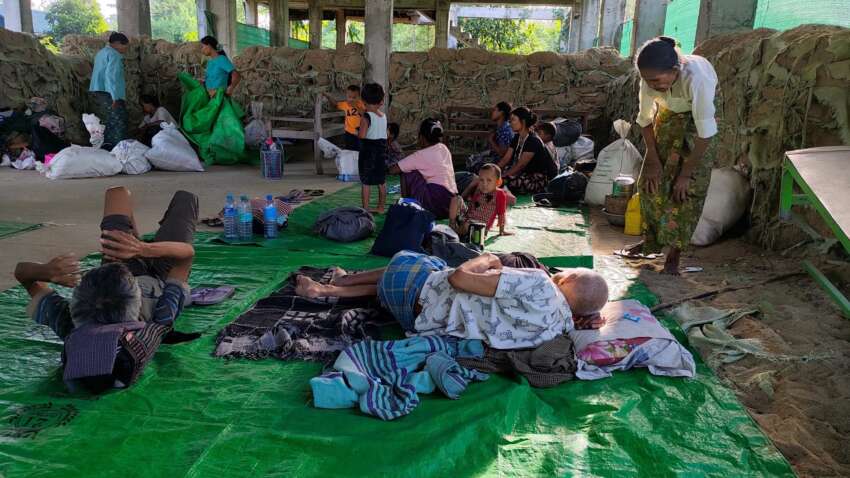
Over 10,000 people displaced as military launches fresh column in Pauk Township, with urgent need for food supplies
Yangon, July 2 Over 10,000 people have been forced to flee their homes as the terrorist military has launched a new column in Pauk Township, Magway Region, and there is an urgent need for food supplies, according to a st
Yangon, July 2 Over 10,000 people have been forced to flee their homes as the terrorist military has launched a new column in Pauk Township, Magway Region, and there is an urgent need for food supplies, according to a statement from the Pauk Township Humanitarian Aid Department and remarks from an official of the Pauk Township People's Security Force. It is known that on June 30, a column of about 500 soldiers from the 101st Division in Pakokku entered Pauk Township for a sweep operation, and as a result, residents from 16 villages in the northeastern part of Pauk Township are now fleeing their homes en masse. It is understood that due to this military column, 10,171 residents have temporarily fled to nearby villages and forests, and food is urgently needed for the displaced people. Currently, the terrorist military column is located around Tin Ngote Pin village and Ngaung Ye Te village in Pauk Township, and it has not yet been confirmed where it will proceed next. "We have not heard of any arrests of civilians by the military column. So far, it is mostly the people who are fleeing first. We are continuing to monitor where the military column will proceed next," an official from the Pauk Township People's Security Force told Yangon Khit Thit Media. It is known that this military column killed U Win Shwe, 61, from Saseik village, U Myint U, 56, from Nanseegan village, Ko Kyaw Lwin, 40, who suffers from mental illness, from Myeyint village, Ko Ne Zaw, 32, from Mitthelay village, and Ko Min Min U, 33, from Mitthelay village, during its sweep operation in Myaing Township.
多角的分析
直接の経済ニュースではありませんが、治安と司法の信頼は地域経済の土台です。職場での暴力や未成年者保護への不安が強まると、夜間営業、観光、雇用、地域サービス業のリスク認識が高まります。
投資家目線では、個別事件よりも法執行の予見可能性が焦点です。加害者への対応が曖昧になれば、ローカルビジネスの統治リスクや従業員保護の弱さとして評価されやすくなります。
マッウィー州で問われるのは、加害者個人だけでなく、雇用主、警察、近隣社会が被害のサインをどう扱ったかです。軍が声を上げたことで、事件は噂話ではなく、記録され検証される公共問題に変わります。
市民にとっては、自分や家族が被害に遭った時に公正な手続きへアクセスできるのかが最大の関心です。地域団体が声を上げることで、事件の風化を防ぎ、被害者側の孤立を和らげる意味があります。
背景・歴史的文脈
このニュースは、ミャンマーの地域社会で法の支配と弱者保護がどこまで機能しているかを映す事案です。暴力事件そのものに加え、女性団体や市民社会が司法手続きを求めて声を上げている点が重要です。軍政下では警察・司法への信頼が揺らぎやすく、個別事件が地域の不安や統治への不信に直結します。
原文ソース
Khit Thit Media