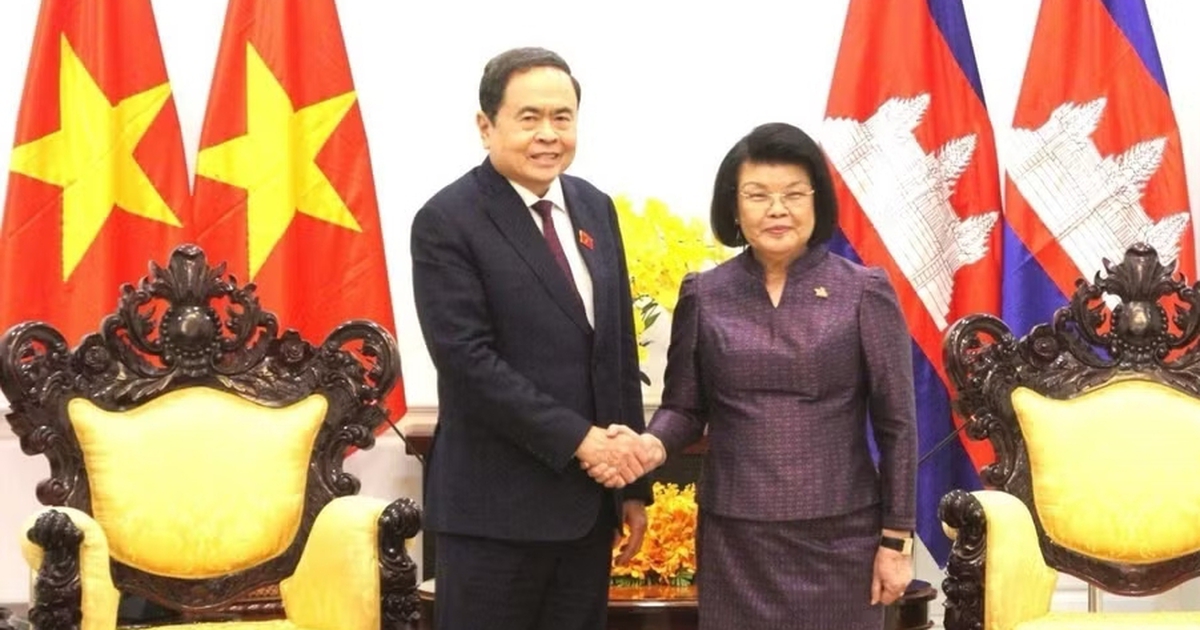
Cambodian National Assembly President to Visit Viet Nam, Deepening Ties Through Parliamentary Diplomacy
Diplomacy
2026年7月27日
5
Bao Chinh Phu
Relations
🇻🇳Vietnam🇰🇭Cambodia🌐United Nations / ASEAN

General articles are free for 24 hours after publish.

Cambodian National Assembly President to Visit Viet Nam, Deepening Ties Through Parliamentary Diplomacy

Share
AI Summary

The President of the Cambodian National Assembly will make an official visit to Viet Nam, a move underscoring the deepening comprehensive cooperation between the two nations through parliamentary diplomacy, with expectations for enhanced trade, investment, and regional stability.

The President of the Cambodian National Assembly is scheduled to pay an official visit to Viet Nam, a move that highlights the deepening comprehensive cooperation between the two nations through parliamentary diplomacy. This visit comes as Viet Nam and Cambodia continue to strengthen their ties across Party, State, Government, and parliamentary channels. Following parliamentary cooperation agreements signed in 2007 and renewed in 2022, the legislative bodies of both countries have expanded collaboration in lawmaking, parliamentary oversight, and institutional development. Exchanges between parliamentarians have also been enhanced, with joint efforts to improve legal frameworks supporting trade, investment, and socio-economic development. The two National Assemblies have closely coordinated the implementation of bilateral agreements, aiming to create more favorable conditions for businesses, investors, and citizens of both nations. According to the Vietnamese Ambassador to Cambodia, the visit reflects the shared determination to further consolidate political trust and enhance practical cooperation between their legislative bodies. Amid evolving regional and global developments, strong political trust serves as the foundation for expanding cooperation into emerging areas such as digital transformation, infrastructure connectivity, logistics, education, tourism, and people-to-people exchanges. The official visit is expected to further deepen parliamentary cooperation, contributing to a more substantive and effective Viet Nam–Cambodia partnership for peace, stability, and sustainable development in the region. Economically, Cambodia is Viet Nam's largest trading partner within ASEAN, while Viet Nam is Cambodia's third-largest trading partner globally. Two-way trade reached approximately US$11.3 billion in 2025. In the first half of 2026, bilateral trade exceeded US$6.86 billion, a year-on-year increase of 10.3 percent. Both countries are working towards a goal of raising bilateral trade turnover to US$20 billion. Investment cooperation has also maintained positive momentum. Viet Nam has 229 valid investment projects in Cambodia with a total registered capital of nearly US$3 billion, making it one of Cambodia's top foreign investors. Major Vietnamese enterprises like Metfone, THACO AGRI, and Angkor Milk have significantly contributed to Cambodia's socio-economic development through projects in telecommunications, agriculture, and food production. People-to-people exchanges remain a crucial pillar of bilateral relations. In 2025, Viet Nam was Cambodia's largest source of international visitors, with around 1.22 million Vietnamese tourists visiting the neighboring country. During the same period, Viet Nam welcomed nearly 700,000 Cambodian visitors. Cooperation has also expanded in education, transport, healthcare, telecommunications, and cultural exchanges. Notably, the Viet Nam Cultural Week held in Cambodia in June 2026 helped promote mutual understanding and friendship, particularly among younger generations. Defense and security cooperation is a key pillar, with close coordination in combating transnational crime, cybercrime, drug trafficking, human trafficking, and online fraud, while working together to safeguard peace and stability along their shared border. Multilaterally, Viet Nam and Cambodia continue to coordinate closely within ASEAN, the UN, and Mekong subregional cooperation mechanisms, contributing to regional peace and stability.

0

Original source

Bao Chinh Phu

原文を読む