General articles are free for 24 hours after publish.
Hanoi Railway Hub Functions Proposed for Relocation to Outskirts
The Vietnam Railway Administration has proposed relocating the main passenger railway terminal functions in Hanoi to Ngoc Hoi and Gia Lam, and cargo functions to Yen Thuong and Thuong Tin. This aims to reorganize the capital's transportation space and improve railway transport efficiency.
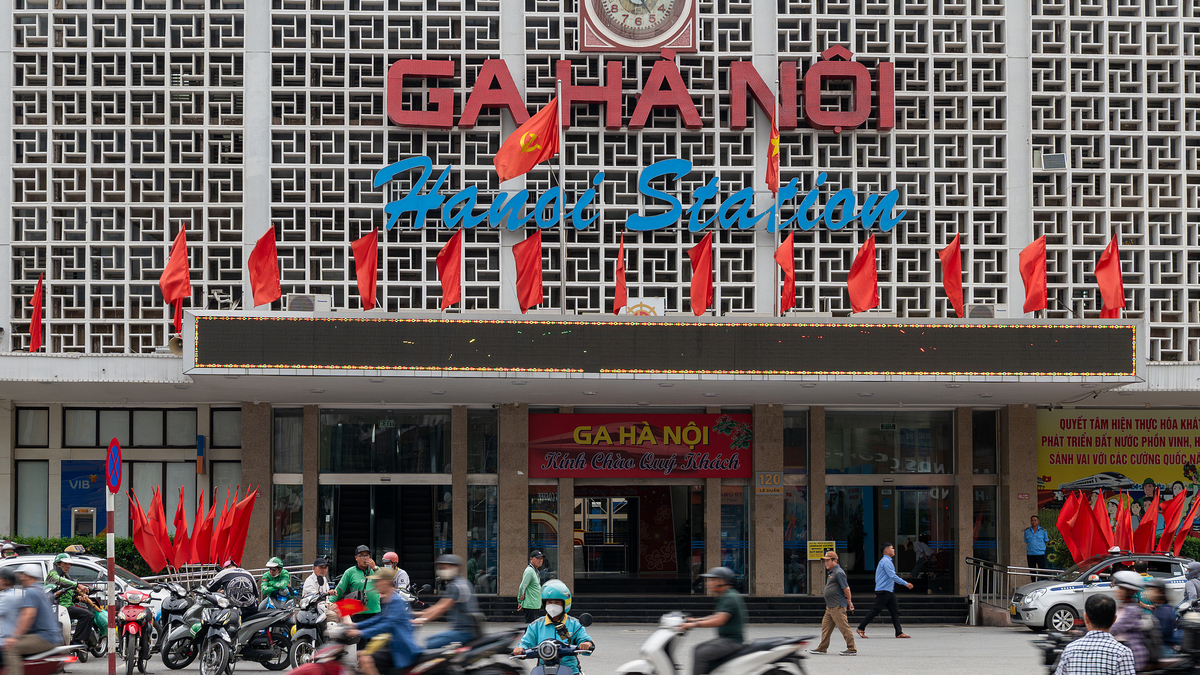
The Vietnam Railway Administration has proposed to the Ministry of Construction a plan to reorganize the functions of railway terminals in Hanoi. A key element of this proposal is the relocation of the functions of the current national passenger railway hub from Hanoi Station to Ngoc Hoi and Gia Lam stations, and the cargo hub functions to Yen Thuong and Thuong Tin stations. According to the proposal, the North-South railway line within the study area from Hanoi Station to Phu Ly, approximately 56 km long and currently a single 1,000 mm gauge track, will be converted to urban railway after the Eastern Ring Line is operational. The section from Ngoc Hoi to Phu Xuyen, about 26.5 km, will be rerouted along the corridor of the North-South high-speed railway. In the list of central and main stations, Hanoi Station, Giap Bat Station, and Long Bien Station are no longer proposed as such. Instead, the national passenger hub functions will be located at Ngoc Hoi and Gia Lam. Passengers arriving in Hanoi will be received and dispatched at Gia Lam and Ngoc Hoi. Passengers traveling between northern and southern provinces will transfer via the Eastern Ring Line and at these two stations. For cargo, the loading and unloading hubs will be located at Thuong Tin and Yen Thuong. Cargo flows between the northern and southern areas north of the Red River will be organized for transfer via the Eastern Ring Line and the new cargo hubs. This adjustment will significantly change how railway transport is organized in Hanoi and will open up possibilities for restructuring the capital's transportation space towards moving major hubs out of the center. To prepare the replacement infrastructure, the Hanoi People's Committee has proposed to the Ministry of Construction and the Ministry of Finance to allocate approximately VND 9.453 trillion (USD 380 million) from the 2026 capital plan. This funding will be used for investment preparation, site clearance, and initial implementation of two national railway projects managed by Hanoi. Hanoi will undertake two railway projects with a preliminary total investment of VND 40.171 trillion (USD 1.6 billion), proposed to be allocated from the central budget. The first project involves improving and rerouting the existing Hanoi-Ho Chi Minh City railway section from Phu Xuyen to Ngoc Hoi, approximately 26.5 km long, along with about 3 km of connection from Ngoc Hoi to the Bac Hong-Van Dien ring line. The line will be a single 1,000 mm gauge track, using diesel traction, and will include three new stations: Ngoc Hoi, Thuong Tin, and Phu Xuyen. The project also includes the construction of a carriage workshop, a locomotive workshop, and the National Railway Operations Control Center, which will be relocated from Hanoi Station to the new Thuong Tin Station. The preliminary total investment for this project is about VND 12.419 trillion (USD 500 million), with completion expected by March 31, 2027. The second project is the Eastern Ring Line national railway from Ngoc Hoi to Kim Son, passing through Hanoi, Hung Yen, and Bac Ninh. The main line from Thuong Tin to Kim Son is approximately 31.3 km long. According to Hanoi's proposal, this line will be a double-track, 1,435 mm gauge, electrified line, with a preliminary total investment of about VND 27.752 trillion (USD 1.1 billion), expected to be completed in December 2028. Currently, Hanoi Station handles about 86 passenger and freight train services daily, with a transport volume of about 3 million passengers and 2.9 million tons of goods per year. During peak periods like Tet and summer, the number of passengers can reach nearly 20,000 per day. In the existing system, Hanoi Station serves as the passenger hub, performing functions such as disassembling and assembling passenger trains, inspecting and repairing locomotives, and housing the National Railway Operations Control Center. Gia Lam Station serves as the northern passenger hub, handling national and international passenger trains. Meanwhile, Giap Bat and Yen Vien stations handle cargo functions for the south and north, respectively, carrying out disassembly and assembly of freight trains, and inspection and repair of locomotives and carriages. Yen Vien also handles international freight functions. Therefore, the handover and conversion of existing lines and stations not only involve the tracks but also require the rearrangement of the entire system for operations, control, and vehicle maintenance. Source: VnExpress
Original source
VnExpress