General articles are free for 24 hours after publish.
25,000-Year-Old Sulawesi Hunter-Gatherers May Have Used Betel Nut to Relieve Toothache
Skeletal remains from Sulawesi, Indonesia, dating back 25,000 years reveal habitual betel nut consumption. This marks the earliest evidence of betel nut used as a painkiller, suggesting ancient inhabitants sought relief from toothaches.
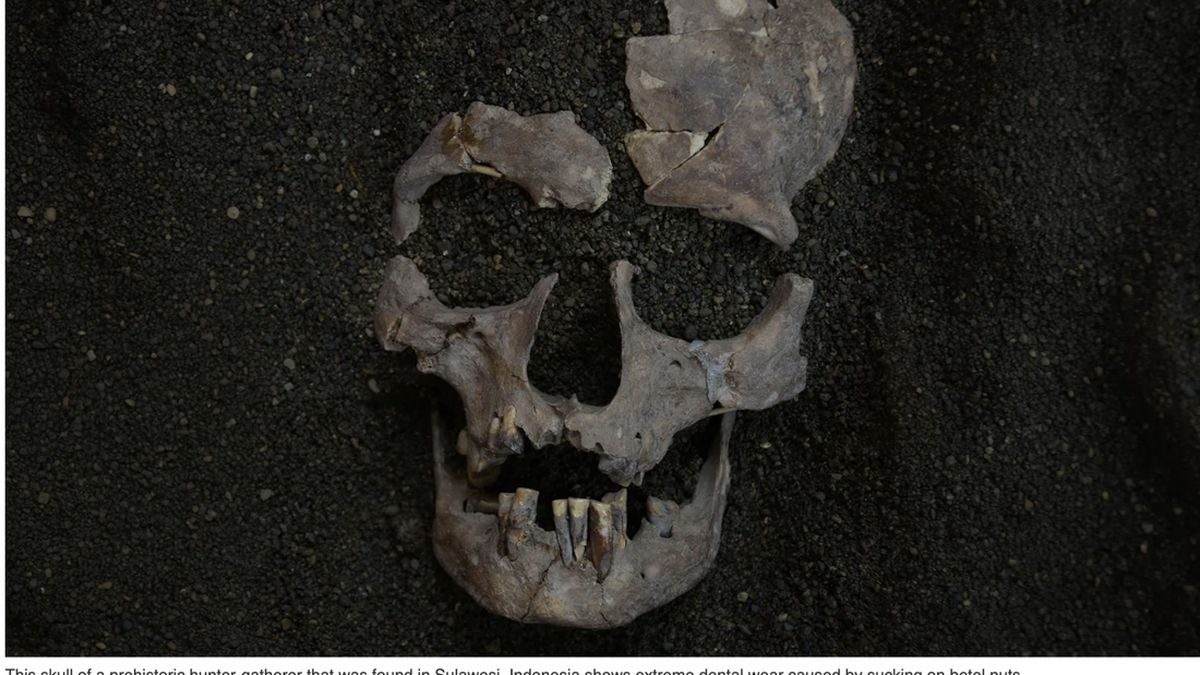
Skeletal remains of two hunter-gatherers from Sulawesi, Indonesia, indicate a habit of sucking whole betel nuts, suggesting this practice was used to relieve toothache as early as 25,000 years ago. This finding pushes back the estimated use of betel nut as medicine beyond the early Neolithic or Bronze Age, around 3,500 years ago. Researchers noted in the journal Science Advances, "With the oldest food gatherers dating from 25,000 to 16,000 years ago, our findings indicate that the use of betel nut as medicine has much older origins than previously thought." The study was conducted by Professor Adam Brumm from Griffith University in collaboration with Indonesian archaeologists from Hasanuddin University (Unhas) and the National Research and Innovation Agency (BRIN). While modern betel nut chewing involves mixing Areca catechu seeds with slaked lime, researchers found that these ancient hunter-gatherers consumed whole betel nuts. The findings come from the analysis of two ancient hunter-gatherer skeletons. One, named Maros-LBB-1a (25,000-16,000 years ago), was excavated from Late Pleistocene deposits at Leang Bulu Bettue. The other, CPL-R2a (7,600-6,300 years ago), was unearthed from the Holocene site of Leang Cappalombo 1 and is believed to be associated with the Toalean gatherer culture, predating the Neolithic era in South Sulawesi. Biochemical analysis revealed arecoline in the dental tissues of both individuals, providing strong evidence of betel nut consumption. Arecoline is the primary psychoactive alkaloid in betel nuts, released when the nut interacts with saliva in the mouth. It acts as a natural pain reliever. Given that the hunter-gatherers generally had poor dental health, researchers hypothesize that relieving toothache was a primary reason for their betel nut sucking habit. Conversely, this habit led to significant tooth wear. Both individuals exhibited unusual wear patterns with deep, rounded grooves and cavities. The wear on the teeth of Maros-LBB-1a and CPL-R2a is consistent with the long-term habit of sucking whole, peeled betel nuts, possibly smaller varieties like Areca triandra, native to South Sulawesi. Professor Adam Brumm, lead author from the Australian Research Centre for Human Evolution (ARCHE) at Griffith University, stated, "Over time, sucking these hard and abrasive seeds wore down the food gatherers’ teeth so severely that, in some cases, the inner pulp chamber became completely exposed." The tooth pulp, containing nerves and blood vessels, can cause severe pain, difficulty eating, and increased risk of chronic infection if exposed. Researchers suggest the hunter-gatherers may have been trapped in a cycle of relieving toothache, which in turn worsened their dental damage, leading to stronger reliance on betel nut. Betel nut, though less known in Western societies, is considered the fourth most popular psychoactive substance globally, after alcohol, caffeine, and nicotine. Information Source: Detik
Original source
Detik