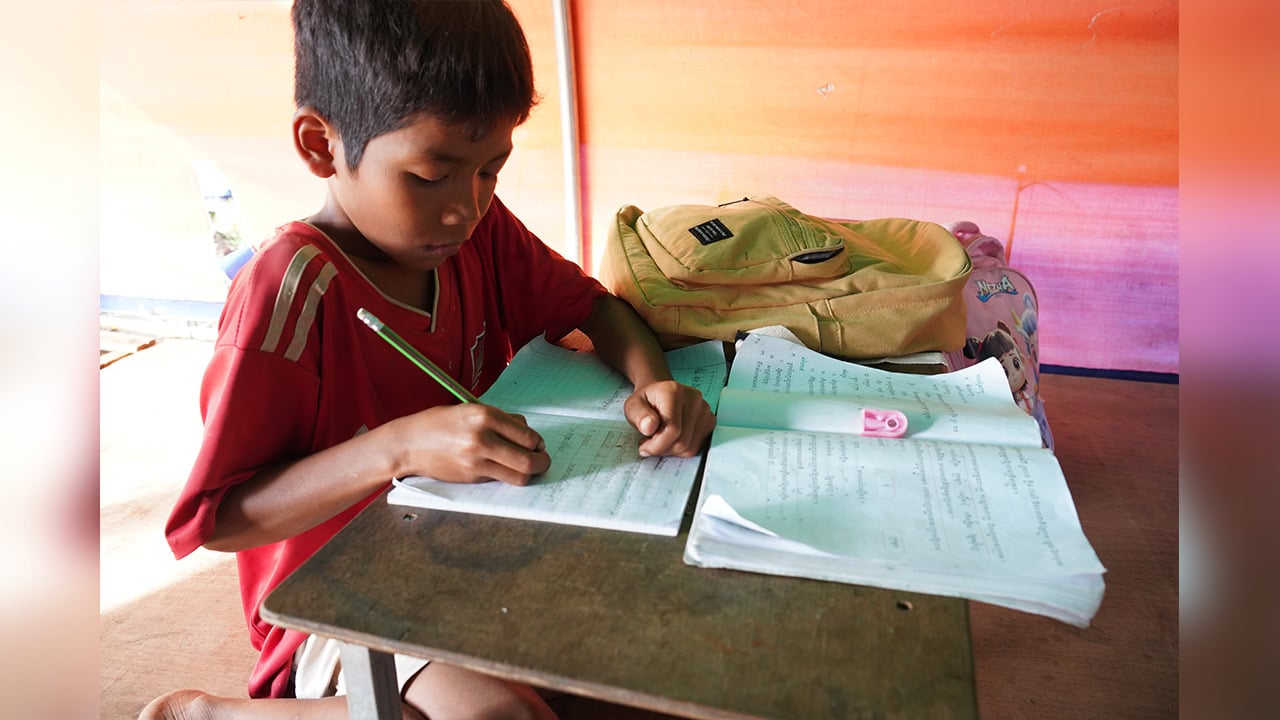
Displaced child's dream: 'I just want to go home as soon as possible'
A young boy displaced by conflict along the Cambodia-Thailand border expresses a strong desire to return home soon. Despite continuing his education, he deeply misses his lost home, land, and livestock.
Third-grader Mach Raksmey, displaced by fighting along the Cambodia-Thailand border, holds a strong wish to return home as soon as possible, even while attending classes three times a day at his current sanctuary. For Raksmey, going home means returning to his familiar school, seeing his family's land again, and resuming the ordinary life of studying, farming, and raising chickens and ducks. He has been unable to return to his house, school, farmland, or relatives for months. "I miss my home and my school, and I miss my uncles and aunts there. I haven’t seen them for a long time," he said. While acknowledging opportunities to study, Raksmey noted what is missing is his home and the life he once had there. "Here, I can study, but I can't do anything else. I just stay here. I can't grow any crops," he said. "Back there, we have our home. We can live at home, grow crops and raise chickens and ducks." He wants to resume his studies at his old school while living with his family on the land where they once farmed and raised animals. If allowed to return, he stated, "I want to raise chickens and ducks, grow crops and study." Before displacement, Raksmey’s family lived in a wooden house. Around their home, they grew crops and kept a dog, chickens, and ducks. He still thinks about the animals he helped care for, but after so long away, he doesn't know their fate. "I don’t know where they have all gone. I haven’t been back for so long. I don’t even know if they are all alive," Crops planted before the family fled, expected to be harvested within a month, were lost due to the fighting. "We worked hard to grow the crops there, thinking that in another month we would have food to eat. But before even one month had passed, everything was gone," His father returned to check on their home and land. The chickens were gone, and crops destroyed. "I feel sorry for my crops and the chickens I raised. Now they are all gone. My father went back to look and everything was gone. The crops were destroyed and dead," The family’s wooden home was also damaged and partly burned, with timber broken and belongings destroyed by fire. The memory of fleeing remains vivid, with Raksmey recalling sounds of shooting. "When we left, there was shooting – boom, boom, boom," he said, admitting, "I was scared." Beyond fear, Raksmey feels anger and sadness about not being able to return home. In his understanding, Thai forces have surrounded the area, preventing their return. "I’m angry. My home is surrounded like that every day. Sometimes I want to cry." His plea to the Thai side is simple: "Please don’t take my home anymore." For Raksmey, the losses are tangible: lost land, home, crops, chickens, and money. "They have taken everything at home," he said. "Our crops and our land are there. Now it is all gone. Where else do we have land? That was the only land we have." What he misses most are the places where he lived and studied. "I want to go home so I can see my school and see my land. I haven’t seen my land for a long time." He doesn't know when his family will be allowed back. "I still don’t know. They still haven’t allowed us to go back." As he waits, Raksmey continues to study, seeing education as part of his hope for returning and rebuilding. "I have to study hard and take my knowledge back to rebuild the place." His wish is uncomplicated: to return home, continue his education, and live again on his family’s land, helping grow crops and raise animals in his free time. "I want to go home as soon as possible," Information source: Phnom Penh Post
多角的分析
国境地帯での紛争は、農作物の損失や家畜の消失といった直接的な経済的打撃に加え、住民の避難による労働力の喪失、そして将来的な農業生産への影響という形で地域経済に深刻な影響を与えている。ラクスメイ君の家族も、収穫目前の作物と家畜を失い、生計の基盤を失った。これは、カンボジアの農村部における脆弱な経済構造を浮き彫りにしている。
国境地帯での治安悪化と紛争は、投資家にとって直接的なリスク要因となる。土地の所有権や財産保護への懸念が生じ、インフラ開発や農業投資などの長期的なプロジェクトの実行が困難になる。特に、紛争が長期化すれば、地域への新規投資は停滞し、既存投資も回収の見通しが立たなくなる可能性がある。
ラクスメイ君の物語は、国境紛争が子供たちの日常生活と未来に与える壊滅的な影響を示している。教育機会の継続は希望の光であるが、故郷、家族、そして慣れ親しんだ環境を失った心の傷は深い。避難生活における子供たちの心理的ケアや、紛争終結後の生活再建支援が喫緊の課題となる。また、タイ軍による土地の包囲という認識は、両国間の緊張関係が地域住民の生活に直接的な不安をもたらしていることを示唆している。
ラクスメイ君のような子供たちが、紛争によって故郷や生活基盤を奪われ、教育の継続さえも不安視される状況は、カンボジア国民全体にとって深刻な問題である。特に農村部では、土地や家畜は単なる財産ではなく、生活そのものを支える基盤であり、それらを失うことは生活の破綻を意味する。早期の紛争解決と、避難民の安全な帰還、そして生活再建への支援が強く求められている。
背景・歴史的文脈
カンボジアとタイの国境線は、長年にわたり両国間の懸案事項の一つであり、特にプノンペンとバンコクの関係が悪化した際には、国境紛争が頻繁に発生してきた。2008年のプレア・ビヒア寺院周辺での紛争や、その後の小規模な衝突は、両国間の緊張を高め、国境地帯の住民生活に影響を与えてきた。今回のラクスメイ君の証言は、こうした歴史的な緊張関係が、現在も国境地帯の住民、特に子供たちの生活に直接的な困難をもたらしていることを示している。タイ軍による土地の包囲という認識は、領土問題や国境管理を巡る両国の複雑な力学を反映している可能性がある。
原文ソース
Phnom Penh Post