Handwriting Expert Mike Maran Delves into Psychology and Forgery Detection in Pattaya
Security
2026年7月10日
7
Pattaya Mail

Handwriting Expert Mike Maran Delves into Psychology and Forgery Detection in Pattaya

AI サマリー

Forensic handwriting expert Mike Maran presented at the Pattaya City Expats Club, explaining graphology and document examination. He demonstrated how handwriting can reveal personality traits and detailed scientific methods for detecting forged documents, engaging the audience.

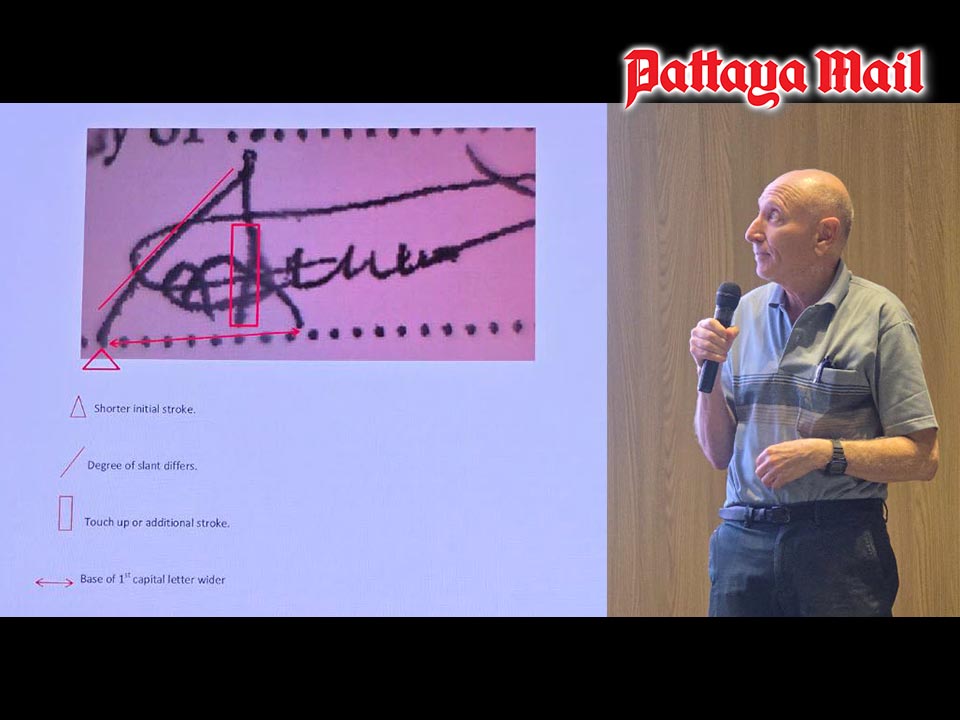
PATTAYA, Thailand – Forensic handwriting expert Mike Maran returned to the Pattaya City Expats Club on Wednesday, July 1, for a presentation that blended audience participation, personality-based graphology, and the more exacting discipline of forensic document examination. Maran opened his presentation by challenging the audience to think of handwriting as “brain writing,” explaining that it is not simply a product of pen and paper but a reflection of habits formed in the brain. He emphasized that no two people write exactly alike, and even one person’s signature naturally changes from one signing to the next. The first part of the presentation introduced members to graphology, the study of inferring character traits from handwriting. Maran outlined the features analysts observe, including letter size, slant, letter connections, upper and lower letter zones, margins, spacing, baselines, T-bars, I-dots, and signatures. He suggested that small handwriting may indicate concentration or introversion, while large writing may point to someone who enjoys attention. Rounded letter connections might suggest an easier-going nature, while angular writing can indicate tension or worry. One of the livelier portions of the morning came when Maran asked audience members to sign a sheet of paper, exchange it with a neighbor, and then respond by show of hands as he described signature features. He said a legible signature suggested a person who is genuine, honest, straightforward, and reliable. An illegible signature, by contrast, could suggest someone who avoids commitments or values their own time highly, although he cautioned that in some professions, an unreadable signature may simply be a time-saving habit. Maran repeatedly reminded the group that signatures should not be judged in isolation and should be compared with a person’s broader handwriting before drawing fuller conclusions. He also noted that factors such as age, health, emotional state, environment, writing instrument, and writing surface can influence how a signature appears. The second part of the talk turned to Maran’s main professional work: forensic document examination. He described cases involving disputed wills, financial fraud, altered checks, malicious notes, forged signatures, and documents that may have been cut and pasted or electronically manipulated. Many of these disputes, he noted, involve money, family conflict, or legal claims. Maran emphasized that original documents are far more useful than photocopies because important evidence can be lost in reproduction. Under a microscope, examiners can study pen pressure, line quality, rhythm, hesitation, touch-up strokes, and other microscopic details. A signature that appears convincing to the naked eye may reveal problems when magnified, especially if the signer consciously tried to imitate another person’s writing. Rather than offering opinions in percentages, Maran said forensic document examiners use a scale of probability ranging from inconclusive to identification. He said he is cautious about conclusions, particularly because reports may end up in court and must be defensible under cross-examination. The examiner’s responsibility, he stressed, is to remain neutral, even when hired by one side in a dispute. During the question-and-answer session, members asked about fountain pens versus ballpoint pens, the significance of initials, how alcohol or age can affect handwriting, and whether people commonly use different signatures for formal and informal purposes. Maran explained that context matters: the writing instrument, surface, pace of signing, and purpose of the document can all influence the result. By the end of the presentation, Maran had shown the audience that handwriting can be both a window into personality and a practical forensic tool. His central message was that while graphology can make handwriting entertaining and revealing, forensic document examination requires disciplined comparison, original evidence, and careful, impartial judgment. Following the presentations, MC Ren Lexander brought everyone up to date on upcoming Club events, followed by the Open Forum portion of the meeting where questions are asked and comments made about expat living in Thailand, especially Pattaya. To learn more about the PCEC, visit their website at https:/pcec.club. A video of the presentation will be uploaded to the PCEC’s YouTube Channel at https://www.youtube.com/@pcecclub6255/videos.

多角的分析

経済的影響

本件は直接的な経済活動とは関連しないが、筆跡鑑定という専門サービスは、金融詐欺や遺言の紛争といった経済的利害が絡む事案において重要な役割を果たす。偽造文書の検出は、不正な金銭移動を防ぎ、経済的損失を回避するために不可欠であり、法的な紛争解決においても経済的影響を左右する可能性がある。

投資家心理

投資家にとって、筆跡鑑定の専門知識は、詐欺的な投資スキームや偽造された企業文書のリスクを評価する上で間接的に役立つ可能性がある。特に、契約書や証券などの文書の真正性を確認する際に、専門家の知見が投資判断の精度を高める一助となり得る。ただし、本件自体が直接的な投資機会を提供するものではない。

社会的影響

筆跡心理学は、個人の性格や内面を理解するためのツールとして、人間関係や自己理解に役立つ。一方、筆跡・文書鑑定は、遺言や契約書などの重要な文書の真正性を保証することで、家族間の紛争や法的な権利侵害を防ぎ、社会的な安定に寄与する。パタヤという国際的なコミュニティにおいて、このような専門知識の共有は、 expats(外国人居住者)間の信頼関係構築やトラブル回避に貢献すると考えられる。

市民の声

市民にとって、筆跡鑑定の知識は、日常生活における様々な場面で役立つ可能性がある。例えば、契約書にサインする際や、重要な書類の真正性を確認する際に、偽造のリスクを認識し、注意を払うことができる。また、筆跡心理学を通じて、自分自身や他者の性格をより深く理解することにつながり、人間関係の円滑化に寄与する。

背景・歴史的文脈

筆跡鑑定の分野は、19世紀後半から20世紀初頭にかけて、科学的な手法が確立されていった。当初は、筆跡の類似性から同一人物の筆跡と断定することが主眼であったが、次第に文書の改ざんや偽造の検出へと応用範囲が広がった。特に、遺言書や契約書といった法的効力を持つ文書の真偽を巡る紛争が増加するにつれて、専門家への需要が高まった。マイク・マラン氏のような専門家は、長年の経験と科学的知識を基に、複雑化する偽造手口に対抗し、公正な判断を下す役割を担っている。パタヤのような外国人居住者が多い地域では、多様な背景を持つ人々間の文書のやり取りが増えるため、筆跡鑑定の重要性はより一層増していると考えられる。

原文ソース

Pattaya Mail

原文を読む