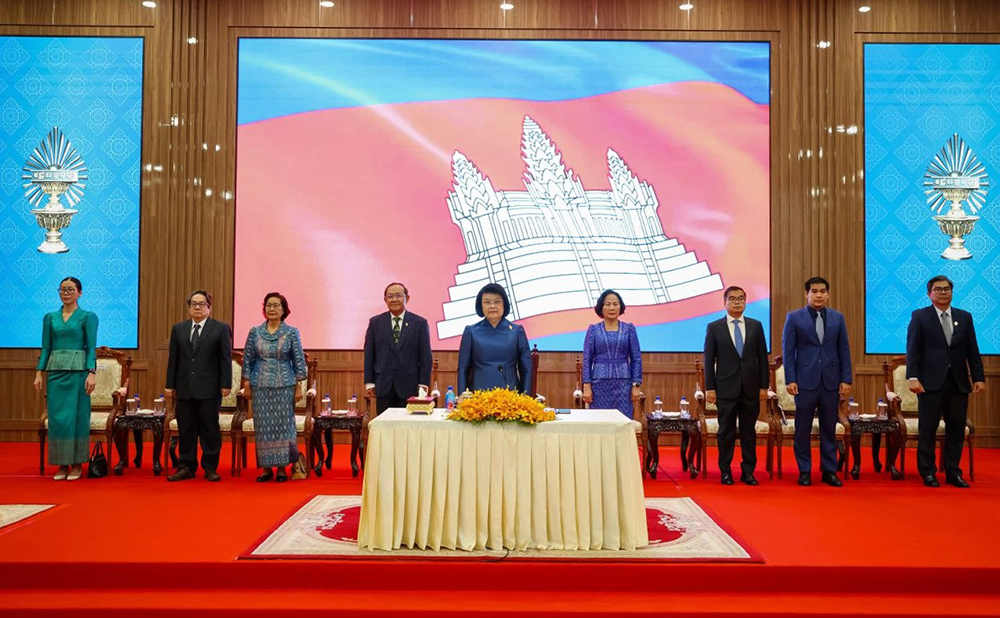
Cambodian National Assembly President Advises Leadership and Innovation Trainees, Pushing Administrative Reform
Cambodian National Assembly President Khuon Sodary advised 179 trainees in a leadership and innovation course on the importance of public service leadership and innovation to drive administrative reform. The training is part of the government's reform agenda to develop officials capable of navigating the digital age.
Khuon Sodary, President of the National Assembly of Cambodia, met and advised 179 trainees of the 8th session of the "Leadership and Innovation" training course at the School of Government on July 16, 2026, at the National Assembly building. The course aims to enhance leadership and innovation among public officials. The training program, which runs for eight weeks, is designed for officials in leadership and management positions within ministries, institutions, and sub-national administrations. It seeks to contribute to the implementation of the government's Public Administration Reform Action Plan (2024-2028) by developing the capacities of officials in leadership and innovation, enabling them to effectively lead and manage their units in response to globalization and digital transformation. This aligns with the directives of the "Pentagon Strategy - Phase 1" under the leadership of Prime Minister Hun Manet. Lok Oknha Yoeuk Bunna, Secretary of State of the Ministry of Public Function and Director of the School of Government, representing Deputy Prime Minister Hun Many, Minister of Public Function and Chairman of the School of Government Council, highlighted the program's objective to support the reform plan through capacity building. He emphasized that the "Leadership and Innovation" program has become an effective mechanism for cultivating leadership and innovation among senior officials, who are crucial drivers for implementing government reforms. President Khuon Sodary expressed her delight in welcoming the trainees and commended the Ministry of Public Function for its initiative in organizing this training. She noted that the 8th session has refined its content to be more realistic, focusing on human resource management, leadership, change management, and fostering a cooperative and highly efficient work environment. During the session, President Sodary shared her personal work experiences and discussed the global and national situations, as well as the role and structure of the National Assembly under the 7th legislature. She highlighted the Assembly's efforts in strengthening governance, deep reform, and institutional modernization. She also referenced former Prime Minister Hun Sen as a "global model leader" and shared his valuable principles for public servants, emphasizing the importance of serving the people, not acting as their masters, and eliminating ego. She stressed the need for officials to be exemplary, to serve as true servants of the people, and to reduce self-importance. Regarding the economic outlook, President Sodary projected Cambodia's economy to grow by 5.3% in 2025 and 4.2% in 2026, citing the impact of rising fuel prices due to the Middle East conflict. For the medium term (2027-2029), the economy is expected to recover gradually between 5% and 5.5%, driven by robust growth in industry and agriculture, and the revival of the tourism sector following the government's success in combating online scams, which has helped restore confidence among tourists and investors. Furthermore, President Sodary addressed the promotion of women's value in Cambodian society, noting that gender equality, championed by Hun Sen and continued by Hun Manet, enhances institutional effectiveness by bringing diverse perspectives and leading to more humane and sustainable policies. Lok Oknha Yoeuk Bunna expressed his profound gratitude to the President of the National Assembly for dedicating her valuable time. The trainees conveyed their joy and readiness to apply the experiences and advice shared by President Sodary, who has served the nation for over 40 years, to enhance their work efficiency. Source: AKP Khmer
多角的分析
カンボジア経済は、世界的なインフレ圧力や地政学的リスクの影響を受けつつも、政府の改革努力と国内需要の回復により、中長期的な成長軌道を維持すると見られている。特に、観光業の回復は、デジタル詐欺対策の成功という新たな要因によって後押しされる可能性があり、これはカンボジアの国際的な信頼回復に向けた重要な一歩となるだろう。しかし、燃料価格の変動や、グローバルサプライチェーンの不安定さは、依然としてリスク要因として残る。政府は、これらの外部要因への対応能力を高め、内需主導型の成長モデルを強化していく必要がある。
今回の指導者研修は、カンボジアの行政能力強化と改革推進への強い意志を示すものだ。投資家にとって、これは政府の長期的なビジョンへの信頼を高める要因となり得る。特に、デジタル化やグローバル化に対応できる人材育成に注力している点は、将来的なビジネス環境の改善につながる可能性がある。ただし、経済成長率の予測には、中東情勢のような外部要因による不確実性が含まれているため、投資判断においては、これらのリスクを慎重に評価する必要がある。また、観光業の回復は、関連産業への投資機会を創出する可能性がある。
指導力と革新をテーマとした研修は、カンボジアの官僚機構が、変化の激しい現代社会に対応するための能力向上を目指していることを示唆している。受講者には、国レベルから地方レベルまでの指導的立場にある人々が含まれており、研修で得た知識やスキルが、公共サービス提供の質向上に直接つながることが期待される。また、女性の指導的役割の推進に言及されたことは、ジェンダー平等の観点からも重要である。これにより、より多様な視点からの政策立案が可能となり、国民生活の向上に寄与することが期待される。
今回の研修は、国民が直接的に恩恵を受ける公共サービスの質向上に繋がる可能性がある。指導的立場にある官僚が、より効果的で革新的なリーダーシップを発揮できるようになることで、行政手続きの効率化や、国民のニーズにより迅速かつ的確に応える体制が期待できる。特に、デジタル化への対応は、行政サービスの利便性を高める上で重要である。また、フン・セン元首相の教えに触れられた「国民に奉仕する」という公務員の基本姿勢は、国民の信頼を得る上で不可欠であり、今回の研修を通じて再認識されることが期待される。
背景・歴史的文脈
カンボジアは、長年にわたる内戦とポル・ポト政権下での混乱を経て、1990年代初頭から国家再建と民主化を進めてきた。その過程で、効率的で透明性の高い行政機構の構築は、経済発展と国民生活の向上にとって喫緊の課題となっている。2018年の総選挙後、フン・セン政権は「戦略五角形」政策を掲げ、経済成長、雇用創出、国内総生産(GDP)の向上、そして社会福祉の増進を目指している。現政権下では、特にデジタル化の推進と行政改革が重視されており、今回の研修はその一環として位置づけられる。フン・マネット首相は、若手リーダーとして、これらの改革を加速させる役割を担っている。
原文ソース
AKP Khmer