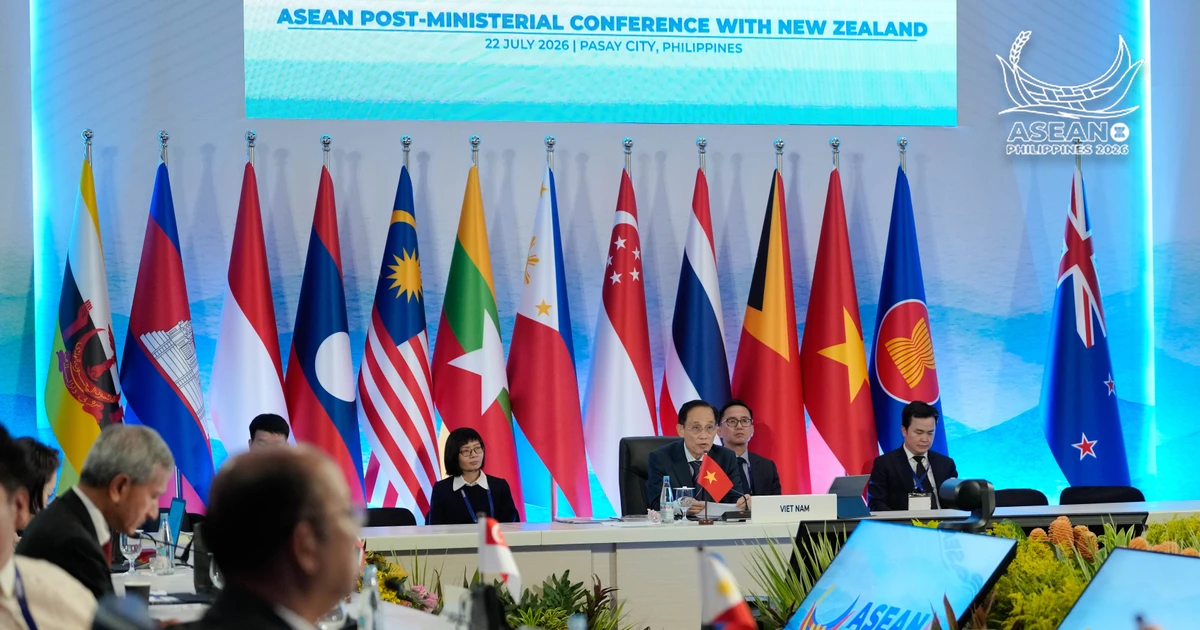
Vietnam Co-chairs ASEAN-New Zealand Conference, Pushes Regional Cooperation
Diplomacy
2026年7月22日
5
VietnamPlus English
Relations
🇻🇳Vietnam🇨🇳China🇯🇵Japan🇺🇸United States🇮🇳India🌐United Nations / ASEAN

General articles are free for 24 hours after publish.

Vietnam Co-chairs ASEAN-New Zealand Conference, Pushes Regional Cooperation

Share
AI Summary

Vietnam's Foreign Minister advocated for strengthened partnerships with China, the US, India, and Japan at an ASEAN conference, emphasizing expanded cooperation in digital economy and AI, and seeking India's support on the East Sea issue. Domestically, the Party Central Committee discussed social development and national security strategy.

Vietnam co-chaired the ASEAN-New Zealand Post-Ministerial Conference, a key event that underscored its commitment to bolstering regional cooperation and strengthening strategic partnerships within Southeast Asia and beyond. Minister of Foreign Affairs Le Hoai Trung, in his remarks, characterized the ASEAN-China relationship as one of the most dynamic and comprehensive partnerships. He emphasized the critical importance of effectively implementing the 2026-2030 Plan of Action to enhance the quality and strategic value of bilateral cooperation. This statement reflects Vietnam's nuanced approach to its relationship with China, prioritizing economic engagement while maintaining strategic autonomy. Furthermore, Trung proposed that ASEAN and the United States collaborate to promote trade and investment in an open, transparent, and mutually beneficial manner. He advocated for expanding joint initiatives in emerging fields such as the digital economy, artificial intelligence (AI), semiconductors, science and technology, innovation, energy transition, and regional energy connectivity. This forward-looking proposal highlights Vietnam's ambition to leverage cutting-edge technologies and international collaboration to drive its economic development. In its engagement with India, Vietnam proposed exploring the establishment of an ASEAN-India maritime dialogue mechanism. Minister Trung also urged India to continue its support for ASEAN's principled position on the East Sea issue. This appeal underscores Vietnam's concerns regarding regional security in the South China Sea and its preference for diplomatic solutions. With Japan, National Assembly Chairman Tran Thanh Man reaffirmed Vietnam's consistent view of Japan as one of its most important and long-term strategic partners. Both nations agreed to intensify their cooperation, focusing on realizing agreements that bolster economic connectivity, economic security, and sci-tech collaboration. Concrete joint projects in digital transformation, green transition, innovation, semiconductors, and AI were prioritized, signaling Vietnam's strategic intent to upgrade its industrial and technological capabilities with Japanese assistance. Domestically, the 14th Party Central Committee convened on July 22. Delegates deliberated on proposals concerning the construction of a disciplined, safe, civilized, harmonious, and development-oriented society. They also discussed the formulation of a national security strategy and the potential establishment of Quang Ninh and Bac Ninh as centrally-governed cities. These internal discussions illustrate the Vietnamese Communist Party's continued focus on consolidating social order and enhancing national security to ensure sustained development. Vietnam also acknowledged Canada as an important partner in its foreign policy, welcoming the positive and comprehensive progress in bilateral relations. This diplomatic engagement with diverse nations is a key element of Vietnam's strategy to strengthen its international position and foster a stable external environment for its continued growth. Source: VietnamPlus English

0

Original source

VietnamPlus English

原文を読む