Massive Whale Graveyard Found 7,000 Meters Deep in Indian Ocean, Dating Back 5 Million Years
Diplomacy
2026年6月29日
4
Mongabay Indonesia

Massive Whale Graveyard Found 7,000 Meters Deep in Indian Ocean, Dating Back 5 Million Years

AI サマリー

A massive whale graveyard, stretching 1,200 kilometers across the seabed at depths exceeding 7,000 meters, has been discovered in the southeastern Indian Ocean. Scientists suggest this site may have served as a 'necropolis' for whales for the past five million years.

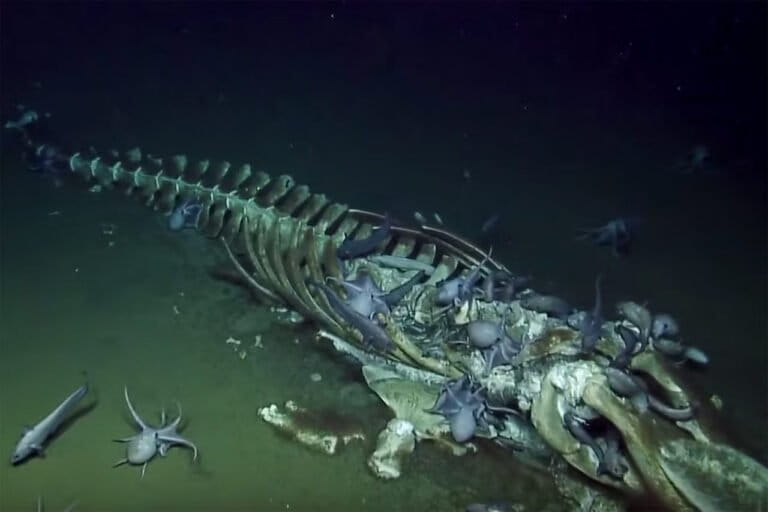
Scientists have announced the discovery of the largest and deepest whale graveyard ever recorded, located in a submarine valley in the southeastern Indian Ocean. Hundreds of whale carcasses and fossils were found spread across approximately 1,200 kilometers of the seabed at depths exceeding 7,000 meters. The findings were published on June 10, 2026, in the journal Nature. The site, known as the Diamantina Fracture Zone, was first surveyed in early 2023 using a manned submersible. The research team conducted 32 dives and discovered 476 whale carcasses and fossils, including five individuals that had recently died. Although the surveyed area was only about 0.065 square kilometers, researchers estimate that the density of whale remains at this location could reach up to 2,000 individuals per square kilometer, making it the largest known cetacean necropolis. Fossilized skulls of various beaked whale species were found in the Diamantina Fracture Zone. Among them are two species still alive today, Mesoplodon bowdoini and Mesoplodon layardii, as well as a newly described species, Pterocetus diamantinae. Fossils of Pterocetus benguelae, dating back 5.3 million years, and Izikoziphius rossi were also identified. The oldest fossil found belongs to Pterocetus benguelae, which lived around 5.3 million years ago, indicating that whale carcasses have been accumulating at this site since the early Pliocene epoch. The team also discovered fossilized skulls of the new species, named Pterocetus diamantinae, which researchers believe will help complete the understanding of the evolutionary history of beaked whales. While the exact reasons for such a large accumulation of whale carcasses at this specific deep-sea location are not yet fully understood, scientists speculate that unique deep-sea depositional environments and past oceanographic conditions may have played a role.

多角的分析

経済的影響

この発見は直接的な経済的影響をもたらすものではないが、古生物学的な価値は計り知れない。化石の発見は、将来的に学術研究や教育目的での観光、さらには関連する博物館や研究機関への投資を促進する可能性を秘めている。また、深海資源探査への関心を喚起する可能性もあるが、現時点ではその経済的インパクトは限定的である。

投資家心理

このニュースは、直接的な投資機会を提供するものではない。しかし、深海探査技術や古生物学分野の研究開発への関心を高める可能性はある。長期的な視点では、このような発見が新たな科学的知見や技術革新につながり、間接的に関連産業への投資を促すシナリオも考えられるが、現時点では投機的な要素が強い。

社会的影響

この発見は、クジラの進化史や生態系に関する人類の理解を深める貴重な機会を提供する。一方で、深海という極限環境における生命の営みや、過去の地球環境の変動について、一般市民の関心を喚起するきっかけとなるだろう。特に、海洋保護への意識を高める上で、このような壮大な自然の遺産は重要な意味を持つ。

市民の声

この発見は、ジャカルタ市民のような都市生活者にとっては、直接的な生活への影響はほとんどない。しかし、ニュースとして報じられることで、遠い海の深くに眠る生命の神秘に触れ、地球の歴史や自然への畏敬の念を抱く機会となるだろう。SNSなどを通じて、この発見に関する情報が共有され、議論が生まれる可能性もある。

背景・歴史的文脈

深海におけるクジラの遺骸の集積は、過去にもいくつかの事例が報告されている。これらは、クジラが死後に海底に沈降し、特定の海流や地形によって一箇所に集められる「クジラ墜とし(whale fall)」と呼ばれる現象が長期間にわたって続いた結果、形成されると考えられている。今回の発見場所であるディアマンティーナ・フラクチャー・ゾーンは、インド洋の深海に位置し、複雑な海底地形を持つことから、このような集積に適した環境であった可能性が高い。最古の化石が鮮新世(約530万年前)に遡ることは、この場所が長期にわたりクジラの死骸を受け入れてきたことを示唆している。

原文ソース

Mongabay Indonesia

原文を読む