General articles are free for 24 hours after publish.
Central Asia at an AI Alliance Crossroads
Central Asian nations, particularly Kazakhstan and Uzbekistan, face potential pressure to choose between two competing AI cooperation frameworks: the US-led Pax Silica and China-led WAICO. The US has warned members that dual membership in conflicting initiatives is effectively impossible, challenging the region's multi-vector foreign policy approach.
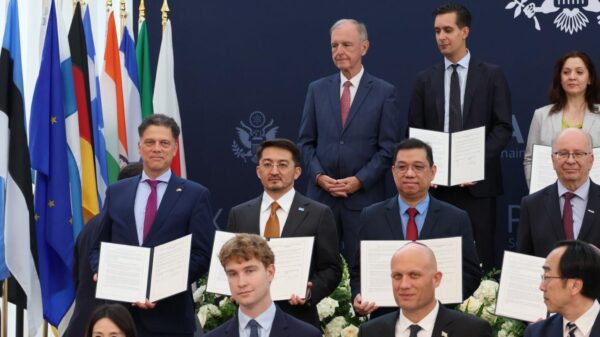
Central Asian nations are facing increasing pressure to choose sides between two major artificial intelligence (AI) cooperation frameworks: the US-led Pax Silica and China-led World Artificial Intelligence Cooperation Organization (WAICO). Kazakhstan, having joined both, finds itself in a unique and potentially precarious position. Kazakhstan officially joined Pax Silica, launched in December 2025, on June 27, 2026. This US-led initiative focuses on AI and supply chain security, aiming to advance economic security consensus among allies and trusted partners. Less than three weeks later, Kazakhstan became a founding member of WAICO, proposed by China and established in July 2026, alongside 28 other countries. WAICO positions itself as an international organization focused on AI governance. Reports suggest the US State Department intends to send a letter to Pax Silica signatories, warning that participation in conflicting initiatives means "being part of nothing." The draft letter reportedly states that signing the Pax Silica Declaration is "not merely a membership subscription, but a commitment," urging countries to "choose deliberately" on AI. This situation could directly impact Central Asian countries, particularly Kazakhstan and Uzbekistan. Uzbekistan joined WAICO in July 2026, following Kazakhstan. However, Uzbekistan's ambassador to the US stated in late August that Tashkent had requested to join Pax Silica. The ambassador argued that setting "red lines" is "counterproductive" and that countries should have "a chance to be part of any kind of international cooperation." While the US partnership with Central Asia addresses key Pax Silica areas like reducing critical mineral dependencies, Russia and China remain dominant in the region's critical minerals mining sector. Forcing the region to choose may not yield the desired outcome for Washington. Tensions are likely to rise between Central Asian countries seeking to maintain their multi-vector foreign policy approach and the US pushing for bloc alignment.
Original source
The Diplomat Indonesia