General articles are free for 24 hours after publish.
Thailand Refutes Cambodia's Claims on Preah Vihear Temple, Demands Factual Verification and Equal Standards
Thailand has countered Cambodia's assertions regarding military activities around Preah Vihear Temple, emphasizing the importance of photo timelines, locations, and context. Thailand also stressed the necessity of investigating the causes and assigning responsibility for any damage to the temple.
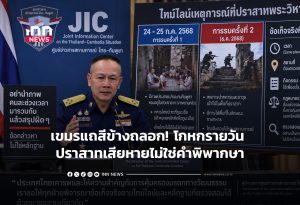
Tensions continue between Thailand and Cambodia over military activities and damage at the Preah Vihear Temple (Khao Phra Wihan), a UNESCO World Heritage site. Thailand has repeatedly countered Cambodian claims regarding evidence such as photos and reports, emphasizing the credibility and contextual importance of such information and demanding objective verification based on facts. Air Chief Marshal Prapas Sonsongdei, Director of the Thai-Cambodian Situation Information Center (JIC), responded to Cambodia's assertion that the area within Preah Vihear Temple is a "civilian refuge" and not a military base, citing photos of civilians within the temple as evidence. He stated, "It is not appropriate to combine photos from different time periods and draw a single conclusion." He stressed the need to clarify when and where the presented photos were taken and their relation to specific incidents. If photos relate to the events of July 24-25, 2024, that fact must be explicitly stated. Thailand has consistently emphasized that "a full timeline matters." Regarding Cambodia's claim that structures Thailand calls "bunkers" are actually "shelters for civilians," ACM Prapas explained that the name itself is not decisive. The crucial issue is what the area was used for at the relevant time. The presence of civilians does not, by itself, prove that the area was not used for military purposes. Conversely, the discovery of military personnel or equipment does not grant unrestricted permission to attack. Concerning Cambodia's report of 562 damaged points at the temple, as noted by UNESCO-ICOMOS, ACM Prapas differentiated between the fact of damage and the responsibility for it. He stated that it is essential to clarify who caused the damage, under what circumstances, and when. The mere recording of damage does not automatically resolve the issue of attribution or legal responsibility. ACM Prapas affirmed that Thailand supports evaluations by neutral experts and calls for a comprehensive review of evidence, including photographs, videos, geolocation data, firing directions, and other verifiable information. He added that international humanitarian law mandates strict criteria for military actions, including distinction, military necessity, proportionality, and precautions in attack, as well as the protection of cultural property. Both parties have a duty to avoid using cultural heritage sites in ways that could expose them to the risks of military operations. ACM Prapas presented the principle that "an accusation is not evidence, one photograph does not constitute a full timeline, and damage is not an automatic judgment of responsibility." He stated that Thailand does not ask anyone to blindly believe its claims, nor does it believe any party's claims should be accepted without scrutiny. Thailand advocates for the protection of civilians, the protection of cultural heritage, the establishment of facts, and the application of the same standards to everyone. This approach, he believes, will reduce conflict and guide both countries back to resolving issues through bilateral mechanisms and peaceful means. Source: INN News
Original source
INN News