Cambodia and US Sign Landmark Air Transport Agreement, Boosted by New Airport Funding
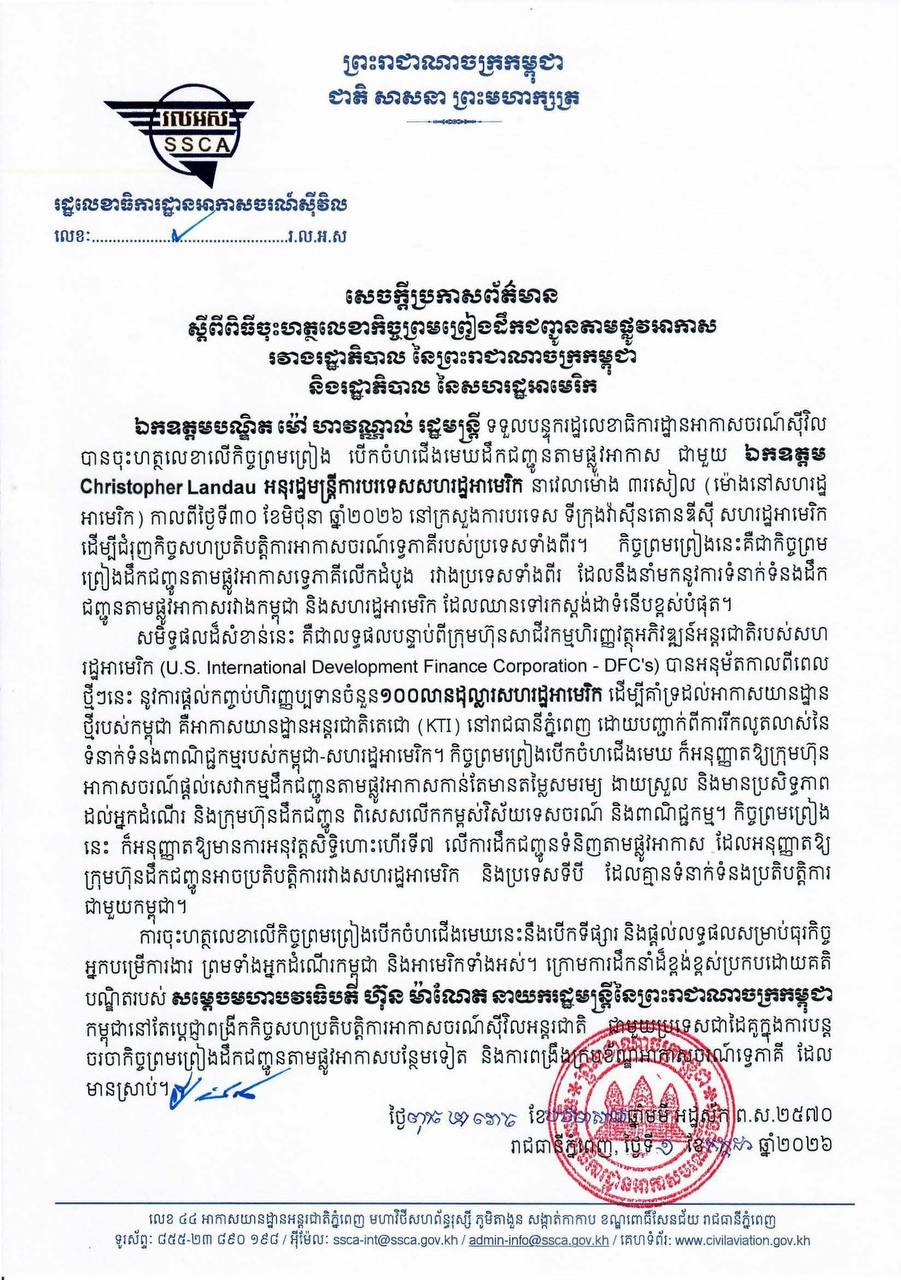
Cambodia and the United States have signed their first bilateral air transport agreement, enhancing air connectivity and facilitating trade and tourism. The deal coincides with a $100 million financing package for Cambodia's new international airport.
Cambodia and the United States have signed their first bilateral air transport agreement in Washington D.C. on June 30, 2026. The agreement, signed by H.E. Dr. Mao Havannall, Minister of State and Secretary of State of the State Secretariat of Civil Aviation, and H.E. Cristopher Landau, U.S. Under Secretary of State for Economic Growth, Energy, and the Environment, aims to enhance bilateral aviation cooperation and elevate it to the highest modern standards. This significant achievement follows the recent approval of a $100 million financing package by the U.S. International Development Finance Corporation (DFC) to support Cambodia's new Techo International Airport (KTI) in Phnom Penh, underscoring the growth in Cambodian-U.S. trade relations. The "open skies" agreement will allow airlines to offer more affordable, convenient, and efficient air transport services for passengers and cargo companies, thereby boosting the tourism and trade sectors. Notably, it permits the implementation of the seventh freedom of the air for cargo transport, allowing carriers to operate between the United States and third countries with which they do not have a direct operational relationship with Cambodia. Under the high and wise leadership of Prime Minister Hun Manet, Cambodia remains committed to expanding international civil aviation cooperation with partner countries by continuing to negotiate additional air transport agreements and strengthening existing bilateral aviation frameworks. This agreement is expected to open markets and yield benefits for all Cambodian and American businesses, workers, and travelers.
多角的分析
この航空輸送協定は、カンボジア経済にとって多面的な恩恵をもたらすと期待される。まず、両国間の直行便の増加は、観光客の増加を促し、サービス業を中心に経済活動を活性化させる。また、貨物輸送の自由化は、カンボジア製品の米国市場へのアクセスを容易にし、輸出を促進する可能性がある。特に、第7の自由が認められたことで、カンボジアをアジア太平洋地域の物流ハブとして活用する可能性が開かれ、サプライチェーンの効率化とコスト削減に繋がる。DFCによる新空港への1億ドルの融資は、インフラ投資として直接的な経済効果を生むだけでなく、国際的な信頼の証ともなり、さらなる外国直接投資を呼び込む触媒となるだろう。過去、カンボジアの経済成長はインフラ整備と国際貿易の拡大に大きく依存してきたため、この協定は成長戦略の重要な一部と位置づけられる。
今回の航空輸送協定は、カンボジアへの投資環境にとってポジティブなシグナルとなる。特に、米国国際開発金融公社(DFC)による新空港への1億ドルの融資は、米国のカンボジア経済へのコミットメントを示すものであり、他の投資家にとって安心材料となる。航空輸送の自由化は、物流コストの低下や市場アクセスの向上を通じて、カンボジアに進出する企業、特に輸出入を行う企業にとって事業リスクを低減させる。これにより、製造業、アパレル産業、そして成長著しい観光・ホスピタリティ産業への投資がさらに促進される可能性がある。過去、カンボジアはASEAN地域における低コスト生産拠点としての魅力を高めてきたが、今回の協定は、その競争力をさらに強化するものと考えられる。
この航空輸送協定は、カンボジア国民の生活にも間接的ながら影響を与える。まず、観光客の増加は、雇用機会の創出、特にプノンペン周辺や観光地におけるサービス業従事者の収入向上に繋がる。また、航空運賃の低下や利便性の向上は、カンボジア国民が海外旅行や留学、ビジネス渡航を行う際のハードルを下げる可能性がある。さらに、貿易の活性化は、より多様な商品が国内市場に流通することを意味し、消費者の選択肢を広げる。一方で、インフラ整備や観光客増加に伴う環境への影響や、地域社会への負荷増大といった課題も生じうるため、持続可能な発展に向けた配慮が求められる。
今回のカンボジアと米国の航空輸送協定は、カンボジア市民、特にプノンペン市民にとっては、海外との繋がりがより身近になることを意味する。これまで高額だった米国への渡航費や貨物輸送費が低下すれば、家族との再会やビジネスチャンスが広がる。また、観光客の増加は、プノンペン市内や近郊で働く人々の雇用機会を増やすだろう。しかし、観光客の増加は、交通渋滞の悪化や物価の上昇を招く可能性もあり、市民生活への影響も懸念される。例えば、テジョ国際空港周辺のインフラ整備が追いつかず、地域住民の生活道路が工事で分断されるといった摩擦が生じることも考えられる。市民としては、経済的恩恵と生活環境の維持とのバランスが問われることになる。
背景・歴史的文脈
カンボジアと米国との関係は、冷戦終結後、経済協力や民主化支援を中心に再構築されてきた。特に、カンボジアの経済発展とインフラ整備は、国際社会からの支援に大きく依存してきた経緯がある。米国は、中国の影響力拡大に対抗する形で、東南アジア地域への関与を強めており、カンボジアとの経済・安全保障分野での関係強化を図ってきた。今回の航空輸送協定は、こうした背景の中で、両国間の経済関係を深化させ、カンボジアの国際的な連結性を高める一環として位置づけられる。また、カンボジア政府は、経済成長の原動力としてインフラ投資、特に大規模空港建設を推進しており、テジョ国際空港は国家的なプロジェクトとなっている。
原文ソース
CPP Cambodia