General articles are free for 24 hours after publish.
The red carpet to nowhere: Min Aung Hlaing’s upcoming visit to Thailand
Guest contributor Kannikar Petchkaew Thailand has every reason to roll out the red carpet. It has fewer reasons to expect miracles from the man walking over it. When Min Aung Hlaing returns to Bangkok this week, he will
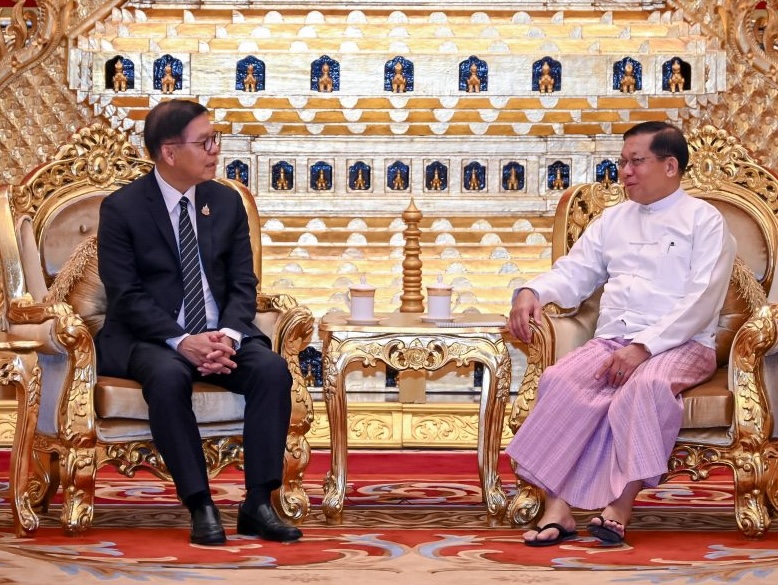
Guest contributor Kannikar Petchkaew Thailand has every reason to roll out the red carpet. It has fewer reasons to expect miracles from the man walking over it. When Min Aung Hlaing returns to Bangkok this week, he will be welcomed with the full ceremonial honours accorded to a visiting head of state—a noticeably grander reception than when he arrived here in April 2025 as the head of Myanmar’s military regime. The red carpet will be longer. The uniforms will be crisper, the ceremony grander, and the title different. This time, he arrives as a president. By giving Min Aung Hlaing the honors of a state visit, Thailand is showing diplomatic civility to a leader who remains under sanctions from the United States, the United Kingdom, the European Union, Canada, Australia and Switzerland. Such a move obviously raises questions about the image Bangkok is sending – and whether the practical rewards will be worth the diplomatic costs. “You roll the red carpet for the wrong guy,” one Myanmar activist argues. But those who have watched Thai politics long enough are probably wondering why anyone is surprised. The red carpet may be new. The script is not. Thailand has never been in favor of isolating Myanmar. Bangkok maintained working-level connections, border mechanisms, cross-border trade and coordination on migration; and time and again argued that dialogue was more productive than diplomatic isolation, even after the 2021 coup. For years, this approach has been based on one simple premise: the best way to deal with the common problems along the 1,501 miles (2,400 km) border is direct contact with the government of Myanmar. The rationale is simple. “We have to bring the government into the fold in Naypyidaw; only it can address our problems,” said a senior officer of Thailand’s Ministry of Foreign Affairs at the Association of Southeast Asian Nations (ASEAN) summit in the Philippines in May, where Min Aung Hlaing’s senior regime officials were excluded. Only the regime’s Permanent Secretary of the Ministry of Foreign Affairs has been allowed to represent Naypyidaw at high-level ASEAN meetings and summits since 2021. The Philippines’ Foreign Minister and ASEAN’s Special Envoy on Myanmar Maria Theresa Lazaro, along with Thailand’s Foreign and Deputy Prime Minister Sihasak Phuangketkeow, held an “informal” meeting with their Myanmar regime “counterpart” Tin Maung Swe in Bangkok on July 12. That calculation to reengage with Myanmar’s regime is more urgent today. Thailand has severe concerns from the increasing growth of cross-border scam centers, rising transnational crime, armed conflict spillover, and escalating environmental issues ranging from river pollution to transboundary haze. If anything, these factors have made Bangkok more keen than ever to have Min Aung Hlaing back at the negotiation table. The red carpet is far shorter than the host’s expectation. Months after drafting and redrafting the terms of reference for a bilateral mechanism to manage transboundary river pollution from mining operations in Myanmar, Thailand is finally ready to place the document before Min Aung Hlaing and ask for his signature. This would be worth more than the ink on paper to the Thai government. But a glorious fame. After months of public criticism that it was impotent to deal with cross-border crime and pollution, a signed agreement would be a pleasant picture opportunity—and possibly the feeling that the problems are now on their way to being remedied. The text has already been weakened to little more than a broad declaration of intent, but for the host, even a minor agreement would be a diplomatic victory—a bottle of wine offered by its guest before the evening is finished Under ASEAN, Thailand has consistently prioritized stability over political transformation. Bangkok has maintained quiet engagement despite the regional bloc freezing out Min Aung Hlaing’s regime over the last five years. Informal meetings with Myanmar took place in Thailand in December 2022, June 2023, and December 2024, saying continuous engagement was needed for practical collaboration on border security, transnational crime and humanitarian issues. Humanitarian coordination operated through state-approved channels. The language was always “constructive engagement.” Thailand has not formally elevated Myanmar’s National Unity Government (NUG) within ASEAN. It works with whoever controls Naypyidaw. That doctrine has endured since the 2021 coup. Within ASEAN, Thailand acts as a stability broker, a communication channel to the regime, and a buffer state focused on containment. If someone sees this visit as signifying a shift in Thailand’s Myanmar policy, it is only because someone failed to read the earlier chapters. The storyline in Bangkok has remained remarkably consistent. What has changed is Myanmar. Diplomacy often relies on maps. Unfortunately, maps don’t show who actually controls the next checkpoint. In Myanmar, the map is no longer a reliable guide to who governs. Recent estimates by the Burma Human Rights Network, a human rights advocacy organization, suggest that the regime controls little over 21 per cent of Myanmar’s territory, with the balance controlled or contested by resistance and ethnic armed forces. Since 2021, Naypyidaw has seen its effective control over large parts of Myanmar steadily shrink. Ironically, many of the issues Thailand is most eager to tackle—online scam compounds, illicit trade, narcotics trafficking and cross-border environmental damage—originate in territories where Naypyidaw has limited authority or where other armed actors hold sway. Most of the states bordering Thailand: Karen, Karenni, and Shan—excluding Tanintharyi Region–are either actively contested or under the de facto control of ethnic armed organizations and other non-state actors, leaving Naypyidaw with only limited influence in areas from which Thailand’s most pressing cross-border problems emanate. This is creating an increasing dissonance between Thailand’s diplomatic policy and realities on the ground. On the other hand, internal opposition in Myanmar has carried forward without him. The NUG, its resistance partners and several ethnic armed organizations, several of whom have begun to develop their own federal political institutions beyond the authority of Naypyidaw, have dismissed his administration as the legitimate government of Myanmar. Across much of the country, the question is no longer who rules from Naypyidaw but if Naypyidaw rules at all. By extending the honors of a state visit to Min Aung Hlaing, Thailand is incurring some diplomatic and reputational cost in the view of elements of the international community. Such a move could be justified if it achieved meaningful advances on the topics that matter most to Bangkok. But that is exactly where the computation starts to go awry.
Original source
DVB