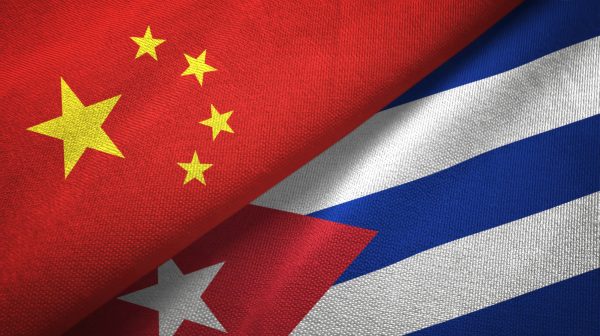
China Bolsters Cuba Aid Amid US Pressure
Diplomacy
2026年7月15日
8
The Diplomat Indonesia

China Bolsters Cuba Aid Amid US Pressure

AI サマリー

China is rapidly expanding its energy sector support to Cuba, counteracting U.S. economic pressure through solar power installations and emergency rice supplies. This move introduces new geopolitical complexities to U.S. Cuba policy.

Read The Diplomat, Know The Asia-Pacific Insights from Orlando J. Pérez The Diplomat author Mercy Kuo regularly engages subject-matter experts, policy practitioners, and strategic thinkers across the globe for their diverse insights into U.S. Asia policy. This conversation with Dr. Orlando J. Pérez, professor of political science at the University of North Texas at Dallas, is the 517th in “The Trans-Pacific View Insight Series.” Examine the scope of China’s involvement in Cuba. China’s involvement in Cuba has expanded fastest in energy. Over the past year Cuba connected 49 Chinese-built solar parks to its grid, pushing solar from under 6 percent of generation to more than 20 percent. Beijing has committed to 92 parks by 2028, roughly 2 gigawatts, close to Cuba’s entire fossil fuel capacity. Chinese solar exports to the island jumped from a few million dollars in 2023 to $117 million in 2025. Add an $80 million emergency credit line and 60,000 tons of rice delivered in January, and you have a lifeline the oil blockade cannot reach. The second area is intelligence. CSIS satellite analysis documents signals-collection sites at Bejucal, Wajay, Calabazar, and El Salao, with a large new antenna array under construction at Bejucal, within reach of Key West, Homestead, and the Cape Canaveral launch corridor. I would urge caution here. Some analysts who have visited the Havana sites argue the hardware looks like aging Cold War equipment, and modern signals work depends far less on geography than it once did. The alarm may be running ahead of the capability. The footprint is real and growing. Its center of gravity has moved, though. China’s leverage in Cuba today comes from keeping the lights on, and that is something Washington cannot sanction away. Analyze Washington’s concerns over Chinese and Russian support of Cuba’s current political regime. Washington tends to fold China and Russia into one anxiety about hostile powers operating 90 miles from Florida. The two relationships differ in ways that matter for an honest threat assessment. Russia’s help has been sporadic. No tanker reached Cuba for three months after the Venezuelan cutoff, until a Russian ship carrying 730,000 barrels of crude docked at Matanzas in late March, and only because Washington waved it through. A second cargo ship followed, and a later sanctioned tanker turned back toward Brazil rather than test the blockade. Russia offers symbolism and a friendly vote at the United Nations. None of that changes Cuba’s trajectory. China is the substantive concern, on two fronts. The first is intelligence: the signals-collection sites near Havana and Santiago sit close to U.S. military and space infrastructure, and the Bejucal expansion has drawn fresh attention from the Pentagon and Congress. The second, and the more consequential, is economic. Beijing is rebuilding Cuba’s power grid with solar capacity, financing it, and feeding the population with emergency rice while Washington squeezes the island’s oil supply. That second front is what should worry U.S. planners. Sanctions can stop a tanker. They cannot stop the sun, and they cannot stop Chinese credit. Every blackout the pressure campaign produces becomes an opening Beijing fills, and each panel installed deepens a dependence that will outlast any single U.S. administration’s Cuba policy. Explain the impact of the U.S. removal of Venezuela’s former president, Nicolas Maduro, on Cuba’s political leadership. The capture of Maduro on January 3 hit Havana harder than any sanctions package. Venezuela had supplied close to half of Cuba’s petroleum, roughly 35,000 barrels a day, under the barter arrangement running since 2000 that traded subsidized crude for Cuban doctors and security personnel. Trump moved to cut it within days, posting that no more oil or money would reach the island. Three nationwide blackouts followed in March. Even more directly, by Havana’s own account, 32 Cuban security officers died in the operation because they were serving as Maduro’s personal protection, and the government ordered two days of national mourning. The episode showed how deeply Cuban intelligence had embedded itself in the Venezuelan state, and how exposed that presence had become once Washington decided to act. In Caracas, Washington had figures it could work with: Delcy and Jorge Rodríguez, who could hold the inner circle together through a transition. Havana offers no equivalent. Here is the lesson Cuba’s leaders take from Maduro’s fall. He spent years alternating defiance with selective bargaining and still ended up on a U.S. Navy ship. Concessions did not buy him security once Washington decided he should go. The Castro network will read that as a reason to close ranks. What is Washington’s strategic calculus behind its pressure campaign on Havana? Washington’s calculus is straightforward, and that is its weakness. The theory holds that with Venezuela gone, Cuba loses its oil and its patron, the economy collapses, and the regime either negotiates its exit or falls on its own. So the administration stacked the pressure: it cut Venezuelan crude, seized tankers, sanctioned the state oil company CUPET [Unión Cuba-Petróleo] in June, and indicted Raúl Castro in May for the 1996 shootdown of the Brothers to the Rescue planes. Trump talks openly about Cuba going down for the count and about a friendly takeover. The strategy misreads how the regime is built. Real power sits with the military conglomerate GAESA and the security apparatus, and those institutions hold a veto over any transition. Economic pain does not move them. It falls hardest on ordinary Cubans and on the small private sector that a genuine opening would require, while the armed forces control the dollar economy and absorb the shock. The CUPET sanctions show the muddle. The administration had encouraged private fuel imports as a humanitarian channel, and Vanguard Energy lined up the largest U.S. fuel shipment to Cuba since 1960 on the strength of leased storage tanks. Days after the CUPET designation, Vanguard suspended the deal, because those tanks belong to the company Washington had just blocked. Pressure without a credible political pathway does not produce capitulation. It produces a harder, more isolated regime that drifts toward Beijing. Assess Beijing’s priorities in supporting Havana and implications for China-U.S. strategic competition in the western hemisphere. For Beijing, Cuba is a low-cost, high-return bet. Solar panels and rice are cheap against the payoff. Much of this runs on Chinese credit and donation to a client that cannot pay its bills, which means the return Beijing is chasing is geopolitical. China gets to place output from a solar industry that has far outrun global demand. It proves what Chinese technology can deliver 90 miles from Florida, and it banks goodwill across a region it is courting. China does not need Cuba to succeed. It needs Cuba to remember who kept the

多角的分析

経済的影響

中国によるキューバへの太陽光発電インフラ投資と緊急米供給は、米国の石油封鎖による経済的圧力を緩和し、キューバ経済の安定化に寄与している。これは、中国がエネルギー分野での技術力と供給能力を誇示し、米国経済圏の近傍で影響力を拡大する戦略の一環である。キューバ経済は、これらの支援なしには深刻な停滞に陥る可能性が高く、中国への経済的依存をさらに深めることになる。

投資家心理

キューバへの投資家にとって、中国の関与拡大は複雑な状況を生み出している。一方で、中国のインフラ投資は、電力供給の安定化や経済活動の基盤強化につながる可能性がある。しかし、米国の制裁リスクは依然として高く、投資環境の不確実性は解消されていない。特に、中国が支援するインフラ関連企業や、エネルギー・食料供給分野でのビジネス機会は存在するものの、政治的リスクを慎重に評価する必要がある。

社会的影響

米国の経済制裁は、キューバ国民の生活に直接的な打撃を与えている。電力不足による停電の増加は、日常生活や経済活動を困難にし、生活の質を低下させている。中国からの緊急米供給は一時的な救済となるが、根本的な解決にはならない。中国による太陽光発電への投資は、長期的に電力供給の安定化に貢献する可能性があるが、その恩恵が国民全体に行き渡るかは不透明であり、政権の支援基盤強化につながる側面もある。

市民の声

米国の経済制裁は、キューバ国民の生活に直接的な打撃を与えている。電力不足による停電の増加は、日常生活や経済活動を困難にし、生活の質を低下させている。中国からの緊急米供給は一時的な救済となるが、根本的な解決にはならない。中国による太陽光発電への投資は、長期的に電力供給の安定化に貢献する可能性があるが、その恩恵が国民全体に行き渡るかは不透明であり、政権の支援基盤強化につながる側面もある。

背景・歴史的文脈

キューバと米国の関係は、1959年のキューバ革命以降、敵対的な状態が続いている。特に、米国はキューバに対する経済封鎖を継続し、政権交代を目指してきた。ベネズエラは、長年にわたりキューバにとって重要な石油供給国であり、両国の関係は政治的・経済的に密接であった。2019年のベネズエラにおける混乱と、それに続く米国によるマドゥロ政権への圧力強化は、キューバのエネルギー供給に壊滅的な打撃を与えた。この状況下で、中国はキューバへの支援を拡大し、米国が推進する経済的圧力を無力化しようとしている。中国の太陽光発電技術の提供は、キューバのエネルギー自給率向上と、化石燃料への依存低減を目指す動きとも解釈できるが、同時に中国の地政学的な影響力拡大という側面も強い。

原文ソース

The Diplomat Indonesia

原文を読む