General articles are free for 24 hours after publish.
Thailand Builds New Synchrotron to Power High-Value Research and Industry
Thailand is constructing a 3 GeV synchrotron facility in Rayong, aiming to create a platform for advanced research, industrial innovation, and high-value technology development. Increased investment in science and technology infrastructure is seen as crucial for the nation's transition from a middle-income to a high-income economy, fostering collaboration with industry and startups.
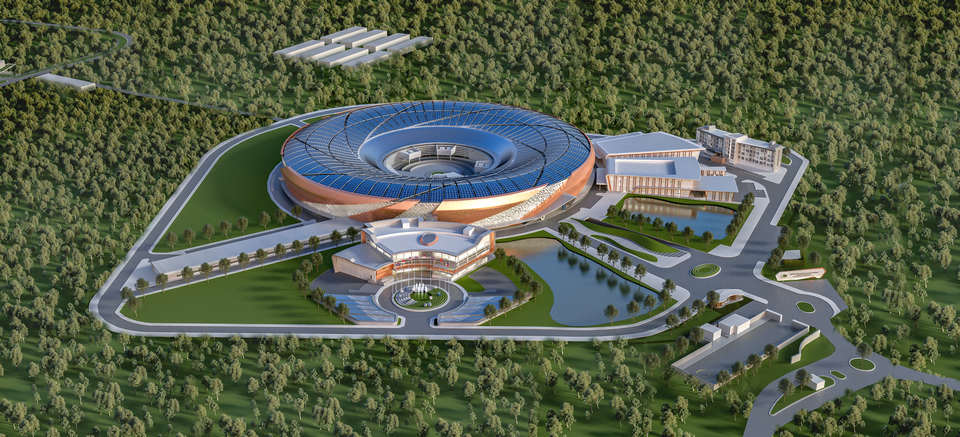
Thailand is preparing to build a new 3 GeV (billion electron volts) synchrotron facility in Rayong, which officials say could become a major platform for advanced research, industrial innovation, and the development of high-value technologies. Prof. Dr. Yodchanan Wongsawat, Deputy Prime Minister and Minister of Higher Education, Science, Research and Innovation, outlined this vision while delivering a keynote address at the SLRI User Meeting 2026. Yodchanan stated that Thailand cannot rely on traditional approaches if it aims to move beyond middle-income status and become a high-income economy. He emphasized that greater investment in advanced science and technology infrastructure will be essential for creating sustainable economic value. The nation's research infrastructure needs to evolve beyond serving only basic research to become dual-use infrastructure that also functions as economic infrastructure. The synchrotron is expected to help create business opportunities, support new industries, encourage technology companies and startups, and attract highly skilled researchers and professionals to Thailand. Rather than measuring research success only through academic publications, Yodchanan said the emphasis should be on making new discoveries that can generate knowledge and value. Synchrotron technology allows researchers to examine the structure and behavior of materials at extremely small scales, including at the electron level and in real time. This capability has applications across several industries. In the electric vehicle sector, for example, synchrotron analysis can help researchers study battery materials at the atomic level and develop advanced materials with improved performance. The facility could also support research into semiconductors, materials science, and photonics, while combining newly generated scientific data with artificial intelligence could help researchers identify solutions to industrial problems more quickly and shorten research and development timelines. The new infrastructure is also planned around an open-access model, allowing researchers, industry, and startups to use its capabilities. Officials see this wider access as a way to encourage collaboration, attract international expertise, and strengthen Thailand’s role in regional research and science diplomacy. The "Siam Photon Project," the new 3 GeV synchrotron, will be built at Wangchan Valley in Wang Chan district, Rayong. The facility will extend about 321.3 meters and is planned to become the largest scientific infrastructure project of its kind in Southeast Asia. Under the current master plan, negotiations on financing with the Japan International Cooperation Agency (JICA) were completed in August 2026. The project is scheduled to move towards signing the loan agreement in November, following the planned submission for Cabinet consideration in late October. Construction and production of major components are scheduled to begin in August 2028. The engineering and support buildings are expected to be completed in January 2029, followed by completion of the main synchrotron and administration buildings in August 2031. Installation and testing of the linear accelerator, accelerator systems, and beamlines are planned from August 2032 through April 2034. The new synchrotron is scheduled to begin full operations in July 2034, providing advanced research capabilities to users from academia, industry, and other sectors. The project is intended to help shift competition towards innovation, advanced technology, and higher-value production rather than relying primarily on labor costs and mass production. Source: Pattaya Mail
Original source
Pattaya Mail