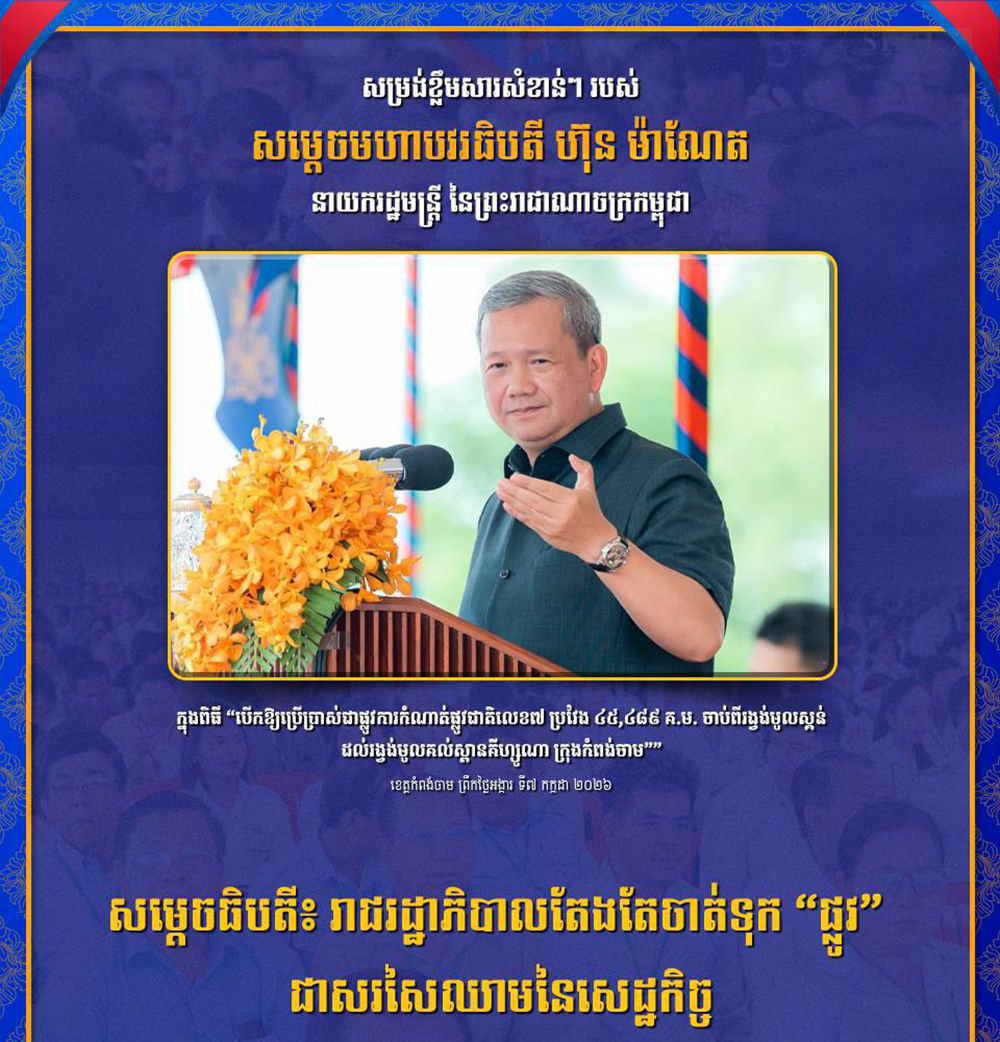
Cambodia Inaugurates Upgraded National Road 7, Boosting Economic Artery with Chinese Concessional Loan
Infrastructure
2026年7月7日
5
AKP Khmer
Relations
🇰🇭Cambodia🇨🇳China

Cambodia Inaugurates Upgraded National Road 7, Boosting Economic Artery with Chinese Concessional Loan

AI サマリー

Cambodian Prime Minister Hun Manet attended the inauguration of the upgraded National Road 7, funded by a Chinese concessional loan. He emphasized the importance of road network development as the "lifeblood of the economy" and highlighted infrastructure investment as part of the national strategy to become a logistics hub.

Prime Minister Hun Manet of the Kingdom of Cambodia presided over the official inauguration ceremony of National Road No. 7, spanning 45.489 kilometers from Skon Roundabout to Kizuna Bridge Roundabout in Kampong Cham City, on the morning of July 7, 2026. The project was implemented under a concessional loan from the government of the People's Republic of China. Speaking at the ceremony, Prime Minister Hun Manet highlighted that the National Road No. 7 section (Skon-Kampong Cham) incurred a total cost of nearly $118 million, financed through a concessional loan from the Chinese government and a contribution from the Royal Government of Cambodia. According to an economic internal rate of return (EIRR) assessment, the project is projected to yield a high return of approximately 15.27%. This return is expected from reduced travel and transportation times, as well as from attracting tourists and fostering the establishment of industries and businesses for residents along the road. In this regard, the government consistently views "roads" as the "lifeblood of the economy." It continues to prioritize the development of road, rail, water, and air transport systems, aligning with the slogan "Where there are roads, there is hope." Specifically, this section of National Road No. 7 will connect with existing national road networks and key geographical areas, including National Roads No. 6, 60, 70, 71, and 71C, and extend connectivity to the northeastern region, further improving access up to the Cambodia-Laos border. This connectivity gains even greater significance following the official launch of the "Cross-Border Transit Transport Corridor" between Cambodia and Laos on June 22, 2026, which facilitates the export of Cambodian agricultural and agro-industrial products to China via Laos. During the occasion, Prime Minister Hun Manet stated that the government has established necessary policies and legal instruments to better manage the development and implementation of transportation and logistics systems in Cambodia, aiming to fully meet the practical demands of national development. According to the "Comprehensive Master Plan on Intermodal Transport and Logistics System of Cambodia 2023-2033," the government plans to develop 11 key logistics bases nationwide. Concurrently, the Prime Minister urged the strengthening of public-private partnerships to continue developing crucial physical infrastructure, including roads, railways, waterways, ports, and airports. Particular emphasis was placed on modernizing the existing railway line (Phnom Penh-Sihanoukville) and constructing new lines (Poipet-Siem Reap-Phnom Penh), considering the development of additional expressways, the Funan Techo Canal project connecting the Mekong River/Tonle Sap River to the sea route, the organization of Techo International Airport, and the creation of a master plan for seaport development to transform Cambodia into a regional logistics hub. Before concluding, Prime Minister Hun Manet advised the preparation of a unified policy and standards for regulating the weight of transport vehicles to facilitate the transportation of agricultural products, while ensuring road quality is not compromised. He further clarified that laws are enacted not to oppress the people but to maintain a win-win balance. The new law has raised the cargo carrying capacity limit from 40 tons to 50 tons to ease transportation. Simultaneously, he instructed the Ministry of Public Works and Transport to enhance the efficiency and transparency of weigh stations to strictly enforce the law against overloaded vehicles, thereby ensuring fair competition. In conclusion, Prime Minister Hun Manet appealed to all citizens and travelers to respect traffic laws and collectively preserve national assets by driving at designated speeds with caution and avoiding overloading, to ensure the longevity of these shared achievements for the benefit of the people and the local economy. By: Kong Sereyrath © All rights reserved by Agence Kampuchea Presse 2018

多角的分析

経済的影響

国道7号線の改修は、カンボジア経済の「生命線」としての道路網の重要性を再確認させるものだ。中国からの融資で実現したこのプロジェクトは、単なるインフラ整備に留まらず、輸送コスト削減、観光客誘致、産業振興といった多岐にわたる経済効果をもたらすと期待されている。特に、越境輸送回廊の運用開始と連携した物流網の強化は、カンボジアが地域物流ハブとして発展するための重要な一歩となる。しかし、15%超という高い経済的収益率の予測が、実際の経済成長にどの程度寄与するかは、今後の政策実行と国際情勢に左右されるだろう。

投資家心理

中国からの融資によるインフラ投資は、カンボジアへの直接投資を促進するインセンティブとなり得る。特に、物流ハブ化を目指す国家戦略は、港湾、鉄道、道路網への投資機会を創出する。国道7号線の開通は、コンポンチャム州周辺地域へのアクセスを改善し、新たなビジネスチャンスをもたらす可能性がある。しかし、投資家は、プロジェクトの実行能力、透明性、そして中国への依存度といったリスク要因を慎重に評価する必要があるだろう。

社会的影響

国道7号線の改修は、沿道住民の生活に直接的な恩恵をもたらす。移動時間の短縮は、通勤や通学、物資の運搬を容易にし、経済活動の活性化につながる。また、観光客の増加は、地域経済の活性化や雇用創出に貢献する可能性がある。一方で、過積載車両による道路の損傷を防ぐための法規制強化は、輸送業者や農家にとっては新たな負担となる可能性も指摘されており、円滑な運用と住民への丁寧な説明が求められる。

市民の声

今回の国道7号線の改修は、カンボジア国民、特にコンポンチャム州周辺の住民にとっては、生活の利便性向上に直結する朗報と言える。移動時間の短縮は、日々の生活や経済活動をより効率的にするだろう。また、物流の円滑化は、物価の安定にも寄与する可能性がある。しかし、首相が言及した積載重量の緩和と道路維持とのバランス、そして厳格な法執行は、輸送業者や農家にとって、新たなコストや手続きを伴う可能性があり、その影響を注視する必要がある。

背景・歴史的文脈

カンボジア政府は、経済発展の基盤としてインフラ整備を長年重視してきた。特に、フン・セン元首相時代から、中国からの融資や投資を積極的に受け入れ、道路、橋梁、ダムなどの大規模プロジェクトを推進してきた。これは、内陸国であるカンボジアが、国際貿易における競争力を高め、経済成長を加速させるための戦略である。2023年に首相に就任したフン・マネト現首相も、このインフラ投資の重要性を引き継ぎ、特に物流ハブ化を目指す国家戦略を推進している。国道7号線の改修は、こうした一連のインフラ開発計画の一環であり、中国との経済的な結びつきをさらに強固にするものと言える。

原文ソース

AKP Khmer

原文を読む