General articles are free for 24 hours after publish.
Vietnam's President Advocates for 'Restoring Trust, Managing Transformation' at UNGA
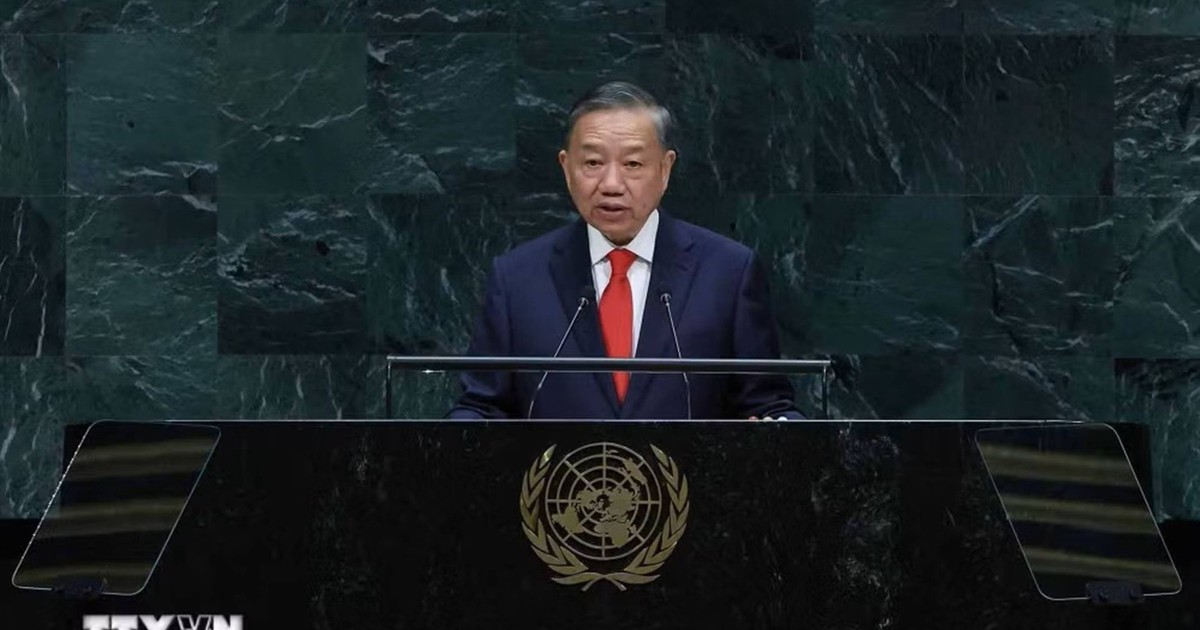
Vietnamese President To Lam addressed the UN General Assembly, highlighting profound shifts and risks in the international order and advocating for restoring trust and managing transformation as top priorities. He particularly called for respect for the UN Charter and international law, promotion of equitable and sustainable development, and strengthening technology governance.
SOCIALIST REPUBLIC OF VIET NAM Government News Excellencies, Ladies and Gentlemen, The world is undergoing profound shifts in the international order, with many risks and uncertainties. The tendency towards the use or threat of force and the arms race, particularly the modernization of nuclear weapons and the development of new technology weapons, are heightening the risks of confrontation, miscalculation and conflict, even of large-scale wars. At the same time, the global economy is becoming increasingly fragmented, amid mounting barriers to trade, investment and technology. Supply-chain disruptions and economic instability are narrowing development opportunities for many countries. Climate change, natural disasters, pandemics and emerging technological risks continue to pose direct threats to people's lives and livelihoods, as well as to the development and stability of many nations. Shifts in the balance of power and development inequalities are placing growing pressure on international relations. Instability is further exacerbated when competition goes unchecked, commitments are left unfulfilled and international law is applied selectively. An erosion of trust is further impeding efforts at cooperation. What should concern us is not only how the international order is changing, but where that change will take our world. Change is inevitable, for it is part of the objective course of history. Conflict and confrontation, however, are not inevitable. From our own history, Viet Nam understands profoundly the cost of war, the value of independence, and the power of reconciliation and cooperation. It is therefore my belief that the theme of this Session, "Restoring trust, managing transformation: a United Nations that delivers for all," aptly reflects the urgent demands of our time. From the losses of the Second World War, humanity created the United Nations with the aspiration to prevent war, safeguard peace, promote cooperation, and place relations among nations on a foundation of common principles. Over the past eight decades, despite its limitations, the United Nations has helped sustain dialogue, advance decolonization, uphold the right of peoples to self-determination, and support development. These achievements must be preserved and carried forward. Our institutions must be reformed to keep pace with the times, while the fundamental principles of the United Nations Charter must be respected and reinforced. What we seek is a more equitable, democratic and inclusive international order, where every country has a voice and every nation has the opportunity to develop. The mission of our generation is to help shape and manage change so that competition does not turn into confrontation, differences do not lead to conflict, and advances in science and technology do not create new divides. In that spirit, I wish to put forward four major priorities: First, we must restore trust among nations on the basis of respect for the UN Charter and international law. The UN Charter and international law form the foundation of the international order. They must be respected fully, consistently and without selectivity. All States must respect one another's independence, sovereignty, territorial integrity and right to choose their own path of development; refrain from interference in internal affairs; and refrain from the threat or use of force inconsistent with the UN Charter. Restoring trust does not require countries to erase their differences, but rather to manage those differences responsibly. Crises must be prevented. Competition must be kept under control. Dialogue must be sustained. Commitments must be honored and fully implemented. Major powers should lead by example in respecting international law, exercising restraint and responsibly addressing common challenges. The United Nations must remain at the center of these efforts. In every conflict, civilians must be protected, international humanitarian law must be respected, and humanitarian access must be ensured. Viet Nam supports the right of the Palestinian people to self-determination and the two-State solution, with an independent State of Palestine living peacefully alongside the State of Israel, in accordance with international law and relevant United Nations resolutions. In the Asia-Pacific, nearly six decades of ASEAN's development have demonstrated that countries can transform suspicion into trust, confrontation into dialogue, division into cooperation, and individual strength into collective strength. In that spirit, Viet Nam remains steadfast in its commitment to resolving disputes, including those in the East Sea, by peaceful means and in accordance with international law, particularly the 1982 United Nations Convention on the Law of the Sea. Viet Nam is resolute in safeguarding its sovereignty, sovereign rights and jurisdiction. The seas and oceans must remain spaces of peace, cooperation, connectivity and sustainable development. In the same spirit of peace and respect for peoples' right to development, Viet Nam has always stood in solidarity with the State and People of Cuba. We call upon the United States to end the unilateral embargo and sanctions and the energy blockade against Cuba, and to remove Cuba from the list of State Sponsors of Terrorism. We also call upon the international community to support Cuba in overcoming the sanction-driven crisis. Second, we must advance development that is equitable, humane, inclusive and sustainable. International commitments must be translated into action and bring people lives of peace, security, dignity and happiness. It is for this reason that the Pact for the Future and the 2030 Agenda, our promises to present and future generations, must be implemented earnestly and in full. Commitments on financing for development, including the Sevilla Commitment, must be translated into concrete measures: expanding access to long-term financing at affordable cost, supporting countries burdened by debt, and amplifying the voice of developing countries in international financial and monetary institutions. The multilateral trading system must be strengthened in an open, equitable and transparent manner, ensuring development opportunities for all countries. Climate action must be accorded its rightful place in development cooperation, particularly through adaptation finance, technology transfer and a just energy transition. Development must be people-centered and leave no one behind. Growth must go hand in hand with social progress and equity, environmental protection and the safeguarding of people's livelihoods, particularly in vulnerable countries and communities. Global progress must uphold the spirit of humanity in relations among nations, safeguard their legitimate interests, and respect differences in history, culture and development conditions. Third, we must proactively shape technology governance so that progress serves humanity and our common develo
Original source
Bao Chinh Phu