Tropical Depression Near Philippines May Become Storm Before Entering East Sea
Environment
2026年7月23日
7
VnExpress International
Relations
🇻🇳Vietnam🇵🇭Philippines

General articles are free for 24 hours after publish.

Tropical Depression Near Philippines May Become Storm Before Entering East Sea

Share
AI Summary

A tropical depression has formed east of the Philippines and is expected to intensify into a tropical storm. While it may approach the East Sea, direct impact on mainland Vietnam is currently deemed unlikely. Northern Vietnam faces risks of flash floods and landslides due to heavy rainfall.

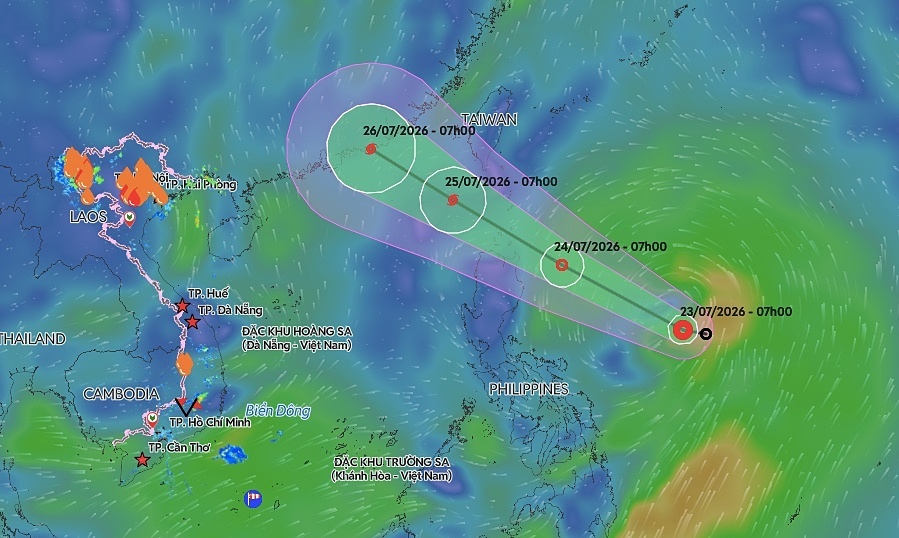
A tropical depression located east of the Philippines is forecast to strengthen into a tropical storm and potentially approach the East Sea, according to Vietnam's National Center for Hydro-Meteorological Forecasting. As of 1 p.m. on Thursday, the system was centered over waters east of the Philippines, moving at approximately 25 kph with maximum sustained winds of 50-61 kph and gusts up to 75-88 kph. By 1 p.m. on Friday, it is expected to be positioned about 100 km east of Luzon Island, with winds strengthening to 61-74 kph, at which point it is likely to develop into a tropical storm. Projections indicate that by 1 p.m. on July 25, the storm's center will be over the northeastern waters of the East Sea. Maximum winds are anticipated to reach 89-117 kph, with dangerous gusts up to 134-149 kph. Both the Japan Meteorological Agency and the Hong Kong Observatory concur that the depression will intensify into a storm on July 24 before entering the East Sea. However, current forecasts suggest it is unlikely to directly affect mainland Vietnam. This year, the East Sea has already seen one tropical depression and one storm. Storm Maysak in early July caused no fatalities but resulted in significant property damage, including 96 houses damaged, 13 boats sunk or swept away, and approximately 1,100 hectares of aquaculture areas affected, leading to estimated financial losses of VND20 billion (US$765,000). Super Typhoon Ba Vi later lingered over the northwestern Pacific, generating strong winds and high waves in many Vietnamese maritime areas but ultimately not crossing into the East Sea. Northern Vietnam has experienced repeated heavy rainfall episodes since mid-July, triggering flash floods and landslides that have caused severe damage in several mountainous provinces. Meteorological authorities project that the total number of storms and tropical depressions in the East Sea this year will be close to or below the long-term average. However, predicting their intensity and precise tracks could be challenging during the peak storm season from July to September, with extreme rainfall, flash floods, and landslides remaining significant risks, particularly in the northern mountainous areas and central Vietnam. Looking at the immediate forecast, the northern region is bracing for moderate to heavy thunderstorms from the evening of July 23 through the night of July 24. Rainfall totals are projected between 40 and 120 mm, with some areas potentially exceeding 250 mm. Authorities have issued warnings for a high risk of localized areas receiving over 100 mm of rain within three hours, which could overwhelm drainage systems and trigger flash floods. The system is also expected to extend southward into Thanh Hoa Province by the evening of July 24, with predicted rainfall of 25 to 50 mm, though some areas might see over 100 mm. While intensity is expected to ease slightly by July 25, wet conditions will persist across northern Vietnam and Thanh Hoa, with additional rainfall of 10 to 30 mm anticipated, and some locations still at risk of receiving more than 80 mm. Total rainfall across northern Vietnam from the evening of July 23 to July 25 is projected to reach between 70 and 150 mm, with the most severely impacted areas potentially recording cumulative totals exceeding 300 mm. Further south, the Central Highlands and southern Vietnam are also forecast to experience sustained periods of moderate rain, with general precipitation ranging from 20 to 50 mm, and localized pockets bracing for heavy to very heavy rainfall exceeding 100 mm.

0

Original source

VnExpress International

原文を読む