General articles are free for 24 hours after publish.
Tropical Storm Queenie to stay far from Philippine landmass
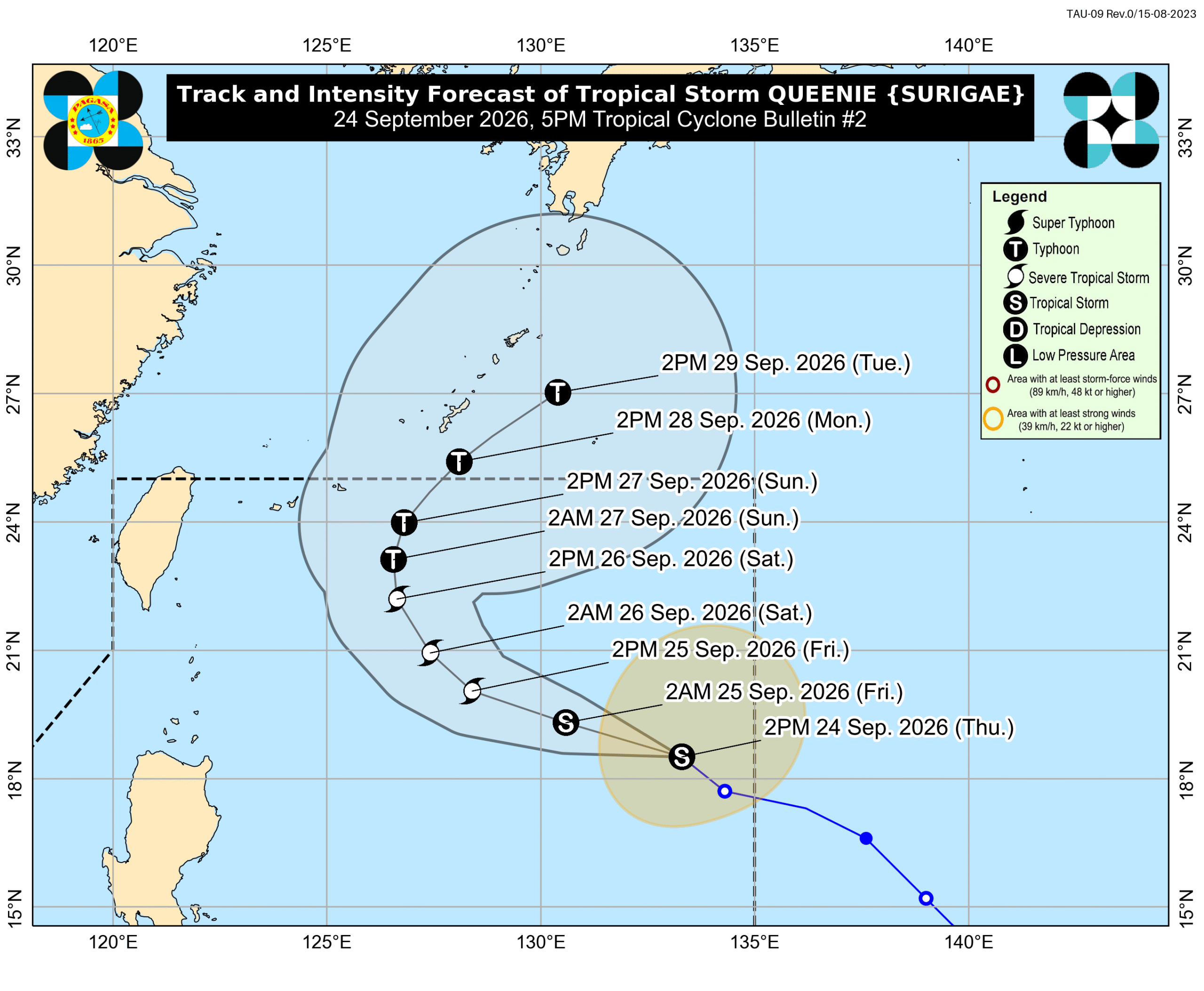
Tropical Storm Queenie is expected to traverse waters far from the Philippines, with no direct impact anticipated on the country's landmass. However, its extended cloud system may bring rain to certain areas.
MANILA, Philippines – Tropical Storm Queenie (international name: Surigae) is expected to remain far from Philippine landmass and will not have a direct effect on any part of the country, according to the Philippine Atmospheric, Geophysical, and Astronomical Services Administration (PAGASA). However, its trough or extension is causing some rain in portions of the Philippines. The tropical storm entered the Philippine Area of Responsibility (PAR) at 7 am on Thursday, September 24. It is the country’s 17th tropical cyclone for 2026 and the first for September. As of 4 pm on Thursday, Queenie was located 1,205 kilometers east of Northern Luzon, moving northwest at 25 kilometers per hour (km/h). It currently has maximum sustained winds of 75 km/h and gustiness of up to 90 km/h. PAGASA forecasts it may intensify into a severe tropical storm on Friday, September 25, and into a typhoon by Sunday, September 27. PAGASA expects Queenie to generally move west northwest until Friday, before turning north northeast by Sunday. Its exit from PAR could happen by Monday morning or early afternoon, September 28. While Queenie itself won’t directly impact the country, its trough could trigger scattered rain and thunderstorms in Mindanao, the Negros Island Region, Aklan, Iloilo, Guimaras, and Siquijor on Thursday evening. Isolated rain showers or thunderstorms are also expected in the rest of the Visayas and Bicol. Furthermore, strong to gale-force gusts may hit Davao Oriental, Davao de Oro, and Sarangani in the next two days due to the storm’s trough. Other parts of the country are expected to experience generally fair weather, with only localized thunderstorms. PAGASA Weather Specialist John Manalo noted that the southwest monsoon or habagat is already winding down, and the transition period to the northeast monsoon or amihan could start within the next couple of weeks. Source: Rappler Philippines
Original source
Rappler Philippines