General articles are free for 24 hours after publish.
BRICS Declaration Signals Potential Shift in India's Iran Policy
The BRICS summit declaration in New Delhi endorsed Iran's key diplomatic concerns without mentioning the country's attacks on neighboring states, marking a notable shift from India's traditional foreign policy.
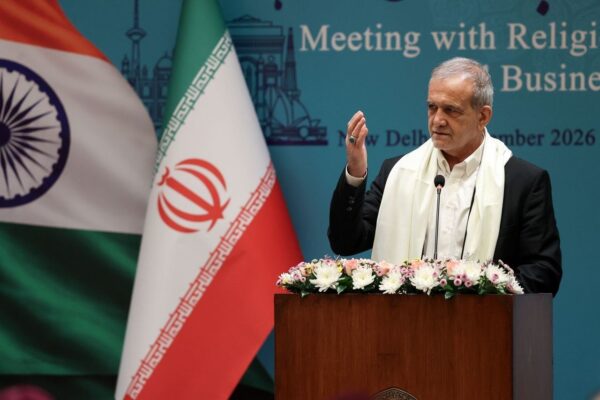
The declaration endorsed by the BRICS summit in New Delhi on September 11, 2026, signals a notable shift in India's foreign policy. Notably, the statements concerning Iran supported the country's main diplomatic concerns without mentioning its drone and missile attacks on neighboring states. Prior to the summit, India was expected to navigate a difficult tightrope walk given the presence of countries like China, Russia, and Iran. While the declaration avoided direct criticism of the United States, it explicitly called for an "end to unilateral economic sanctions, protectionist trade measures, and arbitrary tariffs." This has been hailed as a triumph of "strategic autonomy" under Prime Minister Narendra Modi's administration, though some analysts point to a dilution of its traditional foreign policy. Iranian President Masoud Pezeshkian captured significant attention at the summit. The declaration also failed to mention the disruption of Red Sea trade by Yemen's Iran-backed Houthi rebels or their attacks on Saudi Arabia. A meeting with the Crown Prince of Abu Dhabi did not seem to yield any tangible diplomatic success for India, which instead urged "maximum restraint" in the West Asian situation. Another clear shift in India's foreign policy was the complete absence of any mention of Israel's "right to defend itself." Instead, Israel was explicitly named and called upon to withdraw its forces from Lebanese territory. The declaration demanded unrestricted humanitarian aid to Gaza and opposed the forced displacement of Palestinians. The wording stating, "We reject any unilateral measures that seek to alter the legal and historical status of occupied Jerusalem," is likely to ruffle feathers in Israel. The declaration referenced proceedings brought by South Africa against Israel at the International Court of Justice. It also voiced deep concern over "deliberate attacks" on civilian infrastructure and peaceful nuclear facilities protected by UN atomic energy safeguards, interpreted by some as an indirect criticism of U.S. and Israeli strikes on Iranian nuclear sites. This striking turnaround in India's foreign policy is evident in the explicit mention of Israel, while ambiguous diplomatic language is used when referring to Iran's aggression. Earlier in 2026, during Prime Minister Modi's visit to Israel, which strengthened bilateral ties, Israel and the U.S. launched attacks on Iran. At that time, India's response to the assassination of Iran's Supreme Leader Ayatollah Ali Khamenei and the killing of schoolgirls was limited. However, the situation has changed following Iran's military successes against the superior firepower of the U.S. and Israel. Does this declaration reflect an Iranian military victory, or India's realization that it had backed the wrong horse? The answer likely lies in both. Source: The Diplomat Indonesia
Original source
The Diplomat Indonesia