General articles are free for 24 hours after publish.
Philippine Economy Slows to 5-Year Low of 2.3% Growth
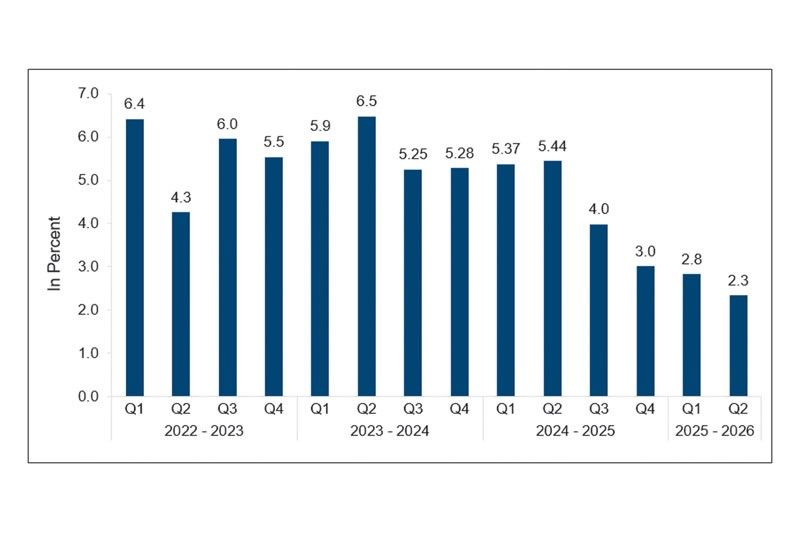
The Philippine economy grew by a mere 2.3 percent year-on-year in the second quarter, its slowest pace in five years. The slowdown was attributed to subdued household consumption due to the Middle East conflict and dampened investments and public construction amid an infrastructure scandal, making the annual growth target increasingly challenging.
MANILA, Philippines — The Philippine economy grew at its slowest pace in five years, registering a mere 2.3 percent in the second quarter, according to data from the Philippine Statistics Authority (PSA). This figure falls short of the 2.8 percent growth recorded in the first quarter and the 5.4 percent expansion seen in the same period last year. The slowdown is primarily attributed to subdued household consumption, impacted by the ongoing Middle East conflict, and a dampening of investments and public construction due to an infrastructure scandal. "Domestic demand remained subdued, mainly because of total investment, and continued to contract as public construction declined. Household consumption growth also moderated amid higher inflation, job losses and lower remittance receipts arising from the Middle East conflict," stated Secretary Arsenio Balisacan of the Department of Economic Planning and Development. However, government final consumption spending accelerated, boosted by expanded social assistance programs. On the demand side, gross capital formation contracted sharply by 9.2 percent, a significant worsening from the 3.1 percent decline in the first quarter. General government construction saw a steep drop of 32.4 percent, largely due to the "continuous cautiousness of the infrastructure-related agencies," particularly the Department of Public Works and Highways (DPWH), which is implementing stricter validation measures for its civil works projects. Household consumption grew at a slower pace of 2.8 percent year-on-year, down from 5.2 percent a year ago, marking the weakest print since the first quarter of 2021, excluding pandemic-related contractions. Government spending picked up to 8.3 percent, but remained below the 8.7 percent expansion in the second quarter of the previous year. With the first-semester growth averaging 2.6 percent, achieving the government's revised annual growth target of 3.5 to 4.5 percent now requires an expansion of at least 4.4 percent in the second half, posing a significant challenge. Secretary Balisacan expressed determination to meet the target through accelerated implementation of high-impact infrastructure projects. Presidential Communications Office Assistant Secretary Claire Castro attributed the second-quarter slowdown to "unusual events," specifically citing the impact of the Middle East conflict on inflation, fuel prices, jobs, and remittances, alongside the temporary lull in public construction. She emphasized that this slowdown is temporary and does not define the country's long-term economic trajectory. Meanwhile, regarding monetary policy, Secretary Balisacan indicated that easing price pressures might reduce the Bangko Sentral ng Pilipinas' (BSP) need for further tightening, although other domestic and external factors will be considered. The BSP has raised its benchmark interest rate by a cumulative 50 basis points this year, bringing the policy rate to 4.75 percent. Ser Percival Peña-Reyes, director of the Ateneo Center for Economic Research, believes the weak second-quarter performance substantially reduces the likelihood of another rate hike at the BSP's upcoming policy meeting. However, he noted the central bank faces competing considerations: sharp weakening of economic activity versus persistent inflation risks. Peña-Reyes suggested that if further tightening is deemed necessary, a 25-basis-point hike would be more proportionate, as a 50-basis-point increase would be difficult to justify without significant new upside risks to inflation. Chinabank Research also anticipates that the deteriorating growth picture will limit the BSP's room for additional tightening, forecasting at most one final 25-basis-point increase in August, as inflation remains above target. — Helen Flores
Original source
Philstar Business