General articles are free for 24 hours after publish.
Philippines' PISA 2025 Scores Improve, But Learning Crisis Persists
The Philippines saw improved scores across reading, math, and science in the PISA 2025 assessment for 15-year-olds. However, significant gaps persist compared to OECD averages, with a majority of students still below proficiency, indicating an ongoing learning crisis.
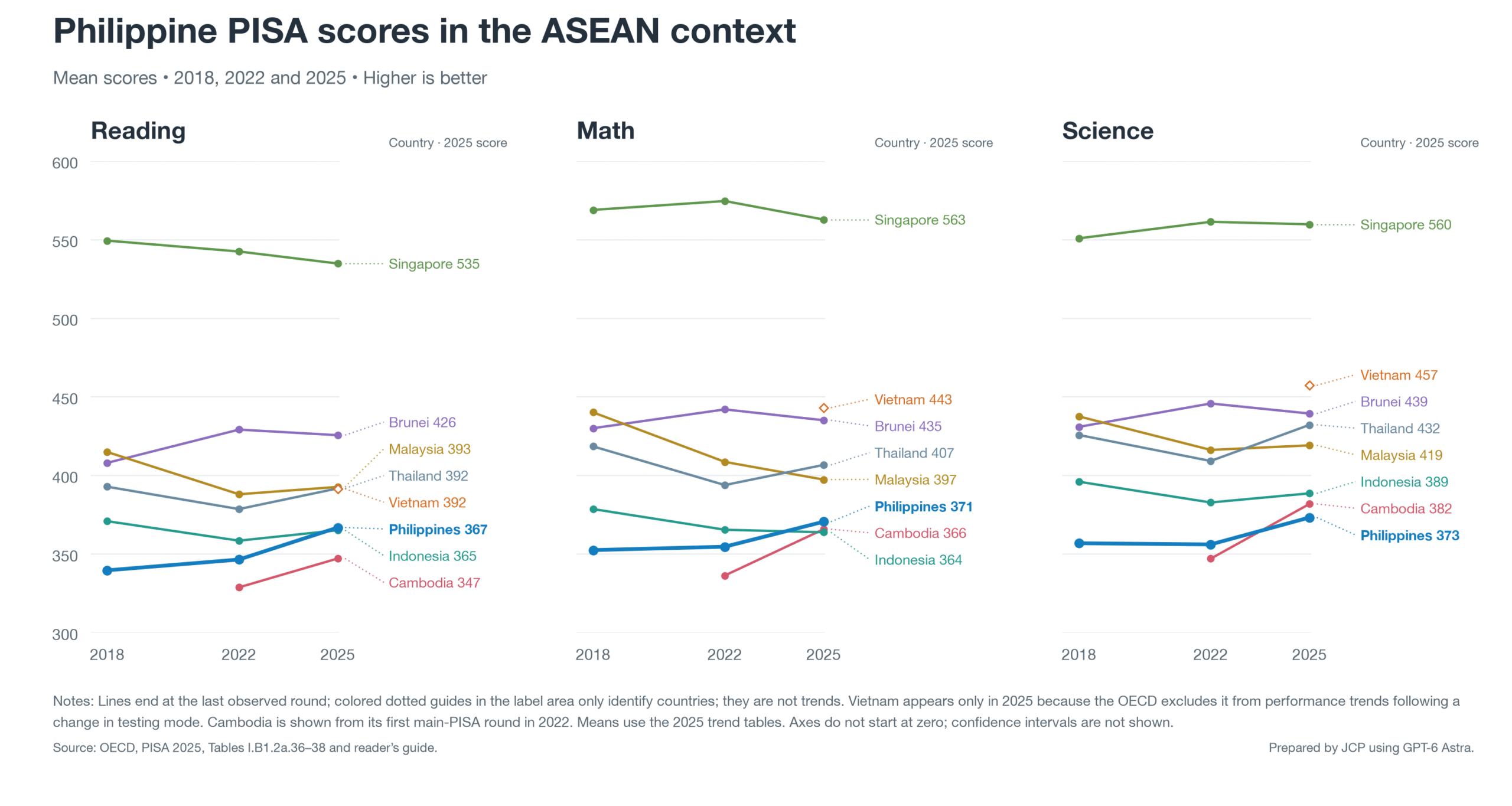
The results of the 2025 Programme for International Student Assessment (PISA), measuring the skills of 15-year-old students, have been released, showing improvements across reading, mathematics, and science. Compared to the 2022 survey, scores increased significantly in all three subjects: reading from 347 to 367, mathematics from 355 to 371, and science from 356 to 373. The Philippines was among eight participating education systems that exhibited significant gains in all three subjects. Additionally, the proportion of Filipino students below the baseline proficiency level in science fell by a significant 8.9 percentage points. The Department of Education (DepEd) had implemented intensive preparations since early 2024, including forming a "Task Force PISA," providing computer test familiarization, practice materials, and creating a "festive mood" on test days. These efforts are believed to have contributed to the score improvements. Notably, the Philippines bucked the global trend of declining scores in reading and mathematics among OECD countries. However, significant challenges remain beneath the headline gains. The Philippines' 2025 reading score of 367 is still considerably lower than the OECD average of 461, mathematics at 371 versus 463, and science at 373 versus 482. Within the ASEAN region, the Philippines is now last in science, having been overtaken by Cambodia. Furthermore, a majority of Filipino students remain below the baseline proficiency level (Level 2): 70% in reading, 79% in mathematics, and 68% in science. A substantial 64.3% of students were below Level 2 in all three subjects simultaneously. The score improvements were not equitable. Science scores rose by 36 points among the most socioeconomically advantaged quarter of students, compared to only 10 points among the most disadvantaged quarter, widening the gap by a significant 26 points. This indicates that the learning crisis persists, and educational disparities remain unresolved. Further scrutiny is needed to determine the effectiveness of DepEd's preparation strategies and whether specific schools received substantial additional support. The learning outcomes of young people outside the PISA coverage also warrant attention. Information source: Rappler Business
Original source
Rappler Business