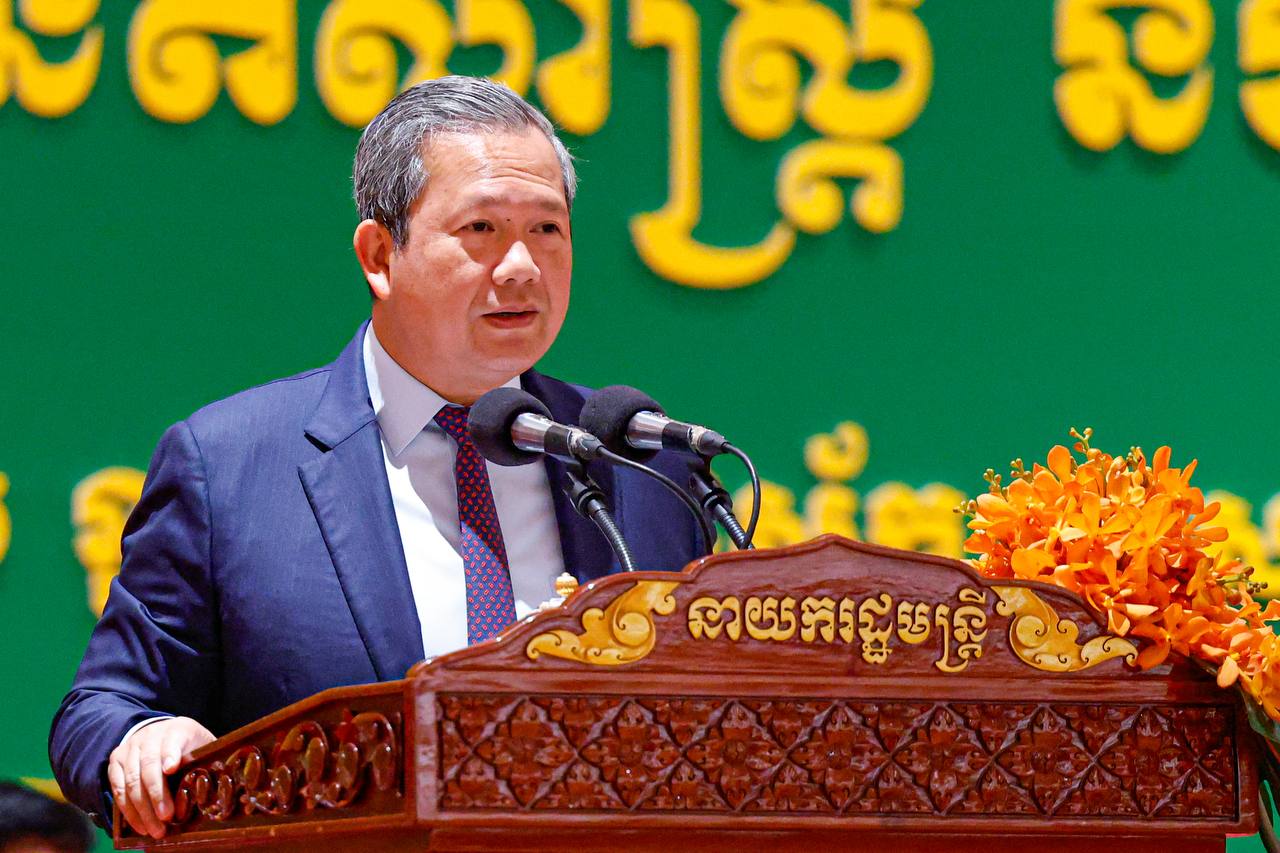
Cambodia's Hun Manet Highlights 'Pentagon Strategy' for Economic Transformation through Human Capital and Digitalization
Technology
2026年8月6日
5
AKP Khmer

General articles are free for 24 hours after publish.

Cambodia's Hun Manet Highlights 'Pentagon Strategy' for Economic Transformation through Human Capital and Digitalization

Share
AI Summary

Cambodian Prime Minister Hun Manet emphasized the 'Pentagon Strategy' at a graduation ceremony, prioritizing human capital development and digitalization to transform the nation's economic structure from labor-dependent to skill-and-technology-driven.

Prime Minister of Cambodia, Samdech Thipadei Hun Manet, emphasized that under the umbrella of nearly 28 years of complete peace across the country, Cambodia has achieved countless brilliant accomplishments and is continuing to create new ones, in line with the rapidly changing trends in politics, society, economy, science, technology, public health, and climate change. The Prime Minister made these remarks during a ceremony to award diplomas to 4,001 Bachelor's and Master's degree graduates of the Royal University of Law and Economics, and to inaugurate a 6-story academic building, parking lot, and offices at the Diamond Island Convention and Exhibition Center on the morning of August 6, 2026. Prime Minister Thipadei highlighted that the government has launched the 'Pentagon Strategy,' a long-term national socio-economic development strategy, prioritizing human capital as the first priority and technology as the second. This aims to transform Cambodia's economic structure from one dependent on labor to one reliant on skills and technology. Within the human capital development framework, the government is enhancing the quality of education and vocational training, developing both hard and soft skills, and preparing the workforce to better respond to the evolving economic landscape, labor market demands, and digital technologies through skill transformation, upskilling, and public health improvement. Concurrently, the government is improving working conditions in both the public and private sectors through institutional reforms, improved governance, promotion of democracy, and adjustments to various incentive systems. In the framework of digital technology development, Samdech Thipadei Hun Manet stated that the government is actively promoting the development of a digital technology ecosystem in Cambodia that is efficient, secure, integrated, synergistic, and innovative. This is being achieved through the implementation of policies such as the 'Digital Economy and Social Policy of Cambodia 2021-2035' to build a vibrant digital economy and society, and the 'Digital Government Policy of Cambodia 2022-2035' to build a smart government, along with other necessary policies and strategies to respond to the Industrial Revolution 4.0, especially artificial intelligence technology. To promote the quality, efficiency, equity, and innovation of Cambodia's education sector, the Prime Minister issued several recommendations for the Ministry of Education, Youth and Sport: 1. Continue to promote digital education in the context of the Industrial Revolution 4.0 by improving digital platforms, establishing digital education centers, producing video tutorials for core subjects for examination classes, integrating digital technology into teaching and learning, developing digital infrastructure in schools, and creating digital education programs to meet market demands, socio-economic development, technological revolution, and global landscape changes. 2. Continue to pay high attention to human capital development to better respond to increasing competition in the labor market and socio-economic development, especially in the context of multifaceted competition – geographical, political, economic, and commercial – as well as the rapid growth of technology and the global landscape leaning towards technology adoption. The primary goal is to enhance resilience and build a strong digital socio-economy. 3. Continue to promote digital education to contribute to building digital citizens, enhancing students' digital capabilities to improve the efficiency of digital teaching and learning, and promoting self-study. Strengthen cooperation with the Ministry of Post and Telecommunications to develop digital infrastructure in schools to promote online training, aiming for sustainable and inclusive education, and encouraging lifelong learning and research. 4. Continue to improve the quality of education, starting with improving the quality of teachers and school principals, focusing on teaching methods, curricula, and appropriate equipment aligned with the vision of 21st-century Cambodian education. Simultaneously, continue to strive to improve infrastructure and the learning environment, especially by establishing libraries equipped with modern technological systems and sufficient resources for study and research in educational institutions, both public and private. University leaders, professors, and staff must continue to play a leading role as advisors, guides, researchers, and innovators, constantly striving to develop their capacities in knowledge, practical skills, teaching methodologies, and the use of digital technology to enhance teaching effectiveness. By: Chan Sophon © All rights reserved by Agence Kampuchea Presse 2018

0

Original source

AKP Khmer

原文を読む