General articles are free for 24 hours after publish.
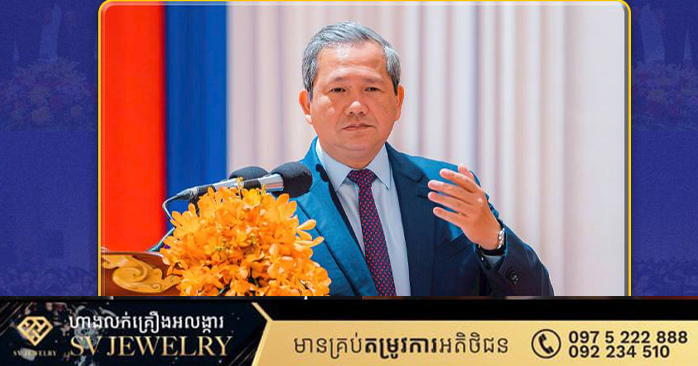
Prime Minister Hun Manet Urges Universities to Enhance Educational Quality and Digitalization
Cambodian Prime Minister Hun Manet has urged universities to improve educational quality, research, and digitalization during a graduation ceremony in Phnom Penh. He emphasized the government's 'Pentagonal Strategy,' prioritizing human capital and technological innovation to transition Cambodia from a labor-dependent economy.
On the morning of August 6, 2026, His Excellency Prime Minister Hun Manet of the Kingdom of Cambodia presided over the graduation ceremony for top students and the inauguration of a 6-story educational building, parking lot, and office of the Royal University of Law and Economics in Phnom Penh. Speaking on the occasion, His Excellency the Prime Minister expressed his joy and extended warm congratulations to the 4,001 top students, their families, professors, management, and staff of the Royal University of Law and Economics for their hard work and efforts that led to the students' success. His Excellency encouraged the leadership and professors of the university to continue strengthening educational quality, research, and innovation to contribute to human capital development in economics, law, justice, and public administration with competence, ethics, and patriotism. Simultaneously, His Excellency urged all educational staff to diligently develop their digital capabilities and teaching methods regularly to enhance educational effectiveness and bridge the gap between theory and practice. On this occasion, His Excellency the Prime Minister highlighted that the government has launched the 'Pentagonal Strategy - Phase 1,' a long-term national socio-economic development strategy that continues to prioritize 'Human Beings' and adds a new priority: 'Technology.' This aims to transform Cambodia's economy from one dependent on labor to one dependent on skills and technology. The government is promoting the quality of education and vocational training; the development of skills, both hard and soft; the preparation of the workforce to better respond to the changes in the economic paradigm, labor market demands, and digital technology through reskilling and upskilling; and the promotion of public health. In addition, the government is improving working conditions in both the public and private sectors through institutional reform and governance, promoting meritocracy, and adjusting incentive systems. His Excellency emphasized that the government is also striving to expand educational infrastructure to the grassroots and recruit teachers based on employment agreements with appropriate qualifications. He also called on all educational institutions not to compromise quality solely for competition. His Excellency stressed that educational quality is not solely about equipping students with computers or high-rise buildings, nor should students study merely to obtain scores or diplomas. Instead, they should gain 'social credit' through practical competence. Sharing his personal experience, he noted that lessons on good behavior, creative thinking, and responsibility in life are unforgettable, while school regulations and academic rigor help train individuals to overcome difficult tasks and avoid taking shortcuts. His Excellency continued that productivity arises from 'Quality + Skills + Attitude' combined with willpower. Simultaneously, he emphasized that schools must serve as centers for defining teaching methodologies and standard conditions to ensure students acquire clear knowledge and skills. Regarding technology, the ultimate goal is its use at an appropriate level to enhance capabilities while maintaining basic skills. Students should not rely too heavily on technology to the point of losing self-control but should possess the ability to manage and use it effectively. Finally, His Excellency advised all top students to rely on themselves and transform their obtained diplomas into indicators of their true competence through lifelong research and learning. He expressed his strong hope that the top graduates will utilize their knowledge, skills, and competencies to serve in government institutions, the private sector, or various organizations to meet their personal and family needs and contribute to national development. Furthermore, all top graduates must strive to overcome all obstacles to build themselves as good citizens, good officials, and good employees with professional conscience, ethics, and a spirit of loyal service to the people for the cause of the nation and homeland.
Original source
CEN Cambodia