General articles are free for 24 hours after publish.
Philippines: No permission-seeking in 2024 Ayungin ‘understanding’ with China
The Philippine Department of Foreign Affairs clarified that a 2024 provisional understanding with China in the South China Sea does not require seeking permission for resupply missions and does not concede Philippine sovereignty. It also refuted Chinese claims of prohibiting construction activities, stating such provisions are not explicitly in the agreement.
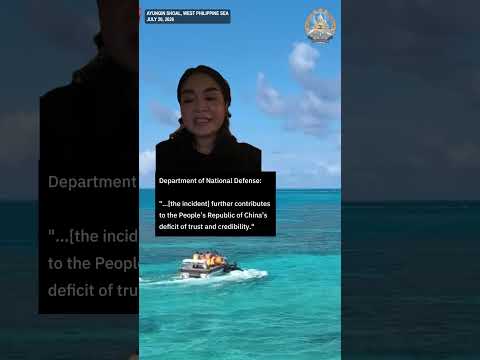
The Philippine Department of Foreign Affairs (DFA) on Thursday, July 23, clarified that a provisional understanding reached with China in 2024 does not imply that Filipinos seek permission for resupply missions, nor does it allow for boarding or inspections of Philippine vessels, nor does it “concede the Philippines’ sovereignty, sovereign rights and jurisdiction” in the Ayungin Shoal in the West Philippine Sea. “As stated from the outset, the Provisional Understanding is a set of principles and approaches observed by both sides in order to avoid misunderstanding and miscalculation in the conduct of the Philippines’ routine rotation and resupply (RORE) missions for daily necessities to the BRP Sierra Madre in Ayungin Shoal,” the DFA stated. The provisional understanding, sometimes referred to as a provisional agreement, was established between the two nations in 2024, a month after Chinese Coast Guard (CCG) personnel harassed Filipino soldiers stationed aboard the BRP Sierra Madre, a warship serving as a makeshift outpost in Ayungin (Second Thomas) Shoal. That 2024 incident resulted in one soldier losing his thumb and the destruction of Philippine Navy equipment due to CCG intervention during a RORE mission to the Sierra Madre. The agreement has recently garnered headlines following a confrontation on July 20, 2026, between the CCG and Philippine soldiers, marking the first such incident in two years. According to the Armed Forces of the Philippines (AFP), CCG personnel entered Ayungin Shoal and sailed around the BRP Sierra Madre, taking photos and videos. Chinese Ambassador Jing Quan stated on Tuesday, July 21, that the CCG was reportedly inspecting the warship to verify reported construction activities, which he claimed were proof of the Philippines bringing in supplies and thus a violation of the agreement. Much speculation has surrounded the provisional agreement, largely due to its secrecy. The exact details of the understanding have never been publicly disclosed. “The Philippines’ legal position, grounded in [United Nations Convention on the Law of the Sea] and vindicated by the Arbitral Tribunal, remains unchanged and non-negotiable,” the DFA asserted. By stating that the agreement “does not concede the Philippines’ sovereignty, sovereign rights and jurisdiction,” the DFA is indirectly addressing Ambassador Jing’s claims. Ayungin Shoal, as affirmed by the 2016 Arbitral Award, is a low-tide elevation that falls within the Philippines’ exclusive economic zone (EEZ), where it should have exclusive rights to exploit and protect resources. This implies that the Philippines should not be restricted from activities in these waters, including building or reinforcing structures like the BRP Sierra Madre. “The Philippines continues to conduct rotation and resupply missions, including normal shipboard activities in BRP Sierra Madre, as a matter of routine government function within Philippine jurisdiction and in the exercise of its sovereign rights under international law particularly UNCLOS and the 2016 Arbitral Award, and will continue to do so for as long as necessary in line with the national interest,” the DFA declared. The agreement was made under former foreign affairs secretary Enrique Manalo, though the current Philippine Foreign Affairs Secretary Maria Theresa Lazaro was then the undersecretary leading efforts to engage with China. “There is no mention of that undertaking in the provisional understanding,” Lazaro stated in a press briefing following the ASEAN foreign ministers meeting on Thursday, referring to Jing’s claim that construction and construction materials were not permitted.
Original source
Rappler Philippines