General articles are free for 24 hours after publish.
Vietnam, Russia Eye Deeper Cooperation in Science, Technology, Innovation
Vietnam and Russia aim to make science, technology, and innovation a new driving force for their bilateral relations in the 21st century, building on traditional friendship and high political trust. Cooperation in green hydrogen, small satellites, and UAV systems is particularly anticipated.
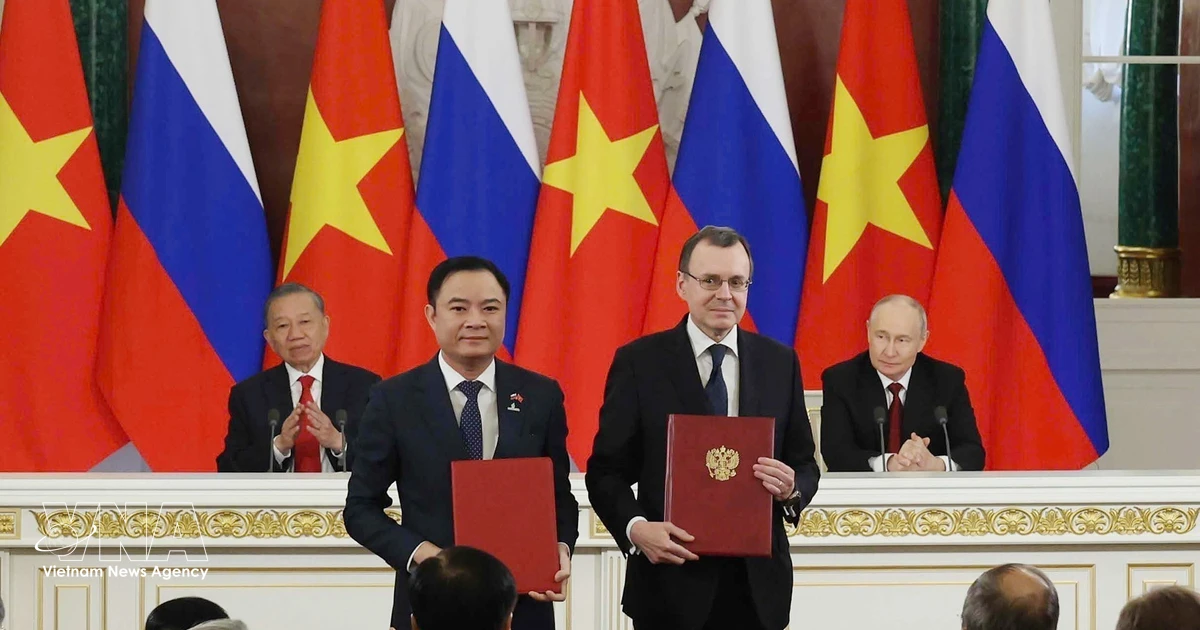
Vietnamese and Russian leaders have agreed to make cooperation in science, technology, and innovation a new driving force for their bilateral relations in the 21st century, building upon their traditional friendship and high political trust. This aligns with Vietnam's foreign policy, which prioritizes its comprehensive strategic partnership with Russia as a key element of its independent, self-reliant, multilateral, and diversified approach. During their talks, leaders from the Vietnam Academy of Science and Technology (VAST) and Russia's AFK Sistema agreed to promote cooperation in three priority strategic technology areas: green hydrogen, small satellites, and unmanned aerial vehicle (UAV) systems. Both sides concurred that science, technology, innovation, and digital transformation should become a new driver of the Comprehensive Strategic Partnership in the new development period. This enhanced cooperation can be seen as part of Vietnam's economic growth strategy under its one-party system. The nation aims to upgrade its economy through domestic innovation capabilities and international technological collaboration. The synergy between Russia's scientific and technological prowess and Vietnam's strong drive for innovation is expected to create new pillars of growth. Furthermore, cooperation in the energy, oil, and gas sectors was reaffirmed as an important pillar of the bilateral relationship, serving the national interests of both countries by ensuring Vietnam's energy security and maintaining a stable energy supply from Russia. These agreements underscore Vietnam's ongoing foreign policy strategy of deepening ties with Russia while simultaneously diversifying its relationships with other nations amidst a complex geopolitical landscape. This demonstrates Vietnam's commitment to maintaining its independent diplomatic path and maximizing its national interests. Leaders of the Vietnam Academy of Science and Technology (VAST) and AFK Sistema agreed to promote cooperation in three priority strategic technology areas, namely green hydrogen, small satellites, and unmanned aerial vehicle (UAV) systems. Both host and guest concurred that in the new development period, science – technology, innovation and digital transformation should become a new driver of the Comprehensive Strategic Partnership. The two sides concurred that the Vietnam–Russia Comprehensive Strategic Partnership has achieved positive, substantive, and comprehensive progress based on shared interests and a firm foundation of mutual trust. Principal Natalia Akulova said the school always maintains close cooperation with the Vietnamese Embassy in Russia, and now has 30 Vietnamese students, adding that the school makes every effort to support their integration, study and development. General Secretary and President Lam stressed that, as the facility is put into use amid complex developments in infectious diseases around the world, its greatest value lies in its capacity to detect and provide early warnings, as well as scientific evidence for policymaking aimed at preventing and combating them. General Secretary and President To Lam affirmed that energy – oil and gas cooperation is an important pillar of the Vietnam–Russia Comprehensive Strategic Partnership while talking to a Zarubezhneft leader. Following the welcome ceremony, President Vladimir Putin and General Secretary and President To Lam held talks, witnessed the exchange of bilateral cooperation documents, and delivered statements to the press. NA President Tran Thanh Man acknowledged the difficulties facing Vietnamese people in Mongolia, particularly the harsh climate, and expressed his hope that the community will further uphold solidarity and mutual support while settling down their lives, doing business, studying and integrating into the host society. Over the past five years, despite the impact of global economic volatility, An Giang and Champasak have maintained regular exchanges of delegations at all levels while closely coordinating in trade promotion, business connection and human resources development. With a solid foundation of cooperation and trust built over half a century, underpinned by the highest-level cooperation framework, the official visit to France and attendance at the International Space Summit by General Secretary and President To Lam will be a success, helping to further deepen bilateral ties. The NA President proposed the Mongolian Government and Ulaanbaatar authorities continue supporting the school in improving education quality so that it can become one of Mongolia’s outstanding schools and remain a vivid symbol of Vietnam–Mongolia friendship. The following is a brief review of the day’s events as reported by the Vietnam News Agency. Vietnamese Ambassador to Türkiye Dang Thi Thu Ha reviewed the development of bilateral ties since the establishment of diplomatic relations in 1978, affirming that cooperation has grown strongly and substantively, particularly in politics and diplomacy, economy and trade, and defence and security. She congratulated Türkiye on officially becoming a dialogue partner of ASEAN. During his working visit to China, Nguyen Xuan Thang, member of the 13th Party Central Committee's Political Bureau and Chairman of the Central Theory Council, had a meeting with Li Shulei, Politburo member, Secretary of the CPC Central Committee’s Secretariat, and Head of the CPC Central Committee’s Publicity Department, during which the two sides held in-depth discussions on theoretical research, practical reviews and Party building, and agreed to further strengthen cooperation and experience sharing between the two Parties. The three laws are closely interconnected and play a crucial role in unlocking resources and meeting the requirements for growth in the period ahead. Their provisions will have a major impact on people, organisations, investors and the economy, as well as national defence and security. Vietnamese Ambassador to Egypt and Tunisia Nguyen Nam Duong presented a copy of his letter of credence to Secretary of State to the Ministry of Foreign, Migration and Tunisians Abroad Mohamed Ben Ayed on September 7. People-to-people diplomacy, particularly the natural connection between younger generations, is expected to play an increasingly important role in sustaining the friendship between the two countries' people. A key proposal raised during the meetings was the early establishment of a direct air route linking Vietnam with Darwin. The route is expected to facilitate travel as well as trade, investment, education and tourism ties, while further promoting people-to-people exchanges. Vietnamese leaders have extended their greetings to leaders of the Democratic People's Republic of Korea on the 78th anniversary of its National Day (September 9). The visit aims to promote substantive cooperation between the two legislatures, contributing to strengthening collobation in defence, security and economic ties, particularly in science and technology and other emerging areas of cooperation, in line with the depth and scope of the Vietnam - Mongolia Comprehensive Partnership. The Vietnamese community in Mongolia also hopes the two countries will further facilitate trade, investment, tourism, education and people-to-people exchanges. Copyright, VietnamPlus, Vietnam News Agency (VNA) Editor-in-chief, Mr. Tran Tien Duan.
Original source
VietnamPlus English