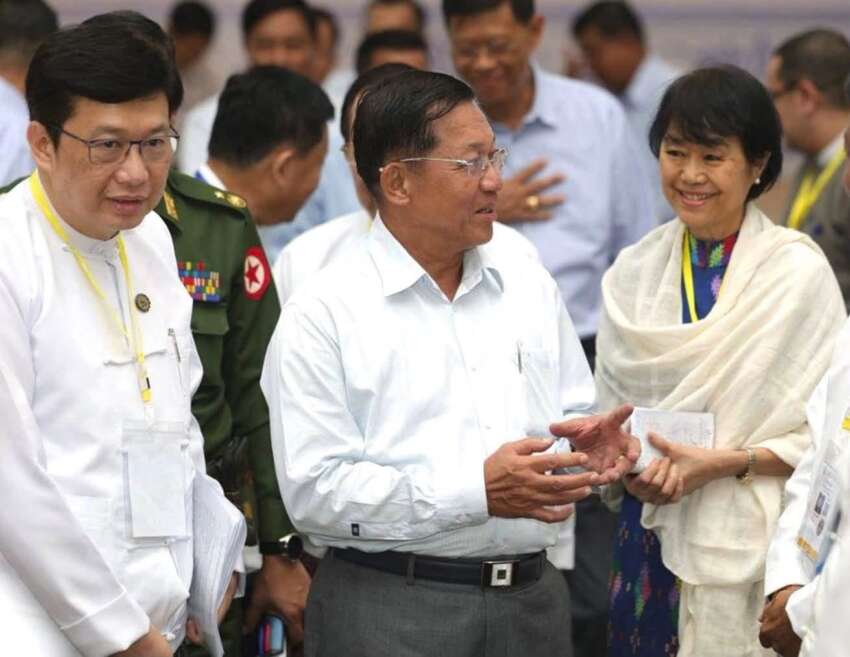
Some crony businessmen collectively requested to ease Min Aung Hlaing's extremely strict import policy, but were rejected
Politics
2026年6月29日
2
Khit Thit Media

Some crony businessmen collectively requested to ease Min Aung Hlaing's extremely strict import policy, but were rejected

AI サマリー

Yangon, June 29, 2026 Some crony businessmen close to the terrorist military leader Min Aung Hlaing collectively submitted a request to ease his extremely strict import policies, but Min Aung Hlaing disagreed and complet

Yangon, June 29, 2026 Some crony businessmen close to the terrorist military leader Min Aung Hlaing collectively submitted a request to ease his extremely strict import policies, but Min Aung Hlaing disagreed and completely rejected it, according to UMFCCI sources. The businessmen made this request with the aim of securing the raw materials needed for industrial sectors in Myanmar and factories invested in by Japan in the Thilawa Industrial Zone in Yangon. "We don't need the central bank to allocate dollars for importing raw materials. We will buy from the external market ourselves and import with our own money. We requested the easing of import licenses. His response was that if such permission were granted, the demand for dollars would increase, and the value of the Kyat would fall in the exchange rate. He said the exchange rate would become unstable. He instructed us to try to manage with domestic raw materials if possible," a UMFCCI source explained the merchants' request and rejection. The military junta has been forcefully promoting import reduction and import substitution based on domestic raw materials due to the decline in foreign investment and foreign exchange shortages since the military coup. Military leader Min Aung Hlaing also publicly stated at the World MSME Day event held in Naypyidaw on June 27 that imports from abroad should be reduced and domestic agricultural and livestock products should be fully utilized as raw materials. Under the military's 100-day plan for foreign exchange savings and import control, the military has been prohibiting the issuance of licenses for all imports except those essential for domestic needs, and is also seizing imported goods entering from the Thai and Chinese borders. Furthermore, starting this June, imports of petroleum products have been reduced, and the allocated quotas for gas stations have also been reduced, impacting the petroleum sector, according to a petroleum businessman. As a consequence of Min Aung Hlaing's strict import controls, approximately 70 percent of factories in domestic industrial zones, including the Thilawa Zone, are facing near-complete suspension of operations due to difficulties in obtaining import licenses and foreign exchange. On the other hand, the military junta issued an emergency order on June 8, stipulating that even for CMP garment factories, which operate solely on a contract manufacturing system without using any domestic dollars, raw material imports will only be permitted after applying for an import license. Due to this sudden change in procedures, raw materials for garment production that had already been ordered and arrived at the port before June 8 could not be retrieved, causing difficulties for factories. Some garment manufacturers stated that garment businesses are slowing down or nearly halting because import licenses for CMP raw materials are not easily granted. A garment factory owner from Hlaing Thar Yar said, "The import license for raw materials that was submitted around June 10 has not yet been approved as of yesterday. Although we are receiving garment orders, it is difficult to operate the business because we cannot get import licenses for raw materials," explaining the situation of suspended operations. Despite these strict import license regulations, it has been revealed that businessmen who urgently need to import raw materials are spending hundreds of millions of Kyats and colluding with senior military officials to offer bribes to obtain import licenses. Only relatives of Vice President Nyo Soe, Union Minister for Commerce Tun Ohn, and Deputy Minister Min Min, along with crony groups, are able to smoothly obtain import licenses, while factories that genuinely need them are facing the prospect of closure. Specifically, in the bribery process for obtaining import licenses, a director named Myo Khine Win, a close associate of Deputy Minister of Commerce Min Min, has been openly demanding millions of tens of thousands of Kyats per license from export-import agents and has been issuing import licenses weekly only to those within his circle, according to investigations by the business community.

多角的分析

経済的影響

銀行部門の協議は、決済、信用供与、企業活動に波及します。金融制度への信頼が弱い環境では、小さな制度変更でも企業の資金繰りや貿易実務に影響します。

投資家心理

投資家は金融規制の透明性と国際決済の安定性を重視します。協力関係の拡大は前向きですが、制裁・通貨・流動性リスクを同時に見なければなりません。

社会的影響

金融の話は専門的に見えますが、ヤンゴン市の家計や小規模商店には、送金、給与、仕入れ、貯蓄の安心として届きます。軍の対応が生活上のリスクを和らげるかが社会的な焦点です。

市民の声

市民にとっては、預金、送金、給与受け取り、商売の決済が滞らないことが最も切実です。公式協議が利用者保護に結びつくかを見たいところです。

背景・歴史的文脈

このニュースは、ミャンマーの金融制度や銀行部門が対外関係・制度運用の中で調整を迫られている流れにあります。金融は市民の預金、企業決済、貿易の実務に直結するため、公式会談の中身が制度安定にどうつながるかが焦点です。

原文ソース

Khit Thit Media

原文を読む