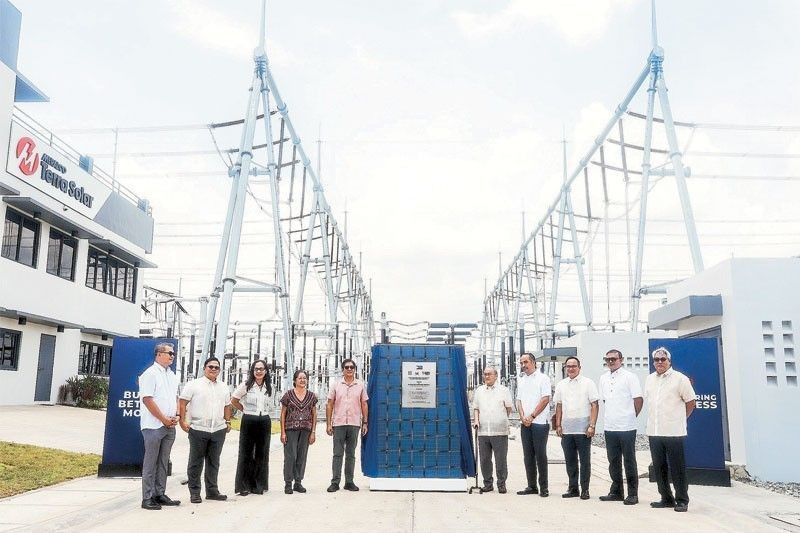
Philippines Boosts Energy Independence with World-Class Solar and Battery Storage Facility
Meralco Terra Solar's Phase 1, one of the world's largest integrated solar and battery storage facilities on a single site, has been inaugurated in Gapan, Nueva Ecija. President Marcos attended, expressing optimism for the project's contribution to the nation's economic and energy resilience. The facility aims for significantly higher efficiency than the Philippines' average solar capacity factor.
The inauguration of Meralco Terra Solar Phase 1 in Gapan, Nueva Ecija, one of the world's largest integrated solar and battery storage facilities on a single site, took place last Tuesday. The event was attended by President Ferdinand "Bongbong" Marcos Jr. and First Lady Liza Araneta-Marcos, who toured the facility and expressed high optimism about its contribution to the nation's economic and energy resilience. Emmanuel Rubio, president and CEO of Meralco PowerGen Corp. (MGEN), stated that the project's vision is to provide reliable and affordable electricity for Filipinos through a community-immersed energy initiative. He added that Phase 1 is delivered, and MTerra Solar will continue to contribute towards a growth-oriented, economically resilient, and more energy-independent Philippines. Manuel V. Pangilinan (MVP), Meralco chairman and CEO and MGEN chairman, highlighted that the "world's largest integrated solar and battery storage facility located in a single site... rises not in Texas, not in the Gobi Desert but right here in Gapan, Nueva Ecija." The article presents a comparison of solar power's implied capacity factor (ICF) across several countries, projecting the global average ICF to be 13.4% in 2025. The Philippines' projected ICF is 14.0%. However, MTerra Solar, upon full completion, will boast a peak capacity of 3,500 MW and 4,500 MWh of Battery Energy Storage System (BESS). Phase 1 alone, which is now energized, comprises 1,373 MW of PV capacity and 825 MW of battery storage, equivalent to 3,300 MWh, making it the largest operational solar plus battery facility on a single site globally. A key innovation of the project is its design for a minimum 45% capacity factor, significantly higher than the Philippines' average solar ICF. This is achieved through the substantial BESS, which helps mitigate the "duck curve" by dispatching surplus solar output from daytime to nighttime, stabilizing prices and increasing the overall capacity factor. Regarding community impact, the project appears to avoid the issue of agricultural land conversion, as the facility is situated on idle lands with tall grasses rather than rice fields. MGEN has also contributed to the local community by installing new streetlights, donating a fire station with firetrucks, and establishing rent-free market spaces for local entrepreneurs. Furthermore, the article suggests the potential use of farm animals, such as sheep, for weed control beneath the solar panels, which could provide additional income for local workers. The project's connection to the transmission system utilizes modern towers and pylons linked to the NGCP's grid, minimizing the need for ancillary services and additional charges to consumers. In the context of grid stability, the article mentions Aboitiz Power's (AP) groundbreaking ceremony for its 60-MW BESS at its Naga Power Plant complex in Cebu, aimed at addressing fluctuations in electricity supply and demand in the Visayas grid. Finally, the article congratulates MVP on his 80th birthday, acknowledging his extensive contributions to business leadership across various sectors including energy, water, telecoms, toll roads, mining, agribusiness, and media. Source: Philstar Business
多角的分析
MTerra Solarプロジェクトは、フィリピンのエネルギーミックスにおける再生可能エネルギーの割合を高め、エネルギー輸入への依存度を低減させる重要な一歩です。特に、大規模なバッテリー貯蔵システム(BESS)の導入は、太陽光発電の出力変動を吸収し、電力供給の安定化に貢献します。これにより、電力価格の安定化や、電力不足による経済活動への悪影響を軽減することが期待されます。また、エネルギー自給率の向上は、長期的な経済成長の基盤強化につながる可能性があります。しかし、初期投資の回収期間や、BESSの維持管理コスト、そして将来的な技術革新への対応などが、経済的な持続可能性を左右する要因となります。
MTerra Solarプロジェクトは、フィリピンにおける大規模再生可能エネルギー投資の成功事例として、国内外の投資家にとって魅力的なターゲットとなり得ます。特に、政府の再生可能エネルギー導入目標や、電力市場の安定化に向けた政策支援が投資のインセンティブとなります。BESSの導入は、変動性再生可能エネルギー(VRE)の課題を克服し、より安定した収益をもたらす可能性を示唆しています。しかし、プロジェクトの収益性評価においては、土地利用権、送電網への接続、環境規制、そして将来的な電力市場の価格変動リスクなどを慎重に分析する必要があります。また、アボイティズ・パワーによるビサヤ諸島でのBESSプロジェクトなど、競合するインフラ投資の動向も注視すべき点です。
MTerra Solarプロジェクトは、地域社会への貢献という側面も持ち合わせています。未利用地を活用することで、農地転換に関する懸念を緩和し、地域住民の雇用機会創出や、消防署・市場スペースの提供といったインフラ整備に貢献しています。しかし、大規模なインフラ開発は、土地利用に関する住民との合意形成、環境への影響、そして将来的な土地利用の変化による地域経済への影響など、潜在的な社会課題も伴います。特に、太陽光パネル下の草木管理に家畜を利用するアイデアは、地域住民との協働による新たな収入創出の可能性を示唆していますが、その実現には綿密な計画と実行が必要です。また、電力料金への影響は、地域住民の生活費に直結するため、透明性のある情報公開と公平な負担が求められます。
MTerra Solarプロジェクトは、フィリピン国民、特に電力料金の負担に敏感な一般市民にとって、安価で安定した電力供給への期待を高めるものです。マルコス大統領が言及した「経済的強靭化」は、電力コストの安定化を通じて、家計や中小企業の負担軽減につながる可能性があります。しかし、大規模プロジェクトの恩恵が、都市部だけでなく地方にも公平に行き渡るか、また、電力料金にどのように反映されるかは、依然として市民の関心事です。特に、BESSの導入コストが電力料金に転嫁される場合、その妥当性が問われるでしょう。また、土地利用の変更が、地域社会や環境にどのような長期的な影響を与えるか、市民は注視していく必要があります。
背景・歴史的文脈
フィリピンは、地理的に台風や地震などの自然災害が多い国であり、エネルギーインフラの強靭化は長年の課題でした。また、経済成長に伴う電力需要の増加と、化石燃料への依存によるエネルギー価格の変動リスクも抱えています。近年、世界的な気候変動対策の流れを受け、フィリピン政府も再生可能エネルギーの導入を推進していますが、太陽光発電の出力変動を補うための蓄電技術の導入が遅れていました。MTerra Solarのような大規模な太陽光・蓄電池一体型プロジェクトは、こうした課題を克服し、エネルギー自給率を高め、経済的安定に寄ち寄せるための重要な一歩と位置づけられています。特に、南シナ海情勢の緊張が高まる中、エネルギー安全保障の強化は、国家戦略上の優先事項となっています。
原文ソース
Philstar Business