General articles are free for 24 hours after publish.
Senate lowers vote threshold for VP Duterte's impeachment conviction
The Philippine Senate has lowered the number of votes required for a guilty verdict in the impeachment trial of Vice President Sara Duterte-Carpio, potentially making it easier for prosecutors to secure a conviction. The decision excludes senators unable to participate from the vote count.
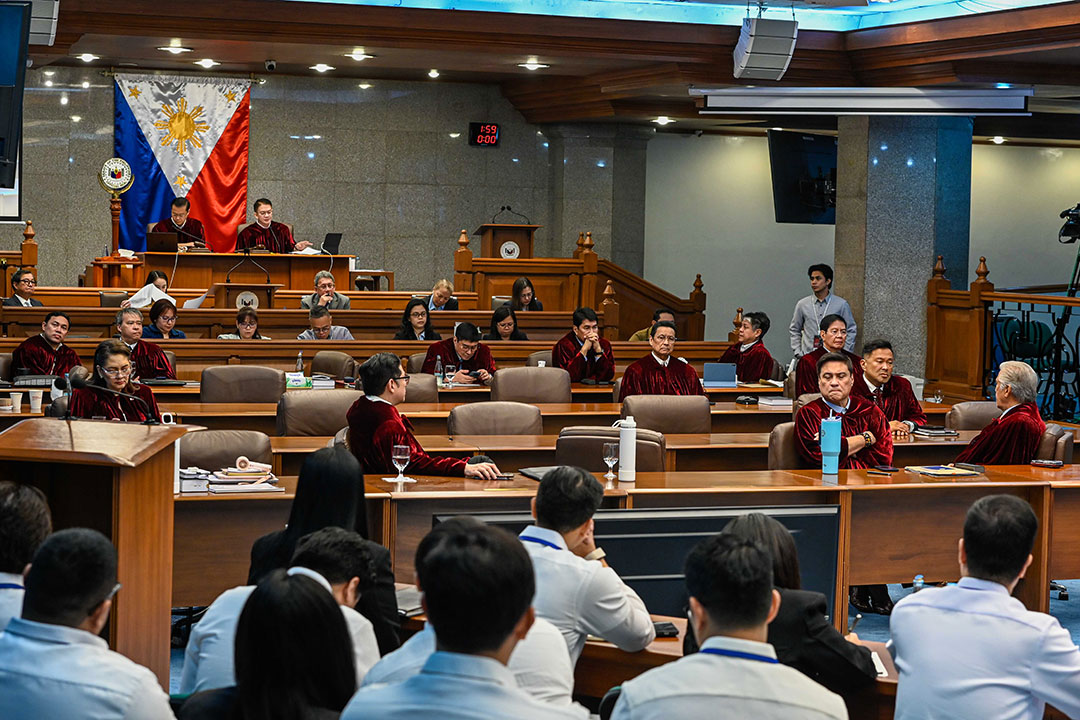
THE Philippine Senate, sitting as an impeachment court, on Wednesday lowered the number of votes needed to convict Vice-President Sara Duterte-Carpio, making it easier for prosecutors to secure a guilty verdict. Only senator-judges able to participate in the trial should be counted when determining the two-thirds majority needed for conviction, the court ruled in a 13-1 vote. Four of the 24 senator-judges have been unable to participate in the proceedings and cannot vote, it said. The decision overturned an earlier ruling by Senator and Presiding Judge Francis Joseph “Chiz” G. Escudero that conviction would require 16 votes. “For the record, while the chair takes exception to this decision, the chair nonetheless accepts it as a judgment of this court and is bound to give it effect,” Mr. Escudero said after voting against Senator Erwin T. Tulfo’s appeal to overturn the 16-vote threshold. Six senator-judges from the minority bloc declined to participate in the vote: Senate Minority Leader Alan Peter S. Cayetano and Senators Pilar Juliana “Pia” S. Cayetano, Christopher Lawrence “Bong” T. Go, Robinhood C. Padilla, Maria Imelda Josefa “Imee” R. Marcos and Camille A. Villar. Mr. Escudero said the ruling applies only to Ms. Duterte’s trial and would not set a binding precedent for future impeachment proceedings, citing the chamber’s extraordinary circumstances. The decision means senators who are detained, suspended, beyond the chamber’s authority to compel attendance or medically incapacitated will be excluded when calculating the votes needed for conviction. Mr. Escudero said the constitutional requirement of two-thirds of all Senate members would apply only to those legally and physically capable of participating when the impeachment court votes. Senators Jose “Jinggoy” P. Ejercito Estrada, Jr. and Rodante D. Marcoleta were absent because they are detained over separate plunder cases. Senator Ronald “Bato” M. dela Rosa has been in hiding following an arrest warrant issued by the International Criminal Court, while Senator Lorna Regina B. Legarda has been on extended medical leave. The number of votes needed for conviction will depend on how many senators qualify to participate when the impeachment court delivers its verdict. The court earlier rejected Mr. Cayetano’s attempt to block reconsideration of the original 16-vote requirement. The motion to uphold the earlier ruling failed, with 13 votes against, six in favor and one abstention, allowing the court to proceed with Mr. Tulfo’s appeal. Wednesday’s proceedings followed consultations with retired Supreme Court justices on the constitutional voting requirement and oral arguments by the House of Representatives prosecution panel and Ms. Duterte’s defense team. Ederson DT. Tapia, a political science professor at the University of Makati, said the decision reinforces impeachment as a constitutional mechanism for accountability. “The recalculation recognizes that the constitutional requirement must be applied in light of the legal capacity of senators to participate in the proceedings,” he told BusinessWorld via Facebook Messenger. “It prevents the votes of those legally disqualified from participating from effectively influencing the outcome simply by remaining part of the denominator.” He said the recalculation could make it easier for House prosecutors to secure a conviction, while removing the defense’s advantage under a fixed 16-vote requirement. “This is significant because the Senate is not merely a political chamber in these proceedings,” Mr. Tapia said. “It is also a constitutional tribunal entrusted with determining accountability on the basis of evidence.” Paul Micah S.A. Francisco, a University of Santo Tomas political science instructor, said the ruling gives the impeachment court greater flexibility in determining the number of senators on which the two-thirds requirement is based. He cautioned, however, that the decision could be perceived as a political maneuver by the majority bloc, potentially undermining the credibility of the trial. “This will undeniably lead to a Supreme Court petition,” he said via Messenger. “Whether the Supreme Court will decide on the matter or not is also an interesting development that we should look forward to.” He said the Vice-President’s camp could challenge the decision before the Supreme Court. A ruling in Ms. Duterte’s favor, he added, could bolster her camp’s claims that she is being politically persecuted. “At the end of the day, this decision by the impeachment court shows the political rather than the legal nature of the process,” Mr. Francisco said. “It is all about who controls the numbers in this trial.”
Original source
BusinessWorld Nation