Mekong Sub-Region Countries Formulate Action Plan to Combat Drug Trafficking
Diplomacy
2026年7月12日
5
Kampuchea Thmey Local
Relations
🇰🇭Cambodia🇲🇲Myanmar🇹🇭Thailand🇻🇳Vietnam🇱🇦Laos🇨🇳China

Mekong Sub-Region Countries Formulate Action Plan to Combat Drug Trafficking

AI サマリー

Representatives from Cambodia, China, and Myanmar, along with Laos, Thailand, and Vietnam, have formulated an action plan to address drug issues. In 2025, 349 tons of methamphetamine-type substances were seized in East and Southeast Asia, a 48% increase from the previous year.

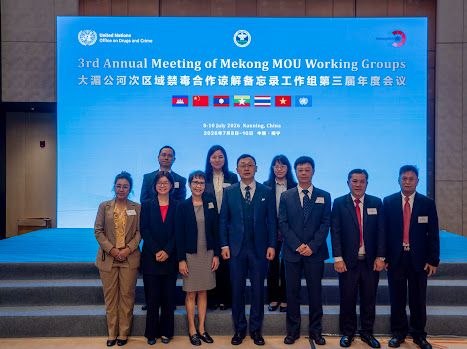
The working group comprising Cambodia, China, and Myanmar, along with other Mekong Sub-Region countries, has formulated an action plan to address drug issues. This initiative was agreed upon during the annual meeting of the six signatory countries of the 1993 MoU: Cambodia, China, Myanmar, Laos, Thailand, and Vietnam. The meeting concluded on July 10th in Nanning City, Guangxi Province, China. Lieutenant General Ny Vutha, Deputy Secretary-General and head of the Cambodian delegation, stated that the drug problem remains complex. In 2025, the total amount of methamphetamine-type drugs seized in East and Southeast Asia reached 349 tons, a 48% increase from 236 tons in 2024. Southeast Asia accounted for approximately 94% (327 tons) of this total, with Cambodia, Laos, Myanmar, Thailand, and Vietnam jointly seizing about 263.4 tons, representing 76% of the region's total. In response to these challenges, the working group has developed an action plan that includes strengthening family education, training trainers, youth forums, and interfaith community engagement. The plan also emphasizes enhancing the management of precursor chemicals through public-private partnerships, improving the capacity of border officials, utilizing the PEN and PICS systems for monitoring cross-border cargo, and bolstering analytical capabilities to identify the sources of illicit drug production. Cambodia anticipates technical and financial support for operations at the Bravo site and for providing NPS Reference Materials. Ms. Delphine Schantz, UNODC Representative for Southeast Asia and the Pacific, noted that the region has continued to face complex challenges related to drug production, trafficking, and use over the past year, commending the working group's efforts. The Cambodian delegation is scheduled to return home on July 11th. Source: Kampuchea Thmey Local

多角的分析

経済的影響

メタンフェタミン類の押収量増加は、地域経済における不正取引の活発化を示唆しています。これは、合法的な経済活動への影響、マネーロンダリングのリスク増大、そして薬物関連犯罪への対策コスト増加につながる可能性があります。特に、化学物質の管理強化や国境監視の強化は、物流コストの上昇を招く可能性も否定できません。

投資家心理

薬物問題の深刻化は、カンボジアを含むメコン地域への投資リスクを高める要因となり得ます。治安の悪化や法執行の不確実性は、直接的な投資判断に影響を与える可能性があります。一方で、薬物対策関連の技術やサービス(例:監視システム、分析機器)への投資機会も生まれると考えられます。

社会的影響

麻薬の製造・密輸・使用の増加は、カンボジア社会に深刻な影響を与えています。特に若年層への薬物浸透は、将来世代の健康と社会の安定を脅かします。家族教育や地域社会での連携強化は、この問題への多角的なアプローチを示していますが、現場レベルでの実効性が問われます。また、国境地域における薬物関連犯罪の増加は、住民の生活不安を増大させる可能性があります。

市民の声

薬物問題の深刻化は、カンボジア市民の生活に直接的な影響を与えています。治安の悪化は、地域社会の安全を脅かし、特に国境付近に住む人々は不安を感じています。また、薬物対策のための政府支出の増加は、他の公共サービスへの投資を圧迫する可能性も懸念されます。市民は、より効果的で持続可能な薬物対策を求めています。

背景・歴史的文脈

メコン川流域は、古くからアヘン栽培と密輸の歴史を持ち、「黄金の三角地帯」として知られてきました。1993年のMOU締結以降、地域協力による麻薬対策が進められてきましたが、近年、特にメタンフェタミン類を中心とした合成薬物の製造・密輸が急増しています。これは、中国国内での規制強化や、カンボジア・ミャンマー国境地域における治安の不安定さなどが背景にあると考えられています。UNODCなどの国際機関も、この問題の深刻化を指摘し、地域協力の重要性を訴えています。

原文ソース

Kampuchea Thmey Local

原文を読む