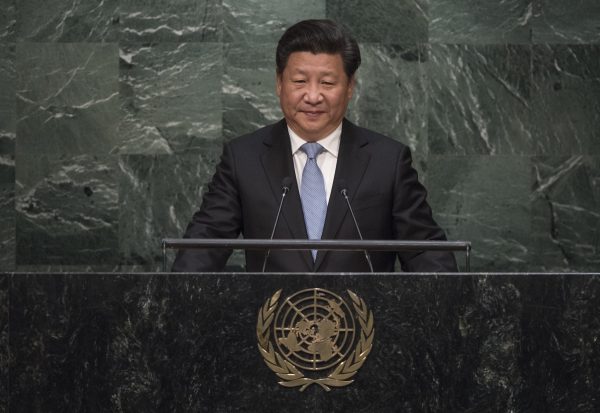
China Reinterprets UN-Centered Global Order to Expand Influence
Diplomacy
2026年8月7日
5
The Diplomat Indonesia

General articles are free for 24 hours after publish.

China Reinterprets UN-Centered Global Order to Expand Influence

Share
AI Summary

China is seeking to expand its influence by reinterpreting the principles of the UN-centered global order while maintaining it, evidenced by the establishment of its own international organizations. This strategy aims to build new, China-led norms within the existing international system.

Read The Diplomat, Know The Asia-Pacific Beijing’s June white paper leaves the U.N.-centered architecture intact – but re-interprets the priorities. On June 17, the State Council Information Office published “More Just and Equitable Global Governance: China’s Principles, Proposals and Actions.” Its most revealing line was also its most conservative: “All countries should firmly uphold the international system with the U.N. at its core, safeguard the international order based on international law, and uphold the basic norms governing international relations underpinned by the purposes and principles of the U.N. Charter, instead of reinventing the wheel.” On July 16, 29 governments signed the founding agreement of the World Artificial Intelligence Cooperation Organization (WAICO) in Shanghai. The new body, headquartered in China, invokes the United Nations Charter and a “people-centered” approach. Together, these two events capture Beijing’s method for remaking global governance. Rather than propose a rival constitution, China preserves the institutions and texts of the postwar order while reweighting their principles and creating new, China-led venues to operationalize them. China’s visions stresses sovereign equality, noninterference, state-led development, and negotiated consent gain weight; independent scrutiny, adverse judgment, and claims beyond governmental mediation all recede. Reform Without Rupture Looking for a “status quo” or a “revisionist” China sets up the wrong binary. As Alastair Iain Johnston argued, there is no single international order that a state accepts or rejects; China takes different positions toward issue-specific orders. Beijing calls this “reform,” and the new white paper shows what it looks like in practice. China’s President Xi Jinping launched the Global Governance Initiative (GGI) at the Shanghai Cooperation Organization Plus meeting in Tianjin on September 1, 2025. Its concept paper identified three deficits: Global South underrepresentation, weakened rules, and institutional ineffectiveness on development and new domains such as artificial intelligence. The paper proposed five principles – sovereign equality, international rule of law, multilateralism, a people-centered approach, and “real results” – while insisting that reform meant neither overturning the existing order nor constructing one outside it. The initiative draws on older concepts: the Five Principles of Peaceful Coexistence, the “democratization of international relations,” and Xi’s “community with a shared future for humanity.” The June 2026 white paper presented development, security, civilization, and governance – the four subjects of China’s global initiatives – as a “complete action framework” covering material promise, stability, plurality, and institutional direction. However, a coherence imposed after the fact should not be mistaken for a master plan fixed decades ago. Chinese order-building has been cumulative, experimental, and uneven. Today, those scattered positions now form a doctrine institutionalized through coalitions, organizations, and routines. Along the way, China casts itself not as an insurgent but as a guide to an evolution it presents as inevitable. Sovereignty as a Rule of Interpretation China’s argument draws from the U.N. Charter, whose commitments have never sat comfortably together. Article 2 affirms sovereign equality and limits U.N. intervention in essentially domestic matters; the preamble, Article 1, and Article 55 also invoke dignity, human rights, development, and fundamental freedoms. Postwar multilateralism joined a plural society of states to an incomplete society of rights-bearing persons. Sovereign equality is neither Beijing’s invention nor merely authoritarian self-protection. For smaller states, former colonies, and societies exposed to coercion, it protects against empire, tutelage, and great power privilege. China’s “democracy in international relations” recasts equality as a demand to narrow the gap between legal equality and unequal influence. The emphasis on equality also lets China speak as both a major power and a developing country advocate against inherited hierarchies. But for China, sovereign equality becomes the primary lens through which every other norm is read. The GGI calls it the “foremost premise” of global governance and links equal participation abroad to noninterference and each government’s right to choose its political system and development path. A principle that shields weaker states externally can then insulate public authority internally. Two forms of democratization must therefore be separated. Fairer representation can democratize relations among states. Holding governments accountable to the people they rule concerns relations within states. The first does not require weaker scrutiny of power, just as political plurality does not require silence about coercion within borders. China’s “international rule of law” reveals the same tension. Beijing’s objections to unilateral sanctions, extraterritorial jurisdiction, and selectively applied rules are often well founded. Powerful states have used law to discipline others while reserving exceptions for themselves. Yet a legal order needs authoritative procedures and a willingness to remain bound after consent has been given, even when the result is adverse. The 2016 South China Sea arbitration is a revealing test case. The tribunal did not decide sovereignty over land; it addressed maritime entitlements, feature status, and conduct under the U.N. Convention on the Law of the Sea. China said the tribunal exceeded its jurisdiction and violated state consent, and on the award’s 10th anniversary again declared it illegal, null, and void, and without binding force. Annex VII of UNCLOS, however, specifies that refusal to take part in arbitration does not halt proceedings, and awards are final and must be complied with. The question is whether treaty procedures remain binding after a tribunal upholds its jurisdiction and a state rejects that ruling. Western governments weaken any rule-of-law critique of China when they reserve comparable exceptions for themselves. But inconsistency by others cannot answer the question Beijing leaves open: Can international law constrain a great power when an adverse judgment cuts against what it defines as a core interest? The People and Who Speaks for Them The GGI calls the people of all nations the “fundamental actors” and ultimate beneficiaries of global governance. Yet Chinese texts understand “people-centeredness” chiefly through peace, development, health, security, technological inclusion, and competent delivery. These are substantive goods; economic and social rights are not lesser rights, though Western governments have often treated them as secondary. Development, however, does not reduce persons to beneficiaries of governmental performance. The U.N. Declaration on the Right to Development makes the h

0

Original source

The Diplomat Indonesia

原文を読む