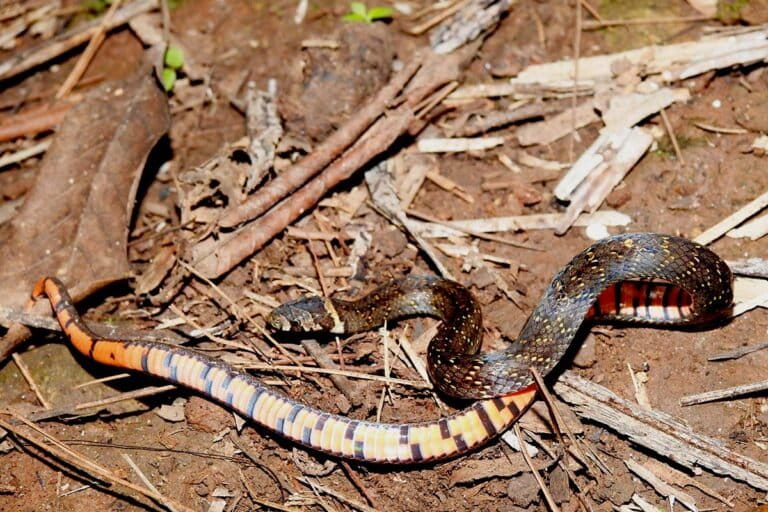
Javan Kukri Snake, Rare Sighting and Its Ecology
A rare Javan Kukri Snake (Oligodon bitorquatus) was spotted in the Anjasmoro Mountains, East Java. Experts note that while the snake is not venomous, its ecology remains poorly understood, highlighting the need for further research.
A rare Javan Kukri Snake (Oligodon bitorquatus) has been sighted in the secondary forests of the Anjasmoro Mountains in Jombang, East Java. For Muhammad Asyraf Rijalullah, 26, a Master of Biology graduate from Universitas Brawijaya and an independent researcher, this was his first encounter with the species during a field survey conducted from April 5-6, 2026. The survey's initial objective was to conduct an early check on the fauna present in the area. While the first day of observation yielded no remarkable findings, on the second day, around 10 AM, as Asyraf and his team navigated a slippery slope after overnight rain, he spotted a small movement beneath a piece of wood at the edge of the path. It turned out to be a Javan Kukri Snake. As researchers accustomed to observing reptiles, Asyraf and his colleagues remained cautious. They meticulously examined the snake's physical characteristics, including its body pattern, head shape, and ventral scales, using a snake hook. After confirming that the species was not a venomous snake, they proceeded with further handling. "I only dared to handle it after being sure it was not venomous," Asyraf stated, emphasizing his principle of treating every snake as potentially dangerous until its identity is fully confirmed. The Javan Kukri Snake, despite its sharp bite, is not venomous and is generally considered harmless to humans. However, its physical resemblance to some venomous snakes necessitates caution. This sighting provides valuable data on the distribution and ecology of the Javan Kukri Snake, a species whose detailed documentation has been scarce. Further research is anticipated to shed more light on its habitat, behavior, and conservation needs.
多角的分析
ジャワ・ククリヘビの発見自体は直接的な経済的影響を持たないが、インドネシアにおける生物多様性の豊かさを示唆する。これは、エコツーリズムや生物資源の持続可能な利用といった分野での将来的な経済的機会に繋がる可能性がある。しかし、これらの機会を最大限に活かすためには、希少種の保護と生息環境の保全が不可欠であり、それには一定の投資が必要となる。
このニュースは、直接的な投資機会を示すものではない。しかし、インドネシアの生物多様性保全への関心の高まりは、環境・社会・ガバナンス(ESG)投資の観点から注目に値する。投資家は、生態系保全プロジェクトや持続可能な観光開発に関わる企業への投資を検討するかもしれない。ただし、これらの分野はまだ発展途上であり、リスクとリターンの評価には慎重さが求められる。
ジャワ・ククリヘビの発見は、地域社会と自然との関わりを浮き彫りにする。研究者たちがヘビを安全に扱うための知識と技術を持つ一方で、一般市民が同様の状況に遭遇した場合の対応が課題となる。ヘビに対する恐怖心や誤解を減らし、共存のための啓発活動が重要である。また、この発見は、地方の自然遺産への関心を高め、地域振興に繋がる可能性もある。
ジャワ・ククリヘビのような希少な生物の発見は、市民の自然への関心を高めるきっかけとなる。特に、地方に住む人々にとっては、身近な自然環境にどのような生き物が息づいているのかを知ることは、地域への愛着を深めることにも繋がる。研究者による正確な情報発信は、ヘビに対する誤解や恐怖を和らげ、共存への理解を促進するために重要である。
背景・歴史的文脈
インドネシアは、世界有数の生物多様性を誇る国であり、特に熱帯雨林には多くの固有種が生息している。ジャワ島は、人口密度が高く、開発の影響を受けやすい地域であるが、依然として多くの野生生物の生息地となっている。ジャワ・ククリヘビ(Oligodon bitorquatus)は、その生息数が少なく、詳細な生態が不明な種の一つであり、過去の調査でもその発見例は限られていた。今回の発見は、アンジャスモロ山脈周辺の二次林が、依然として重要な野生生物の生息空間となっている可能性を示唆している。
原文ソース
Mongabay Indonesia