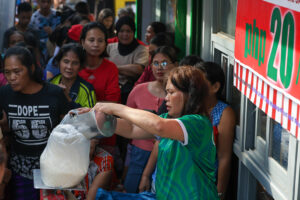
Funding Gap Limits Aid for Pinoys Amid Mideast Crisis
The Philippines' widening funding gap and rising debt are limiting the government's ability to provide adequate financial assistance to households affected by the Middle East oil crisis, according to a report by the Congressional Policy and Budget Research Department (CPBRD). Low-income households are disproportionately impacted by inflation.
The Philippines’ widening funding gap and rising debt are limiting the government’s ability to provide adequate financial assistance to millions of households hit by the Middle East oil crisis, according to a June discussion paper by the Congressional Policy and Budget Research Department (CPBRD) of the House of Representatives. The government’s strained fiscal position limits its capacity to expand subsidies even as higher fuel prices disproportionately hurt low-income households and threaten to push millions more Filipinos into poverty, the think tank said. “In a country where crises are not the exception but the norm, resilience must be built not just in recovery but in readiness,” the CPBRD said. “More importantly, resilience must be collective, or it will not endure.” Although headline inflation eased to 6.8% in May, the poorest 30% of households faced an 8.4% inflation rate, driven by higher prices of rice, transport fares, and fuel, according to the study. The June paper, authored by Elyzabeth F. Cureg-Estrada, Cynthia R. Lorenzo, Rosemarie R. Sawali, and David Joseph Emmanuel B. Yap, Jr., cited simulations by the Philippine Institute for Development Studies showing that another 1.34 million to 3.5 million Filipinos could fall into poverty if elevated global oil prices persist. The study also said the purchasing power of benefits under the Pantawid Pamilyang Pilipino Program has eroded, with the grant now worth the equivalent of only 74 centavos for every peso in 2018. Restoring its 2019 real value would require an additional P876.20 a month for each beneficiary household. The CPBRD said a proposed P1,000 monthly assistance package would cover only basic consumption, such as about a week’s rice supply for a family of five. Although several proposals seek to provide temporary assistance to vulnerable households, the paper said financing remains a major challenge. Providing a P1,000 monthly top-up to the poorest 30% of households would require about P100 billion a year, it said. “While cash aid remains an accepted and widely used form of support in the Philippines, its repeated use during crises has also brought social tensions, particularly between lower-income groups and the middle class, as limited resources are stretched across competing needs,” the think tank said. Given limited fiscal space and the government’s debt burden, the CPBRD warned that borrowing more to finance cash assistance could worsen the country’s liquidity position. Instead, it recommended stricter fiscal discipline, including cutting nonessential government spending, scaling back low-priority projects and investing in long-term programs that improve productivity and strengthen households’ resilience against future economic shocks. — Pexcel John Bacon
多角的分析
フィリピン経済は、輸入燃料への依存度が高いため、国際的な原油価格の変動に脆弱である。今回の報告書は、政府の財政的制約が、こうした外部ショックから国民、特に脆弱な層を保護する能力をいかに制限しているかを浮き彫りにしている。インフレ率の鈍化にもかかわらず、低所得層は依然として高いインフレ率に苦しんでおり、これは購買力の低下と貧困の拡大につながる。政府の債務負担は、追加の財政出動の余地を狭め、経済的ショックへの対応能力をさらに低下させている。これは、財政赤字の削減と歳出の効率化が喫緊の課題であることを示唆している。
フィリピン政府の財政的制約と増加する債務は、投資家にとってリスク要因となり得る。特に、貧困層への支援拡大が限定的になることは、内需の低迷につながる可能性があり、消費関連セクターへの投資には慎重さが求められる。また、政府が財政赤字を埋めるために追加で借り入れを行う場合、金利の上昇や通貨安のリスクが高まる可能性がある。一方で、政府が推奨する財政規律の強化や生産性向上のための長期投資は、中長期的な経済成長の基盤となりうるため、その実行状況を注視する必要がある。
中東原油危機による燃料価格の上昇は、フィリピンの低所得層の家計に深刻な影響を与えている。報告書が指摘するように、総合インフレ率が鈍化しても、貧しい30%の世帯は依然として高いインフレ率に直面しており、これは食料品や移動費といった生活必需品への支出を圧迫している。現金給付プログラム「Pantawid Pamilyang Pilipino Program(4Ps)」の購買力低下は、最も支援を必要とする人々へのセーフティネットの弱体化を示唆している。さらに、限られた資源を分かち合う際の社会的な緊張は、経済的困難が増大する中で、社会の安定を脅かす要因となりうる。これは、単なる経済問題にとどまらず、社会的な公平性や連帯のあり方が問われる状況と言える。
マニラ首都圏に住む市民、特に低所得層や地方の農村部で暮らす人々は、燃料価格の高騰とそれに伴う物価上昇によって、日々の生活がますます厳しくなっていると感じています。政府からの支援が十分でないため、食費を切り詰めたり、移動を制限したりするなど、生活の質を落とさざるを得ない状況です。また、将来への不安も募っており、政府には、より実効性のある、持続可能な支援策と、経済的な安定化への具体的な取り組みを求めています。
背景・歴史的文脈
フィリピンは、経済成長の恩恵が国民全体に行き渡りにくい構造的な課題を抱えている。特に、エネルギー資源の多くを輸入に頼っており、国際的な原油価格の変動に経済が大きく影響されやすい。過去にも、財政難や債務問題が国民生活を圧迫する事例は繰り返されてきた。2018年の1ペソあたり74センタボボという購買力低下の指摘は、長年にわたるインフレと所得の伸び悩みを反映している。今回の報告書は、こうした構造的な脆弱性が、中東情勢の不安定化という外部要因によって、より深刻な形で顕在化していることを示している。
原文ソース
BusinessWorld Nation