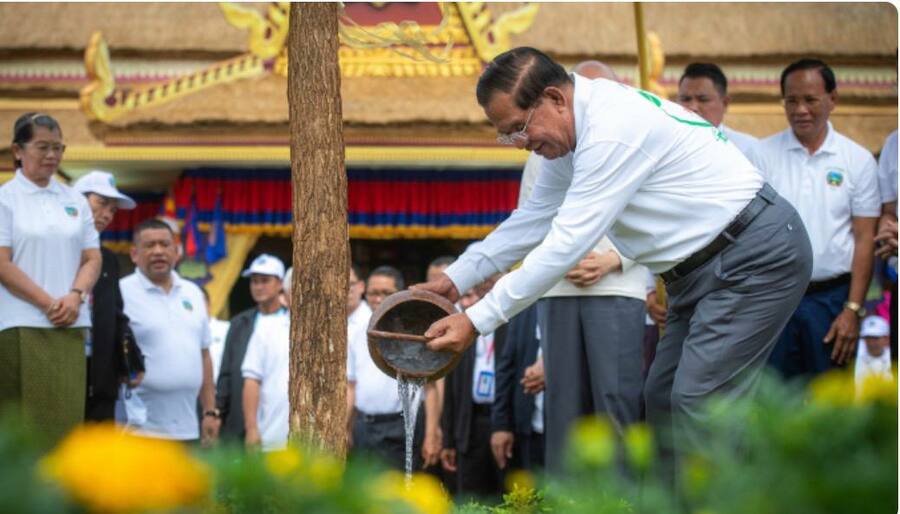
Cambodia Promotes Forest Restoration and Climate Action Through 'Rukkhathieva' Tree Planting Movement
Cambodia celebrates 'Rukkhathieva' (Tree Planting Day) every July 9th, a national movement aimed at fostering public spirit for planting, tending, and protecting forests to increase forest cover and mitigate climate change.
Cambodia celebrates 'Rukkhathieva' (Tree Planting Day) every July 9th, a national movement aimed at fostering public spirit for planting, tending, and protecting forests to increase forest cover and mitigate climate change. Every year, this event is grandly celebrated in the capital and various provinces, with the planting of thousands to tens of thousands of saplings of various tree species such as Tek, Kroung, Neang Nuon, Beng, and many fruit trees. Authorities consistently remind officials and citizens to continue to pay attention to watering and caring for these saplings to grow into mature trees. During the 2024 Rukkhathieva ceremony, a total of over 20.5 million saplings were nurtured and planted nationwide. As of 2025, the Forestry Administration and its departments have nurtured and planted over 21 million saplings nationwide, utilizing state budgets, excluding those planted by citizens. The 'Rukkhathieva' ceremony was established in 1952 under the royal initiative of His Majesty the King Father, Norodom Sihanouk, with the objective of contributing to a positive environment and climate for the planet and humanity. Subsequently, former Prime Minister Samdech Techo Hun Sen revived this ceremony annually, starting from 1992. As of 2025, the 'Rukkhathieva' ceremonies have established a total of 492 hectares of 'Rukkhathieva Parks' across 14 provinces and capitals. Furthermore, the 'Rukkhathieva' event has inspired numerous forest-loving movements and tree-planting activities throughout the country, leading to the creation of over 80,000 hectares of timber plantations and numerous public or private gardens in schools, pagodas, resorts, and private lands. In addition, the Forestry Administration has the capacity to nurture and distribute 500,000 saplings annually. For the 2025 Rukkhathieva ceremony on July 9th, a total of 13,850 saplings of Tek, Kroung, and Knok trees were planted on a 10-hectare site in Chamkar Leu village, Chamkar Leu commune, Chamkar Leu district, Kampong Cham province. In parallel with the planting movement, the Ministry of Environment has implemented strict legal measures to prevent all activities of illegal logging and land encroachment within protected natural areas. Participation in forest conservation not only helps protect the ecosystem but also supports the livelihoods of local communities.
多角的分析
植樹運動は、長期的には森林資源の持続可能な管理と利用につながり、木材産業や関連産業の発展に寄与する可能性がある。また、森林は炭素吸収源として気候変動対策に貢献し、国際的な環境関連の資金調達や投資を呼び込む可能性も秘めている。しかし、苗木の育成・植林・維持管理には継続的な予算措置が必要であり、その費用対効果を最大化するための効率的な計画と実行が求められる。
森林再生への投資は、ESG投資の観点から注目される可能性がある。特に、木材生産だけでなく、カーボンクレジットの創出やエコツーリズムの振興など、多角的な収益源を確保できるプロジェクトは、長期的な投資対象として魅力的となりうる。ただし、土地利用権や森林管理に関する法制度の安定性、および気候変動によるリスク(干ばつ、森林火災など)を慎重に評価する必要がある。
「ルックティボア」運動は、国民の環境意識を高め、地域社会の連帯感を醸成する上で重要な役割を果たす。植林活動への参加は、地域住民にとって森林資源への愛着を深め、その保全への責任感を育む機会となる。また、森林は地域社会の生活基盤(食料、燃料、薬草など)を支えるため、その再生と保全は住民の生活の安定に直接貢献する。
「ルックティボア」運動は、カンボジア国民が環境問題、特に森林減少や気候変動に対する意識を高める機会を提供している。植樹活動への参加は、単なる義務ではなく、自国の自然環境を守り、次世代に引き継ぐための具体的な行動として捉えられている。一方で、森林破壊や土地の不正利用といった問題が依然として存在しており、国民は政府の環境保護政策の実効性にも関心を寄せている。
背景・歴史的文脈
カンボジアにおける「ルックティボア」運動は、1952年にノロドム・シハヌーク国王によって設立された。これは、国土の緑化と環境保全を目的としたものであった。その後、1970年代の混乱期を経て、1992年にフン・セン元首相によって毎年恒例の行事として復活された。この復活は、内戦後の復興期において、環境問題への意識を再喚起し、国土の再生を図るための重要な一歩であった。近年では、気候変動への対応という国際的な課題とも結びつき、その重要性が増している。
原文ソース
CPP Cambodia