Philippine Marine Injured in Clash With China Coast Guard at Disputed South China Sea Shoal
Diplomacy
2026年7月21日
5
The Diplomat Indonesia

General articles are free for 24 hours after publish.

Philippine Marine Injured in Clash With China Coast Guard at Disputed South China Sea Shoal

Share
AI Summary

A confrontation near the Second Thomas Shoal in the South China Sea has resulted in an injured Philippine marine. Both sides are trading accusations, though China claims its coast guard acted with "maximum rationality and restraint."

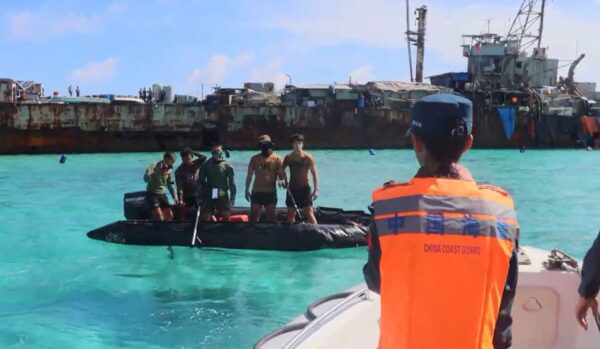
A Philippine marine sustained a head injury after being struck with a baton by China Coast Guard (CCG) personnel during an encounter at Second Thomas Shoal in the South China Sea, the Armed Forces of the Philippines (AFP) stated yesterday. The incident, which occurred near the disputed shoal that has long been a flashpoint for maritime tensions between Manila and Beijing, saw the two sides trading accusations. The AFP said a CCG rigid-hull inflatable boat (RHIB) carrying eight personnel from vessel CCGV 21560 unlawfully approached within close range of the BRP Sierra Madre, a grounded Philippine warship that serves as the Philippines’ outpost on the shoal. The CCG boat reportedly circled the area while taking photos and videos, prompting two Philippine Navy rubber boats to "calmly and non-confrontationally" drive it away. The Chinese personnel then "reacted violently and aggressively" by striking a Philippine marine on the head with a wooden baton, the AFP stated. The injured marine was then taken back to the BRP Sierra Madre to receive treatment. The incident also damaged one of the Navy’s rubber boats. The AFP released a photo of the wound sustained by the marine, as well as a video, apparently shot from aboard the BRP Sierra Madre, that showed the CCG boat ramming the Philippine dinghy, and the personnel from both sides swinging oars and batons at each other. The AFP said that the "aggressive actions" of the CCG "demonstrate a blatant disregard for safety, endanger the lives of our personnel, and escalate tensions in the West Philippine Sea." The Department of National Defense issued its own statement asserting that the incident "adds to a clear pattern of provocative and hostile behavior, and further contributes to the People’s Republic of China’s deficit of trust and credibility." Unsurprisingly, the Chinese government has challenged this account. In a statement, the Chinese Embassy in Manila insisted that the CCG acted with "maximum rationality and restraint" while accusing the Philippines of spreading "false propaganda." The CCG also put out its own statement, claiming that two rubber dinghies were launched "illegally" from the BRP Sierra Madre. The Philippine vessels "ignored our repeated and explicit warnings, rapidly approached in a dangerous manner and rammed the Chinese patrol vessel from the front," the CCG said. During the incident, Philippine personnel "first used tools such as oars and long sticks to maliciously attack Chinese law enforcement officers." In an attempt to substantiate its version of the story, the CCG released several videos showing two rubber boats driving out from the Sierra Madre to confront the Chinese RHIB. In the videos, Philippine personnel wave the Chinese boat off with oars, while CCG personnel brandish batons in response. The South China Sea Strategic Situation Probing Initiative, a Beijing-based think tank, said that the videos showed that "there is no doubt that the Philippine side took the first move." The videos do not appear to show the same footage as was released by the AFP. Naturally, the legitimacy of each side’s actions – and the relevance of the question of who made the “first move” – depends almost entirely on whether one believes the waters to belong to China or the Philippines. In its statement, the CCG said that it would continue to “resolutely uphold the country’s territorial sovereignty and maritime rights and interests,” just as the AFP said that it “remains steadfast in protecting the country’s sovereignty rights and jurisdiction.” However, Philippine officials were right to point out that their nation’s maritime claims, unlike China’s, were upheld by an international arbitral tribunal in The Hague and ruled valid under the U.N. Convention on the Law of the Sea (UNCLOS). Handed down 10 years ago this month, the South China Sea Arbitral Award found that China’s expansive “nine-dash line,” which asserts Beijing’s sovereignty over nearly all of the South China Sea, had no standing under UNCLOS, a treaty signed by both nations. It also found that Second Thomas Shoal, which Manila refers to as Ayungin Shoal, forms part of the Philippines’ 200-nautical-mile Exclusive Economic Zone and continental shelf. Last week, 14 nations issued a joint statement in support of the ruling, stating that it was “final and legally binding,” and rejecting any “destabilizing” actions in disputed waters. The 27-nation European Union also expressed its support for the award. China has refused to acknowledge the tribunal’s ruling, describing it as “null and void,” and even implying that the United States and Japan somehow pushed the Philippines into instigating the case in 2013. It remains unclear how many other nations support China’s claim over Second Thomas Shoal. Yesterday’s incident breaks a stretch of relative quiet at Second Thomas Shoal, which was the primary focus of tensions between China and the Philippines in 2023 and 2024. This stemmed mostly from Chinese attempts to prevent the resupply of the Philippine forces aboard the BRP Sierra Madre. These attempts grew gradually more forceful, involving the ramming of Philippine Coast Guard ships and the use of high-powered water cannons against Philippine vessels. The tensions culminated in July 2024 in a melee between the two sides that left eight Philippine naval personnel injured, including one who lost a thumb in the fighting. The two sides subsequently de-escalated the situation at Second Thomas Shoal, reaching a “provisional understanding” that allowed the Philippines to resupply the grounded warship. The situation at Second Thomas Shoal then calmed down, even as tensions persisted in other areas of the South China Sea. The incident also took place just before Chinese Foreign Minister Wang Yi flew to Manila for a series of meetings hosted by the foreign ministers of the Association of Southeast Asian Nations (ASEAN). According to the South China Morning Post, he is expected to hold talks with Philippine Foreign Secretary Ma. Theresa Lazaro, “with discussions tipped to focus on the South China Sea.”

0

Original source

The Diplomat Indonesia

原文を読む