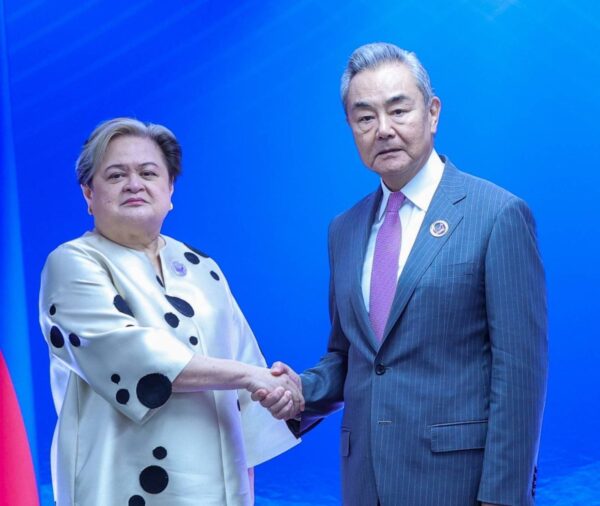
Philippine, Chinese Foreign Ministers Exchange Protests Over South China Sea Clash
Diplomacy
2026年7月23日
5
The Diplomat Indonesia
Relations
🇮🇩Indonesia🇻🇳Vietnam🇨🇳China🇵🇭Philippines🇲🇾Malaysia🇧🇳Brunei🌐United Nations / ASEAN

General articles are free for 24 hours after publish.

Philippine, Chinese Foreign Ministers Exchange Protests Over South China Sea Clash

Share
AI Summary

Philippine and Chinese foreign ministers exchanged strong protests over a recent vessel clash in the South China Sea. Held on the sidelines of the ASEAN Foreign Ministers' Meeting, the talks saw both sides call for de-escalation and peaceful resolution, while criticizing each other's actions.

The foreign ministers of the Philippines and China exchanged strong protests over an encounter between their vessels in a disputed South China Sea shoal earlier this week. Held on the sidelines of the 59th ASEAN Foreign Ministers’ Meeting in Manila, the talks saw Philippine Foreign Secretary Ma. Theresa Lazaro reiterate a protest against the Chinese Coast Guard’s (CCG) “unacceptable actions against Filipino personnel.” The incident occurred Monday at Second Thomas Shoal in the Spratly Islands, involving a confrontation between Philippine marines and CCG personnel. The Armed Forces of the Philippines (AFP) claimed a Philippine marine sustained a significant head injury after being struck with a baton by a CCG sailor. According to the AFP, the confrontation began after a CCG boat approached the BRP Sierra Madre, a grounded Philippine warship serving as an outpost on the shoal, and Philippine dinghies attempted to drive it away, leading to a melee. China disputed this, asserting the Philippines instigated the incident and rammed the CCG boat. During her meeting with Chinese Foreign Minister Wang Yi, Lazaro conveyed the Philippines’ consistent positions on the South China Sea and raised concerns over actions infringing on maritime rights and entitlements, including incidents affecting the safety of Filipino personnel. The Philippines emphasized the need for restraint, avoiding actions that increase tensions, and resolving disputes peacefully in accordance with international law. Lazaro also protested a recent AI-generated video posted by state-controlled China Daily, which depicted the Philippines as a karaoke-singing monkey. She described the video as “deeply offensive, distressing, and unacceptable.” The video shows a monkey in traditional Filipino dress being forced by two faceless figures, representing the United States and Japan, to parrot the 2016 arbitral award. While the Chinese Ambassador attempted to distance his government, Lazaro stressed that “disagreements over legal and political issues do not justify resorting to disturbing imagery, drawing a firm line at the depiction of Filipinos as monkeys.” China’s Foreign Ministry later stated that Wang registered his own “strong protest” over the incident at Second Thomas Shoal and urged the Philippines to “immediately stop provocative actions on maritime issues and make concrete efforts to stabilize bilateral relations.” Wang characterized the bilateral relationship as being at a “crossroad” and stated that the Philippines needed to make a “correct and rational” choice, warning that allowing external forces to meddle would only make the Philippines a pawn. The incident overshadowed the ASEAN-related meetings. Foreign ministers from the Quad (U.S., Australia, India, Japan) voiced strong opposition to any attempts to change the status quo by force in the region, including in the South China Sea. Australian Foreign Minister Penny Wong concurred, adding that “We have real concerns about behavior that is destabilizing and risky.” Canada’s Foreign Minister Anita Anand also described the incident as “troubling.” U.S. Secretary of State Rubio raised the issue in his own sideline meeting with Wang, stating that the incident was “escalatory” and “benefited no one.” He also reminded Wang that Washington had a defense treaty with Manila and intended to abide by it. Rubio separately met with Philippine President Ferdinand Marcos Jr., during which they underscored the importance of upholding freedoms of navigation and overflight in the South China Sea and noted the 10th anniversary of the Arbitral Award in the South China Sea, which ruled that China’s expansive maritime claims had no basis under international law. Despite the recent incidents, Lazaro and Wang expressed their “continued willingness” to conclude negotiations on the long-expected ASEAN-China Code of Conduct (COC) for the South China Sea. The COC aims to reduce the risk of conflict in the region, where China’s “nine-dash line” claim clashes with those of Vietnam, Malaysia, the Philippines, and Brunei. Twenty years of negotiations have passed, and while pledges for its speedy completion are a hardy perennial of ASEAN-China meetings, its finalization remains uncertain amid current tensions and a long line of lapsed deadlines. Source: The Diplomat Indonesia

0

Original source

The Diplomat Indonesia

原文を読む