Cambodia Strengthens Social Security Healthcare Services; Stakeholders Convene
Health
2026年7月4日
5
Kampuchea Thmey Local

Cambodia Strengthens Social Security Healthcare Services; Stakeholders Convene

AI サマリー

Cambodia's Ministry of Labour and Vocational Training convened a consultation meeting on July 3rd with stakeholders regarding the implementation of agreements for healthcare services and payment mechanisms of the Social Security Fund (B.S.S.). The meeting aimed to resolve challenges in service provision and contract execution with partner healthcare facilities, and to establish effective and sustainable payment mechanisms for B.S.S. members.

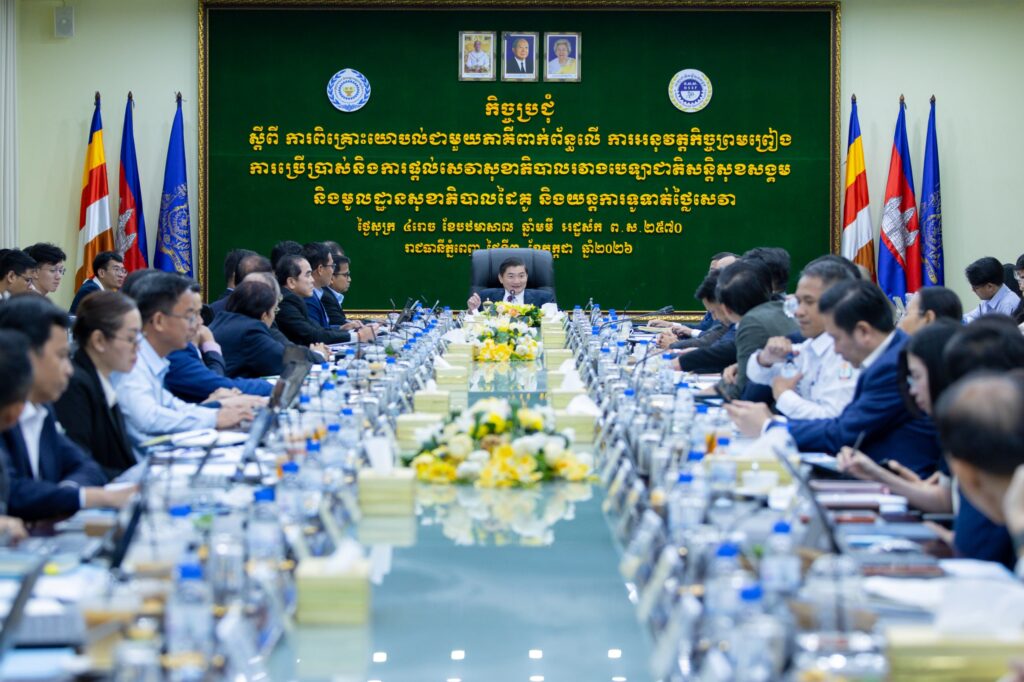
Heng Sour, Minister of Labour and Vocational Training and Chairman of the Board of Directors of the National Social Security Fund (B.S.S.), led a consultation meeting with stakeholders on the implementation of agreements for healthcare services and payment mechanisms of the B.S.S. with partner healthcare facilities. The meeting was held on the afternoon of July 3, 2026, at the Ministry's headquarters. The important meeting was attended by over 80 participants from the Ministry of Labour, Ministry of Health, Medical Council, B.S.S., General Secretariat of the National Social Protection Council, National Agency for Cost Verification, Social Security Regulator, and healthcare facilities. The primary objective was to review the service delivery system, exchange views, and gather input to find solutions to challenges related to the implementation of agreements on the use and provision of healthcare services. It also aimed to establish appropriate and sustainable payment mechanisms for B.S.S. members, especially as the number of users at partner hospitals, both public and private, continues to rise, particularly at national-level hospitals. Minister Heng Sour emphasized the government's high attention to providing B.S.S. services to members in the areas of work-related risks, healthcare, and pensions, which has made these services increasingly popular and attracted more citizens, especially in healthcare. Furthermore, the government has a vision to expand B.S.S. service coverage sustainably, based on the principles of equity and equality, not solely relying on the national budget. He noted that B.S.S. members currently tend to use services at national hospitals with confidence. Concurrently, the Minister highlighted the necessity of jointly seeking methods to encourage B.S.S. members to utilize services at local facilities, such as district or provincial referral hospitals. This would help alleviate the burden on national hospitals and provide income for local hospitals to strengthen their capacity, particularly in terms of specialized equipment, human resources, consultation rooms, and inpatient beds, enabling them to meet member needs. Following a presentation by Khun Channarith, Deputy Director General of B.S.S., on the implementation of agreements and the healthcare service payment mechanism between B.S.S. and partner healthcare facilities, the meeting engaged in a lively discussion. Important suggestions were made to address these challenges in line with the government's considerations. Participants expressed gratitude to the Ministry of Labour for organizing the meeting to inform them of the B.S.S. situation and supported the strategic and far-sighted remarks of Minister Heng Sour. Minister Heng Sour expressed his profound gratitude to all participants and highly valued the fruitful discussions, deeming them valuable input for implementation. He encouraged continued cooperation to achieve the common goal of maintaining the sustainability of B.S.S. operations and promoting the health of the Cambodian people. Source: Kampuchea Thmey Local

多角的分析

経済的影響

B.S.S.の医療サービスと支払いメカニズムの強化は、医療費負担の軽減を通じて国民の可処分所得を増加させ、国内消費を刺激する可能性がある。また、医療機関への安定した支払いシステムは、医療サービスの質向上と投資を促進し、長期的な経済成長に寄与すると考えられる。持続可能な財政基盤の確立は、将来的な医療制度の拡充にも繋がる。

投資家心理

医療サービス提供の効率化と支払いメカニズムの明確化は、医療分野への投資リスクを低減させる。特に、B.S.S.会員の増加とサービス利用の拡大は、民間の医療機関にとって新たなビジネス機会を生み出す可能性がある。投資家は、B.S.S.との連携強化や、地方病院の設備投資などに注目するだろう。

社会的影響

B.S.S.の医療サービスへのアクセス改善と支払いメカニズムの円滑化は、国民、特に低所得者層の医療へのアクセスを大幅に向上させる。国営病院への集中を緩和し、地方病院の利用を促進することは、地域医療格差の是正にも繋がる。これにより、国民全体の健康水準の向上と、医療サービスに対する信頼感の醸成が期待される。

市民の声

B.S.S.会員は、より迅速かつ容易に医療サービスを受けられるようになることが期待される。特に、国営病院の混雑緩和は、待ち時間の短縮や、より質の高い医療の提供に繋がる可能性がある。地方病院の機能強化は、遠隔地に住む人々にとっても、身近な場所で適切な医療を受けられる機会を増やす。

背景・歴史的文脈

カンボジアにおける社会保障制度、特に社会保障基金(B.S.S.)は、2000年代初頭から段階的に整備が進められてきた。当初は労働災害保険が中心であったが、徐々に医療保険や年金制度へと範囲が拡大されている。特に、近年は国民皆保険を目指す動きが加速しており、医療サービスへのアクセス改善と財政的持続可能性の確保が喫緊の課題となっている。今回の会議は、こうした背景のもと、B.S.S.の医療サービス提供体制と支払いメカニズムの効率化を図り、国民へのサービス向上と制度の持続可能性を高めるための取り組みの一環である。

原文ソース

Kampuchea Thmey Local

原文を読む